Table of Contents
18.1 ROAD TRAFFIC SIGNS ARE DIVIDED INTO THE FOLLOWING CLASSES:
Class I: Road signs
- Regulatory signs
- Warning signs
- Guidance signs
Class II: Road markings
- Regulatory markings
- Warning markings
- Guidance markings
Class III: Road traffic signals
- Regulatory signals
- Warning signals
18.2 ROAD TRAFFIC SIGNS- SUMMARY OF SYMBOLS AND SIGNS
The following is a short summary of the meaning of symbols in the sign system. It is not exhaustive, and only serves as a short reference to the meaning of the shapes and symbols.
Please go to Road signs section
18.3 ROAD MARKINGS
Any prohibition lines, pedestrian crossings, parking lines and other directions or warnings painted or otherwise displayed on the road are referred to as road markings. They contribute substantially to orderly road use, and it is important that you understand their message and behave accordingly. The following markings are commonly used in Zimbabwe:
Longitudinal lines
Lines on the road conforming roughly to the direction of the traffic flow (longitudinal lines) are there to demarcate the road centre line, or traffic lanes, or to indicate the course vehicles should take. They are usually white and may not be straddled.
If the line is a broken (dotted) line, it is there to guide you and you may cross it, but only if you are quite satisfied that it is safe to do so.
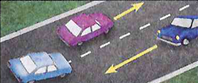 The driver is wrong for crossing line in face of oncoming traffic.
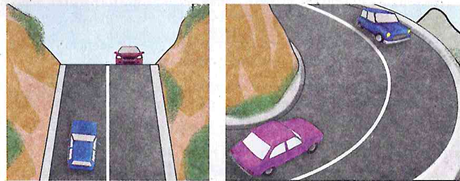 The continuous white line on this hill or this bend confines approaching vehicles to their proper sides, preventing collision where sight distance is insufficient to allow for avoiding action if they were using the same traffic lane.
If the line is continuous, you are prohibited from crossing it, and doing so is an act of criminal folly and a punishable offence.
A broken line is sometimes used in combination with a continuous line; the line on your side of the road is the one that governs your behaviour, just as if it were on its own.
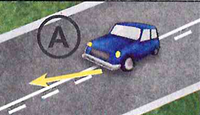 Provided that there is no oncoming traffic, and if it is safe to do so, Car A may cross the continuous line because the broken line is on its side of the road.
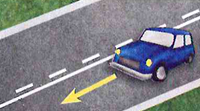 Car B must not cross the continuous line because the continuous line is on its side of the road.
A road marking consisting of two continuous lines running side by side or separated by a broken line directs that no vehicle shall either cross these lines or be driven to the right of them.
Transverse lines
Prohibition or "Stop" lines - Where a continuous line (usually white) crosses your traffic lane, you must not cross that line until you have complied with the instruction of the traffic sign or signal that controls your action at that point.
"Stop" lines at traffic light signals - you may not cross the "stop" line unless by doing so you obey the traffic light signal's instructions.
Note. - A "stop" sign requires you to stop immediately before continuing into the road directly ahead. If it is used in conjunction with a "stop" line, you must stop immediately behind the line.
Pedestrian Crossing
Where pedestrian crossings are demarcated at traffic light- controlled intersections, respect them and give the pedestrian a chance to cross the road safely.
A vehicle turning left or right must yield right of way to any pedestrian within a crossing.
Where pedestrian crossings are provided at positions other than road intersections, they are of the zebra variety i.e. alternate wide stripes of black and white, and the driver is warned of their existence by advance warning signs. At such crossings, the driver must concede right of way to the pedestrian unless, of course, traffic at the crossing is controlled by a light or police officer.
Always be on the lookout for these crossings.
Other Road Markings
Road markings are used for many other purposes, for instance:
- To emphasize the existence of a regulation.
- To indicate the course to follow.
- To guide and instruct the driver into the proper use of traffic lanes.
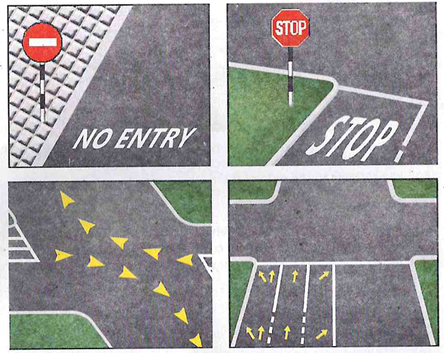 Road markings examples. Yellow arrows - Regulatory. White arrows - Informative
Note: Where direction arrows are shown on the road surface between longitudinal lines, the instructions of the arrows must be obeyed.
Parking areas or bays are often demarcated by white pavement or kerb markings. When the colour yellow is used, it signifies that the area is subject to a parking or stopping prohibition or restriction often associated with the presence of unloading zones, fire hydrants, bus- stops, intersections, etc, as decided by the authority concerned.
Not only is it inconsiderate and selfish to ignore such markings; it could spell danger for persons and property, and moreover, it makes you liable to prosecution.
18.4 POLICE CONTROL
The signals given by a police officer controlling traffic override all other signs and signals, and you should know and obey them.
These are meanings of the signals he or she will normally use, but he or she may sometimes have to use others because of special circumstances or the peculiarities of a situation, such as at a controlled intersection, when the State Motorcade is approaching.
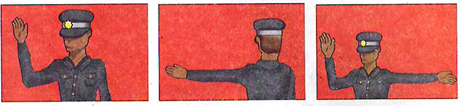 You must stop. Once stopped, you may not move on or filter to the left until you are signalled to do so, even though the police officer has lowered his or her arm.
 You may proceed or continue, but before you do so, make sure the police officer is signalling to you.Proceed signal from police
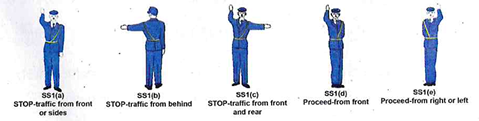 When you approach a police officer directing traffic, tell him or her what you intend to do by giving the correct signal.
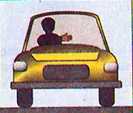 "I wish to turn left."
When you intend to turn left, point your hand to the left, making the movement sufficiently pronounced to be easily seen by the police officer.
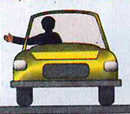 "I wish to turn right."
When you intend to turn to the right, give the signal, "I am going to turn right."
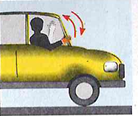 "I wish to go straight on."
When you intend to go straight ahead, raise your hand towards your shoulder and move your forearm well forward and then back in a vertical plane, making the movement sufficiently pronounced to be easily seen by the police officer.
Do not, if you can possibly avoid it, speak to a police officer controlling traffic. This distracts his or her attention, and may cause obstruction or danger.