Table of Contents
All vehicles
Good drivers take care of their vehicles, not only because it is against the law to drive an unroadworthy vehicle, but because they are proud of them and know that badly kept vehicles are dangerous. This section aims to help you comply with the law and so protect yourself and others.
Many collisions have been caused by a vehicle going out of control owing to a mechanical fault that could easily have been attended to.
See that your vehicle is regularly inspected, so that any faults that may have developed can be corrected before they become serious. Take advantage of the Vehicle Inspection Depots of the Ministry of Transport, where a thorough inspection is available for a nominal fee. Ensure that you use vehicle parts that have been approved by a recognised standards body.
Here are some of the items to which you should pay very special attention, and if they are in any way suspect, have them attended to immediately.
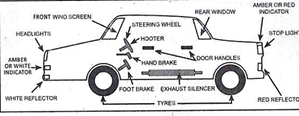 Vehicle safety check points: front windscreen, steering wheel, hooter, hand brake, foot brake, door handles, exhaust silencer, tyres, headlights, indicators, stop lights, reflectors, and rear window; note that no motor vehicle may draw more than three trailers.
Steering
With faulty steering, you are in danger, and without steering you have no control. Your steering wheel must not have more than 45 degrees of free play.
Brakes
Brakes must be effective and efficient.
Tyres
Ensure that your tyres have sufficient tread (a minimum of 1mm tread depth) and are correctly inflated, as per the manufacturer's specifications. Blow- outs at high speed have resulted in many deaths and injuries.
Hard- braking, fast cornering and rapid acceleration damage your tyres.
Get the most out of your tyres by checking for proper inflation and changing them round periodically, as per the manufacturer's recommendation.
Exhaust and Silencer
Beware of leaks in the exhaust system. Exhaust gases are odourless but poisonous.
Be considerate to yourself and others and have an efficient silencer.
Hooter
When you need it, you need it badly. See that it works, but only use it when absolutely necessary.
Rear View Mirror
See that it is clean and properly adjusted. If your central mirror does not give you a clear view to the rear (when drawing a trailer or carrying a load), you require both left- and right- hand wing mirrors.
Windscreen, windows and wipers
Good visibility is of primary importance. See to it that everything is clean and free from oil, and that your wipers are operating properly.
Do not obscure your view by putting stickers on the glass.
Lights
Make sure that all your lights including the stop lights, are lighting up efficiently and that lamps, glasses and reflectors are clean.
Your headlamps MUST be correctly adjusted and your dipping mechanism MUST function properly.
Direction indicators
Front indicators must be white or amber, whilst rear indicators must be red or amber.
Make sure that indicators work, or you may be misleading yourself and others, with serious consequences.
Reflectors
See that your vehicle is fitted with efficient reflectors: white ones at the front, and red ones at the rear.
Projecting loads
For the information of road- users behind you, any load projecting behind your vehicle must be marked with a red cloth by day and a red lamp or red reflective material at night.
Doors
Check the security of all door catches.
Safety belts
Safety belts often save drivers and passengers from the worst effects of collisions. So, you MUST wear them. Use safety belts approved by a recognised standards body.
Safety belts are compulsory for cars registered on or after 1 January 1980. Attend to all adjustments before you drive off.
Couplings
The trailer or caravan must be securely attached to the towing vehicle. In addition to the draw- bar, safety chains MUST be fitted.
Identification
Unless other road- users know that your vehicle is drawing a trailer or caravan, they may easily commit serious errors of judgment, especially at night.
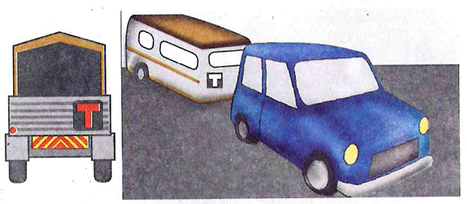
The reflective white "T" that you are required to display on the extreme right panel of the towed vehicle serves to warn approaching drivers of your vehicle train at night. It should therefore be clearly visible to oncoming drivers and in no way obscured.
You are required to display a red reflective "T" on the right side at the rear of the trailer.
 All trailers (except for light two- wheeled trailers) must have adequate brakes. These may be operated from the towing vehicle or by the trailer's pressure on the draw- bar (overrun brakes). Unless these types are fitted, someone must be carried on the trailer specifically to operate its brakes.
Connections
Connections for brakes and lighting between a towing vehicle and trailer should be sound, firmly fixed and functioning properly.
Suspension
All types of vehicle suspension, namely: leaf spring, coilspring, rubber and pneumatic, should be in efficient working order. Broken, splayed, worn or leaking suspension parts should not be used.