Table of Contents
- You MUST be in possession of a valid Zimbabwean or other recognised Driver's Licence.
- You MUST be at least 16 years of age to obtain a Zimbabwean Driver's Licence.
- Public Service Vehicle (PSV) drivers need to meet certain additional requirements. If you want to drive a PSV, you MUST make sure that you meet these requirements.
- If you do not have a Driver's Licence and want to drive, you MUST acquire a Learner's Driver's Licence that allows you to drive under the supervision of a fully- licensed driver until you obtain a full Driver's Licence. You are exempt from driving under supervision on certain vehicles which only have a seat for the driver.
- If you are driving on a Learner's Driver's Licence, your vehicle MUST display a visible L- Plate of the dimensions and colours prescribed by the law.
- Your vehicle MUST be registered, licensed, and insured against death and injury to third parties.
- Ensure that your vehicle is roadworthy.
- Do not drive if you feel physically and/or mentally unfit.
- Do not drive under the influence of alcohol and/or any other drugs that may impair your judgement.
- Never set your vehicle in motion until you look around and under it for any obstruction, particularly children and small animals/pets.
- You MUST always obey all road rules and regulations.
- You MUST always wear your seatbelt at all times, and you should ensure that your passengers are wearing their seatbelts, where available.
- Do not drive on to the road until it is clear of traffic or you are certain that you can do so safely, without causing danger to other vehicles.
- Drive on the LEFT side of the road.
- Never drive on the wrong side of the road unless the police, road markings or other traffic controls specifically require you to do so.
- Do not cut corners.
- Do not cross continuous lines.
- Keep well left on blind rises.
- When meeting oncoming vehicles, slow down and keep well to your side of the road. On strip roads, your right-hand wheels should be on the left-hand strip. On narrow mat roads, your left-hand wheels should be on the left-hand gravelled shoulder of the road.
- When travelling behind other vehicles, maintain a safe following distance by using the 2-second rule, and keep a sharp lookout for any hand, mechanical or light signals that may indicate the intention of the driver ahead to slow down, stop or turn.
- When your side of the road is divided into traffic lanes by road markings, choose the proper lane for your route and stay in it until you have good reason to move to another.
- When changing lanes, make sure that it is safe to do so, and that it will not inconvenience other traffic. Check on the position of traffic behind you/following traffic, give appropriate signals and make sure that your signal has been understood. The changing lane drill is Mirror- Blind Spot - Signal - Manoeuvre.
- On a road with two or more lanes going in the same direction, keep left and move to the right only when overtaking or when you want to turn right.
- When other vehicles wish to overtake you, give them the opportunity to do so by moving carefully over to the left within your lane. Maintain a constant speed while you are being overtaken.
- When approaching road junctions, decide what you intend to do at the junction ahead in sufficient time for you to take up your correct position on the road.
- Do not enter a junction unless you are satisfied that it is safe to do so.
- At a 4 Way or 3 Way Stop-controlled junction, STOP until every vehicle that has stopped at the junction before you has cleared the junction. Only then can you proceed. The vehicle that stopped first MUST proceed first.
- At uncontrolled intersection, you MUST give precedence to vehicles approaching you from the road to your RIGHT.
- If traffic at the junction you are approaching is controlled by traffic light signals, the instruction conveyed by these devices overrides all others, except those of a police officer controlling traffic. You MUST STOP on the RED and AMBER and may GO on the GREEN.
- You MUST NOT turn RIGHT in front of oncoming traffic.
- You MUST NOT overtake at a junction.
- Exercise the intersection defensive driving technique: Know, Slow, Show and Go.
- Approach every intersection with extreme caution, knowing that there is no right of way.
- At a traffic circle, you must give precedence to traffic already circulating in it.
- Always exercise a high degree of alertness and consideration for the drivers in the circle.
- In a traffic circle, signal left just after you pass the exit before the one you want to turn.
- If you have a good reason to overtake, do so on the right only when it is safe to do so. There are exceptions to this rule: (i) if the road has two or more traffic lanes, that rule does not apply; and (ii) if a driver ahead has signalled that he or she is turning right.
- Do not overtake on the road shoulders.
- Do not "jump" lanes. Make sure the road is clear.
- When you intend to overtake, do not move either to the right or to the left from your lane or stream of traffic before: (i) you have seen that the road ahead is clear of traffic; (ii) you have taken all the precautions necessary for changing lanes; (iii) you have warned the driver ahead that you want to pass him or her; and (iv) you have checked their speed and satisfied yourself that you can successfully overtake without resorting to excessive speed and causing danger to others. You must not assume that the driver ahead will slow down.
- When it is safe to overtake, the first step is to move gradually into the proper position well before actually starting to overtake. If the road ahead is clear, accelerate and pass.
- You MUST NOT overtake : (i) in face of oncoming traffic; (ii) where road markings or some other traffic control forbids it; (iii) when visibility is bad; (iv) when approaching blind curves, blind rises or blind corners; (v) another vehicle that has slowed down or stopped to let pedestrians or other traffic pass; (vi) on or approaching restrictions to traffic flow such as bridges, flyovers, tunnels, etc.; (vii) on or approaching railroad level crossings; (viii) where the road narrows; (ix) at pedestrian crossings; or (x) when approaching road junctions.
- Be particularly careful at night and in bad weather.
- Speed limits in Zimbabwe are expressed in kilometres per hour (km/h). Speed limits are the maximum speeds allowed by law but are not necessarily safe speeds at all times. For safety reasons, reduce your speed to suit the conditions of weather, light, traffic, vehicle, road and your ability to control the vehicle.
- Avoid reversing as much as possible.
- If you have to reverse, choose an appropriate place to manoeuvre. Do not reverse into a busy road.
- Before reversing, look carefully behind you. You should: (i) use all mirrors; (ii) check the blind spots; and (iii) check for pedestrians, cyclists and other road users or obstructions in the road behind you.
- You may then reverse slowly while: (i) checking all around you; (ii) looking mainly through the rear window; and (iii) being aware that the front of your vehicle will swing out as you turn.
- Get someone reliable to direct you if necessary.
- At road junctions where pedestrian crossings are demarcated, give the pedestrian a chance to cross the road safely. A vehicle turning LEFT or RIGHT MUST yield precedence to any pedestrian within the crossing.
- Where pedestrian crossings are provided at locations other than road junctions, they are called zebra- type (i.e. alternate wide stripes of black and white). At such crossings, STOP and give precedence to any pedestrian crossing or intending to cross the road.
- You MUST NOT hold any communication device while driving.
- You MUST NOT tow a vehicle with a net mass exceeding the net mass of the towing vehicle, and the distance between the two vehicles MUST NOT exceed 4 metres.
- You should only blow your horn for safety purposes.
- You MUST NOT push a vehicle using another vehicle.
Driving at night:
(i) Avoid night driving as much as possible. (ii) You MUST have your headlights on between 5.30pm and 6.30am. (iii) Do not use anything that obscures your vision at night unless it has been prescribed for night vision. (iv) If dazzled by headlights of oncoming vehicles, cast your eyes slightly to the left. Do not aggravate the situation by retaliating. Slow down or stop, if necessary. You may remind the driver of the other vehicle to dip their lights by quickly flicking your own lights up and down once. (v) Reduce speed so as to be able to stop well within the distance illuminated by your headlamps. It is important to remember that if your lamps are dipped, you cannot see very far ahead. (vi) A single headlight might be a cycle, but it could also be a motor vehicle - KEEP CLEAR. (vii) A vehicle might be pulling a trailer, so keep well clear until the whole train has passed. (viii) Do not dazzle others. Dip your lights before they shine into the eyes of oncoming drivers.
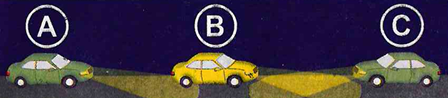 A dip for B, B dip for C, C dip for A and B
(ix) Always dip your lights: - for oncoming traffic; - for the vehicle in front of you; - for a traffic officer directing traffic; and - where there is adequate street lighting. (x) If you have to stop on the open road at night, get right off the road, if possible. If you cannot, pull off as far to the left as you can and use your park lights so that others can see you. (xi) Avoid long journeys at night, as these can be dangerous due to fatigue. If you begin to feel sleepy, you should pull off the road, stop and rest.
Driving in adverse weather conditions:
(i) Avoid driving in adverse weather conditions, if possible; (ii) Use headlights when and where visibility is limited; (iii) Where available, use fog lights and switch them off when visibility improves; (iv) Keep a longer following distance than that required for normal conditions; and (v) In sun-glare conditions, use sun visors and sunglasses. If dazzled by bright, sunlight, slow down and if necessary, stop.
Instructions relating to the carriage of passengers:
(a) Ensure proper control of your vehicle by not carrying too many passengers, to avoid cramping the driver and overloading the vehicle. (b) Do not allow anyone to ride on bumpers, bonnets, mudguards, sides or any other part of the vehicle except the seats. (c) Generally, passengers may not be carried in goods vehicles, but if you are permitted to carry passengers in an open vehicle, see that they are under strict control and remain seated while the vehicle is in motion.