Provisional - Zimbabwe Highway Code, Road Signs & VID Test Prep & lessons

Fatigue and Defensive Driving Practice Questions

Fatigue and defensive driving questions cover how tiredness affects your reactions and the defensive habits that keep you and other road users safe.

20 questions on this topic, all of them printed below. Answer them all and get marked at the end, or take them one at a time with the answer after each.

Mode

Exam is timed and marked at the end, like the real test. Learn marks each answer as you go and shows the right one.

All 20 fatigue and defensive driving questions

Every question on this topic, as it is set. Open the fold under a question to read its answer and why that answer is right, or take the quiz above to have your answers marked.

1.

On a long motorway journey boredom can cause you to feel sleepy. You should

  1. ALeave the highway and find a safe place to stop
  2. BStop on the hard shoulder for a rest
  3. CEnsure a supply of fresh air into your vehicle
Show the answer

Answer: Leave the highway and find a safe place to stop

If you begin to feel sleepy, pull off the road, stop and rest. Fresh air does not cure tiredness, it only delays the moment you notice it. Stopping at the side of a fast road leaves you where traffic is still going past, so leave the road and stop somewhere safe.
2.

When following a large vehicle you should keep well back because this

  1. AAllows you to corner more quickly
  2. BHelps you to keep out of the wind
  3. CAllows the driver to see you in the mirrors
Show the answer

Answer: Allows the driver to see you in the mirrors

Keep a safe following distance behind any vehicle, and more behind a big one. A large vehicle blocks your view of the road ahead, and its driver sees only what is in the mirrors. Sitting close behind puts you in neither, so the driver does not know you are there.

3.

When you see a hazard ahead you should use the mirrors. Why is this?

  1. ATo check how your actions will affect following traffic
  2. BBecause you will need to brake sharply to stop
  3. CTo check what is happening on the road ahead
Show the answer

Answer: To check how your actions will affect following traffic

You should glance in your mirror often so you always know what is behind you. When a hazard appears ahead you may need to slow or change position, and the mirror tells you whether a following vehicle is close enough to be affected. So you check how your actions will affect following traffic.

4.

You are waiting to turn right at the end of a road. Your view is obstructed by parked vehicles. What should you do?

  1. AMove quickly to where you can see so you only block traffic from one direction
  2. BStop and then move forward slowly and carefully for a proper view
  3. CWait for a pedestrian to let you know when it is safe for you to emerge
Show the answer

Answer: Stop and then move forward slowly and carefully for a proper view

Never venture where you cannot see. If parked vehicles hide the road at the end of yours, stop first, then move forward slowly and carefully until you can see clearly both ways before you turn right. Do not rush out to block one side, and never rely on a pedestrian to judge the traffic for you.

5.

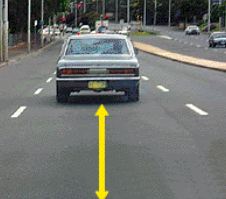
Under good conditions, when driving behind any vehicle, at any speed, you should

Diagram for fatigue and defensive driving practice question 5
  1. ADrive as close to the vehicle in front as possible
  2. BStay at least three seconds behind the vehicle in front of you
  3. CStay one second behind the vehicle in front of you
Show the answer

Answer: Stay at least three seconds behind the vehicle in front of you

Leave enough space to stop if the vehicle in front stops, which is the gap the yellow arrow marks. The Code gives a two second rule, and one vehicle length for every 15 km/h of your speed. The gap this paper works to in good conditions, at any speed, is three seconds.

6.

When driving in wet weather, your vehicle will

  1. AStop in the same distance as on a dry road
  2. BHandle better, so you can go faster
  3. CTake longer and further to stop, so slow down
Show the answer

Answer: Take longer and further to stop, so slow down

A wet road gives your tyres less grip, so the vehicle takes longer and further to stop than it would on a dry one. The Code tells you to reduce speed in rain and to keep a longer following distance than normal. Slow down, and the extra stopping distance is there when you need it.

7.

At night, if an oncoming vehicle's headlights dazzle you, you should

  1. ASlow down, until your eyes recover
  2. BClose your eyes for a short time until they recover
  3. CWatch the centre line of the road
Show the answer

Answer: Slow down, until your eyes recover

If oncoming headlights dazzle you, slow down, and stop if you have to, until your eyes recover. Cast your eyes slightly to the left and follow the left edge of the road. Closing your eyes leaves you driving blind, and the centre line puts you looking straight into the lights.

8.

In wet weather when it becomes hard for you to see, you should

  1. ATurn your headlights on high beam
  2. BFlash your headlights to warn other drivers
  3. CTurn on your headlights, slow down, and double your following distance behind the vehicle in front
Show the answer

Answer: Turn on your headlights, slow down, and double your following distance behind the vehicle in front

Use your headlights whenever visibility is limited, so other drivers can see you through the rain. Reduce speed and keep a longer following distance than normal, since you can see less and the wet road takes longer to stop you. Flashing your lights only tells a driver to dip.

9.

Why should you avoid heavy braking on a wet road?

  1. AYour wheels may skid and cause a loss of control
  2. BIf the wheels lock up your handbrake may not work
  3. CYou might wet pedestrians walking along the footpath
Show the answer

Answer: Your wheels may skid and cause a loss of control

A wet road gives your tyres less grip. Brake hard on it and the wheels can lock and slide, and a sliding wheel does not steer, so the vehicle keeps going where it was pointed. Brake early and gently, and leave a longer following distance than you would on a dry road.

10.

When it is very foggy during the day or night and your vehicle has no fog lights, you should

  1. AFollow closer to other vehicles
  2. BPut on your high beam lights
  3. CSlow down and use your low beam headlights and hazard warning lights to make your vehicle seen
Show the answer

Answer: Slow down and use your low beam headlights and hazard warning lights to make your vehicle seen

Use your headlights when visibility is limited, and fog lights only where they are fitted. High beam shines back off fog, and following closer leaves less room to stop. Slow down and use low beam headlights with your hazard warning lights so you are seen; the hazard lights in fog are this paper's advice.

11.

At night, when you approach an oncoming vehicle, you should

  1. ANot look at its headlights, but keep left and watch the left of the road
  2. BCarefully watch the vehicle by looking directly at its headlights
  3. CPut your lights on high beam, to make your vehicle more easily seen
Show the answer

Answer: Not look at its headlights, but keep left and watch the left of the road

Do not look at the headlights coming at you, since the glare leaves you seeing nothing for a moment. Cast your eyes slightly to the left, keep well to your own side of the road and follow the left edge until the vehicle has passed. Your own high beam only dazzles that driver too.

12.

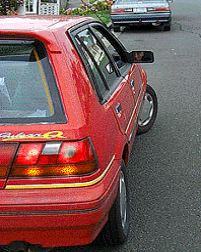
You are about to move away from the kerb in your car. What is the last thing you should do before you move into traffic?

Diagram for fatigue and defensive driving practice question 12
  1. AAdjust your seat
  2. BPut on your seat belt
  3. CCheck over your shoulder
Show the answer

Answer: Check over your shoulder

The drill is mirror, blind spot, signal, then move. The mirror does not show the space just behind your right shoulder, so the look over your shoulder is the last thing before you pull out. The red car has signalled right, and a cyclist coming past would be sitting in that space.

13.

What is the best way to avoid hitting other vehicles, people or animals when moving off from the kerb?

  1. ACheck your mirrors and look over your shoulder before moving off from the kerb
  2. BHave a good look around while you walk up to your car and then drive off as soon as you can
  3. CSound your horn before moving away from the kerb to warn people of your intentions
Show the answer

Answer: Check your mirrors and look over your shoulder before moving off from the kerb

Never set the vehicle in motion until you have looked around it, and do not drive onto the road until it is clear. Check the mirrors, then look over your shoulder at the space they do not show, and only then pull out. A look taken while walking up is already out of date.

14.

You are planning to drive from Harare to Bulawayo with some friends. To minimise fatigue and make the trip as safe as possible you should

  1. ADrive mostly at night as there is less traffic on the road and therefore less risk of crashing
  2. BDrive during the day, take plenty of breaks and share driving if possible
  3. CAim to drive for as long as possible when you are feeling good so you can arrive earlier
Show the answer

Answer: Drive during the day, take plenty of breaks and share driving if possible

Avoid long journeys at night, since fatigue makes them dangerous, and if you feel sleepy you must pull off and rest. Travel by day, break the drive up with stops and share the driving if someone else can take a turn. Pushing on while you feel fine is how you end up tired at speed.

15.

It is night time and you are driving home from the movies. You are travelling in a line of vehicles. What size gap should you leave between your vehicle and the vehicles in front of you?

  1. AA gap of about 2 seconds so you can watch the vehicles in front closely and see when they are stopping
  2. BThe same 3-second gap you would leave during the day
  3. CA gap of about 4 seconds as it is easy to misjudge distances at night
Show the answer

Answer: A gap of about 4 seconds as it is easy to misjudge distances at night

You see less at night and distances are harder to judge, so the gap you keep must be bigger than the one you keep by day. The Code gives a two second rule and tells you to increase it in bad light. The gap this paper works to at night is about four seconds.

16.

While driving, you come across aggressive, selfish or ignorant driving behaviour by another driver. You should

  1. AChase the car to tell the driver how to drive
  2. BRespond by using your horn and/or flashing your lights to let the driver know how you feel
  3. CStay calm and in control of your vehicle at all times
Show the answer

Answer: Stay calm and in control of your vehicle at all times

Never retaliate when another driver behaves badly. The Code calls it degrading and dangerous. Stay calm and keep control of your own vehicle. Chasing, sounding your horn or flashing your lights only draws that driver into a contest, and then two of you are driving badly.

17.

You set out on a fairly long drive to see some friends. After a while you start feeling tired. What should you do?

  1. APull off the road, stop and rest until you no longer feel tired
  2. BStop at a shop and get a drink that contains caffeine to help keep you awake
  3. CMake sure you get plenty of fresh air circulating inside the car by winding down your window
Show the answer

Answer: Pull off the road, stop and rest until you no longer feel tired

If you begin to feel sleepy while driving, pull off the road, stop and rest until the tiredness has gone. A drink with caffeine in it and an open window only cover the feeling for a while, and the tiredness is still there, waiting to become sleep at the wheel.

18.

It is important to scan while driving so you can see everything that is happening on the road. What does scanning involve?

  1. AContinually looking ahead, to the sides and using all mirrors when driving
  2. BLooking in the rear and side mirrors continually when driving
  3. CLooking further ahead down the road when driving
Show the answer

Answer: Continually looking ahead, to the sides and using all mirrors when driving

Scanning is watching the whole road, not one part of it. You keep your eyes moving: well ahead for signs, markings and anything slowing down, to both sides for what other road users are doing, and into all your mirrors for the road behind. Doing all three, all the time, is what scanning means.

19.

Many people crash within the first few years of driving. What is the best way of learning to drive on your own without crashing?

  1. ADrive as much as you can with friends on the way to parties
  2. BStart driving in daylight where it is not too busy and only drive in busier traffic as your driving gets better
  3. CDrive in every kind of traffic situation as soon as you get your licence
Show the answer

Answer: Start driving in daylight where it is not too busy and only drive in busier traffic as your driving gets better

Even with a full licence you still have much to learn, and you are asked to be particularly careful while gaining experience. Start in daylight where the road is quiet, and move on to busier traffic only as your driving improves. Parties with friends and every kind of traffic at once are the wrong place to learn.

20.

Which of the following attitudes is most likely to make you a safer driver?

  1. AWhen I drive, I have the main responsibility for my safety and the safety of other road users
  2. BCrashing or not crashing is a matter of luck
  3. CIt is up to other drivers to avoid crashing into me
Show the answer

Answer: When I drive, I have the main responsibility for my safety and the safety of other road users

The Code puts the responsibility on you, and warns that it is dangerous to assume another driver will give way just because they should. Luck decides nothing, and waiting for other drivers to avoid you leaves you doing nothing. Treating your safety and theirs as your own job is what makes you safer.

Study all the questions offline

The app carries these questions and the 2026 papers offline, links every answer to the rule it comes from, and keeps your progress between sittings.