Provisional - Zimbabwe Highway Code, Road Signs & VID Test Prep & lessons

Intersections Practice Questions

Intersection questions are some of the trickiest in the VID test, right of way, traffic circles, and who gives way to whom come up constantly.

20 questions on this topic, all of them printed below. Answer them all and get marked at the end, or take them one at a time with the answer after each.

Mode

Exam is timed and marked at the end, like the real test. Learn marks each answer as you go and shows the right one.

All 20 intersections questions

Every question on this topic, as it is set. Open the fold under a question to read its answer and why that answer is right, or take the quiz above to have your answers marked.

1.

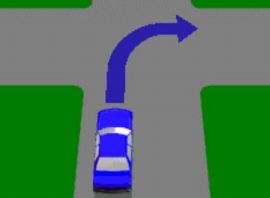
When making a right-hand turn at the intersection shown, you must give way to

Diagram for intersections practice question 1
  1. AA vehicle approaching from your left and intending to turn right
  2. BOnly pedestrians
  3. CAn oncoming vehicle going straight ahead or turning left and any vehicle on your right
Show the answer

Answer: An oncoming vehicle going straight ahead or turning left and any vehicle on your right

You must never turn right in front of oncoming traffic, so a vehicle coming the other way keeps its precedence whether it is going straight on or turning left. Where no sign or light controls the intersection you also give precedence to anything on your right. The blue car waits for both, then turns.
2.

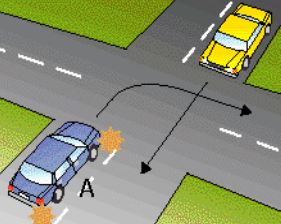
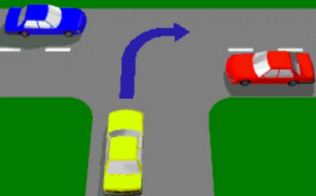
If turning right at a T-intersection (as shown) must you give way to vehicles approaching from both the left and right?

Diagram for intersections practice question 2
  1. AYes, whether they are turning or not
  2. BNo, only the vehicle on the right
  3. CNo, you have right of way
Show the answer

Answer: Yes, whether they are turning or not

When you enter a major road from a minor one you give precedence to all cross traffic. The yellow car is on the side road, turning right up into the through road; the blue car comes from its left and the red car from its right, both on the through road. The yellow car gives way to both, turning or not.

3.

If a STOP or GIVE WAY sign has been knocked down, for example, as the result of an accident, does the line marked across the road have any meaning?

  1. ANo, but you must give way if turning
  2. BNo, you only need to give way to the vehicle on your right
  3. CYes, it has the same meaning as the sign itself
Show the answer

Answer: Yes, it has the same meaning as the sign itself

A line painted across your lane is a traffic control in its own right, and you may not cross it until you have done what the control at that point requires. A sign lying on the ground does not cancel the marking still painted on the road. Stop or give way at the line just as you would have at the sign.

4.

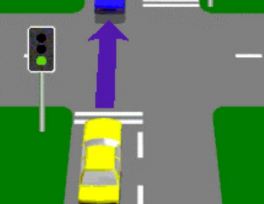
When you come to an intersection and the road beyond is choked with vehicles going in the same direction, what should you do?

Diagram for intersections practice question 4
  1. AWait until there is room for you to completely cross the intersection
  2. BProceed if there is no traffic on your right
  3. CTravel into the intersection and wait until traffic ahead moves
Show the answer

Answer: Wait until there is room for you to completely cross the intersection

Do not enter a junction unless you can clear it; at a box junction you must not enter until your exit is clear. The robot is green, but the blue car beyond the intersection is stopped in a queue, so the yellow car would be left standing across it. Wait until there is room to cross the intersection completely.

5.

Right-turns must be made from which lanes when travelling on a laned roadway?

  1. AThe lane carrying the least amount of traffic
  2. BThe far left-hand lane
  3. CThe far right-hand lane or any other lane having an arrow pointing right
Show the answer

Answer: The far right-hand lane or any other lane having an arrow pointing right

Your correct position for a right turn is as far to the right of your side of the road as possible, and where arrows are painted between the lane lines you must obey them. On a road divided into lanes that means the far right lane, or any other lane with an arrow pointing right.

6.

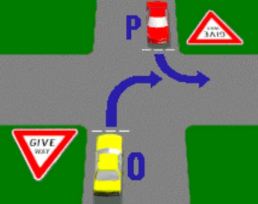
In this diagram both vehicles O and P must pass through GIVE WAY signs before entering the intersection. Which vehicle goes first?

Diagram for intersections practice question 6
  1. AVehicle O
  2. BVehicle P
  3. CIt depends on who moves first
Show the answer

Answer: Vehicle P

Both drivers face a give way sign, so neither gets precedence from the sign. The turn decides it. Yellow O is turning right across the path of red P, which is coming the other way and turning left, and you never turn right in front of oncoming traffic. So P goes first and O waits for it to clear.

7.

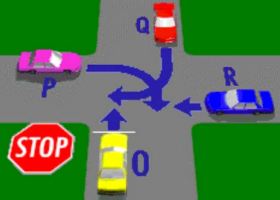
Vehicle O is at a STOP sign, which statement is true

Diagram for intersections practice question 7
  1. AVehicle O must give way to vehicles P, Q and R
  2. BVehicle O must give way only to vehicle R
  3. CAll vehicles must give way to vehicle O
Show the answer

Answer: Vehicle O must give way to vehicles P, Q and R

A stop sign takes away the rights of the traffic facing it. Yellow car O is at the stop sign; pink car P crosses from the left, red van Q comes down from the top and blue car R comes in from the right, all passing in front of O. O must stop and give way to P, Q and R before moving off.

8.

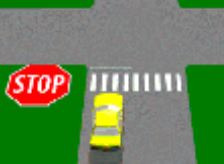
The diagram shows a marked pedestrian crossing at an intersection. There is also a STOP sign at the intersection. You have already stopped for a pedestrian. Must you stop again at the STOP line?

Diagram for intersections practice question 8
  1. AYes, if there is traffic on your right only
  2. BNo, if the intersection is clear
  3. CYes, at all times
Show the answer

Answer: Yes, at all times

A stop sign used with a stop line requires you to stop immediately behind that line every time, whatever the traffic. In the picture the crossing lies just before the intersection. Having stopped for the pedestrian on the crossing, you still stop again at the stop line before entering the road ahead.

9.

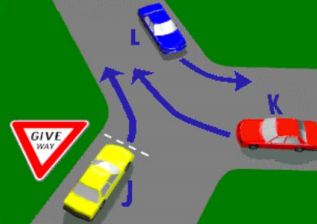
Which vehicle in the diagram must give way?

Diagram for intersections practice question 9
  1. AVehicle J
  2. BVehicle K
  3. CVehicle L
Show the answer

Answer: Vehicle J

A give way sign takes away the rights of the traffic facing it. Yellow car J is at the give way line on the side road. Blue car L is coming down the through road turning towards K, and red car K is heading up it towards L's road; both are on the road J is joining. J must give way.

10.

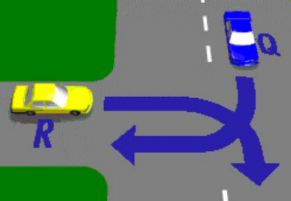
At the T-intersection shown in the diagram which vehicle should give way?

Diagram for intersections practice question 10
  1. AVehicle Q
  2. BVehicle R
  3. CWhichever vehicle got there last
Show the answer

Answer: Vehicle R

When you enter a major road from a minor one you give precedence to all cross traffic. Yellow car R is on the side road, turning right into the through road; blue car Q is on the through road, going straight on or turning right into R's road. R is the one joining, so R gives way.

11.

As you drive into an intersection, the lights turn to yellow/amber. You should

  1. AContinue through the intersection
  2. BAccelerate as hard as you can
  3. CBrake immediately to a stop
Show the answer

Answer: Continue through the intersection

Amber means stop, and the place to stop is at the line. Here the change catches you when you are already past the line and inside the intersection, so there is nowhere left to stop and halting would leave you sitting in the path of the crossing traffic. Drive on and clear the intersection.

12.

You drive up to an intersection with a stop sign. There is no painted stop line. Where should you stop?

  1. ABefore coming to and as near to the intersection as possible
  2. BAt the point where you can see clearly in both directions
  3. CAt least five metres before the intersection
Show the answer

Answer: Before coming to and as near to the intersection as possible

A stop sign requires you to stop immediately before continuing into the road ahead, and where there is a stop line you stop behind it. With no line painted, stop before the intersection and as near to it as you can, then edge forward if you need a clearer view. Five metres back is too far to see from.

13.

This intersection does not have any traffic lights or signs. You are in car A and want to turn right. When can you go?

Diagram for intersections practice question 13
  1. AAs soon as you get to the intersection
  2. BAfter the car going straight ahead has passed
  3. CBefore the car going straight ahead has passed
Show the answer

Answer: After the car going straight ahead has passed

You must not turn right in front of oncoming traffic. Car A is waiting to turn right at an intersection with no signs or lights, and the yellow car is coming the other way and going straight ahead through it. Let the yellow car pass, then make your turn when the way is clear.

14.

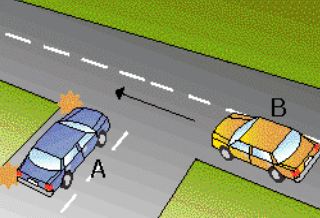
At this intersection there are no signs or traffic lights. You are in the car marked A. You want to turn left. What should you do?

Diagram for intersections practice question 14
  1. ASlow down and give way to car B on your right
  2. BEnter the intersection and make the turn
  3. CSound the horn to warn the other driver
Show the answer

Answer: Slow down and give way to car B on your right

At an intersection with no signs or lights you give precedence to the road on your right. Car A wants to turn left into the road that yellow car B is already on, and B is coming from A's right. Slow down as you reach the junction and let B go through before you pull out.

15.

When police officers are at intersections giving directions you must

  1. ADrive through the intersection as you normally would
  2. BWait for the traffic lights to start working again
  3. CAlways follow any instruction they give you
Show the answer

Answer: Always follow any instruction they give you

A police officer directing traffic overrides every sign, marking and traffic light at the intersection. So it makes no difference what the lights are showing or what the signs say. Make sure the signal is meant for you, then do exactly what the officer tells you to do.

16.

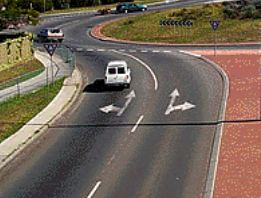
You wish to go straight ahead on this roundabout with two lanes. Which lane may you use?

Diagram for intersections practice question 16
  1. ALeft lane only
  2. BRight lane only
  3. CEither lane
Show the answer

Answer: Either lane

Where arrows are painted on the road between the lane lines you must obey them. In the picture the left lane is marked for left turn or straight ahead, and the right lane for straight ahead or right turn. Straight ahead is allowed from both, so you may use either lane for this traffic circle.

17.

You are at an intersection and see a pedestrian crossing the road into which you are turning. You must

  1. AGive way to the pedestrian
  2. BSound your horn to warn the pedestrian to get out of the way
  3. CSwerve around the pedestrian to avoid hitting them
Show the answer

Answer: Give way to the pedestrian

A vehicle turning left or right gives precedence to any pedestrian on the road it is turning into. The person is already crossing, has the right to be there, and has nothing to protect them. Wait until they are clear of your path, then finish the turn.

18.

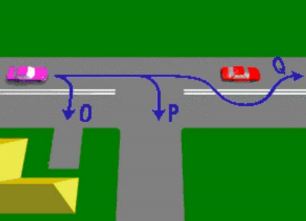
Which movements shown in the diagram can legally be made by the driver of the purple car?

Diagram for intersections practice question 18
  1. AO and P only
  2. BP only
  3. CO, P and Q
Show the answer

Answer: O and P only

Where a broken line runs beside a continuous one, the line on your own side governs you. Here your side has a continuous line, so you may not cross it to overtake, and the move round the red car is out. The turns across into the side road and the driveway are the two you may make.

19.

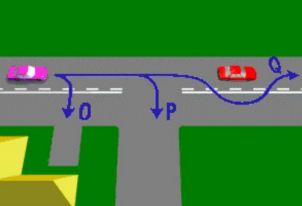
Which movements shown in the diagram can legally be made by the driver of the purple car?

Diagram for intersections practice question 19
  1. AO and P only
  2. BP only
  3. CO, P and Q
Show the answer

Answer: O, P and Q

Where a broken line runs beside a continuous one, the line on your own side governs you. Here your side has the broken line, so you may cross it whenever you are satisfied it is safe. That leaves all three open: the turn into the driveway, the turn into the side road, and the move round the red car.

20.

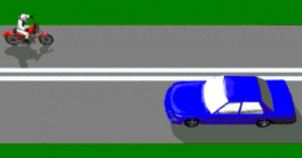
A section of road is marked with double unbroken dividing lines as in the diagram. When is a vehicle allowed to cross these lines?

Diagram for intersections practice question 20
  1. ATo enter or leave a street or driveway
  2. BTo overtake a slow vehicle ahead
  3. CWhen there is no traffic coming the other way
Show the answer

Answer: To enter or leave a street or driveway

A continuous line may not be crossed, and a pair of them keeps each direction on its own side, so you cannot cross to overtake and an empty road coming the other way changes nothing. The one crossing this paper allows is entering or leaving a street or driveway, made slowly and only when it is clear.

Study all the questions offline

The app carries these questions and the 2026 papers offline, links every answer to the rule it comes from, and keeps your progress between sittings.