Provisional - Zimbabwe Highway Code, Road Signs & VID Test Prep & lessons

Negligent Driving Practice Questions

Negligent driving questions cover the careless and reckless behaviours the VID test checks for, and the rules that keep Zimbabwe's roads safer for everyone.

15 questions on this topic, all of them printed below. Answer them all and get marked at the end, or take them one at a time with the answer after each.

Mode

Exam is timed and marked at the end, like the real test. Learn marks each answer as you go and shows the right one.

All 15 negligent driving questions

Every question on this topic, as it is set. Open the fold under a question to read its answer and why that answer is right, or take the quiz above to have your answers marked.

1.

When driving near parked vehicles, you should

  1. AStop, if you see a car with its right-hand indicator on
  2. BSound your horn and flash your headlights to warn drivers not to pull out
  3. CCheck for parked vehicles with turn signals on, or children about to step out
Show the answer

Answer: Check for parked vehicles with turn signals on, or children about to step out

A parked vehicle hides whatever is on the far side of it, and a child stepping out is what you see last. So read the line of parked vehicles as you go by: an indicator or a driver in the seat means one is about to pull out, and a gap between vehicles is where someone may step into the road.
2.

You are approaching a hill or curve. You must not cross the centre line to overtake

  1. AIf you do not have a clear view of any approaching traffic
  2. BIf you cannot see clear road ahead for 100 metres
  3. CIf you cannot see clear road ahead for 75 metres
Show the answer

Answer: If you do not have a clear view of any approaching traffic

Never overtake where you cannot see. On or approaching a blind rise or a blind bend, you have no way of knowing what is coming the other way. The test is your own view, not a set number of metres. If you cannot see enough clear road to pass and get back to your left in time, stay where you are.

3.

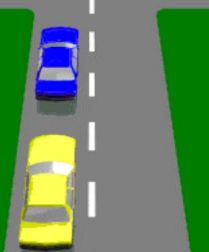
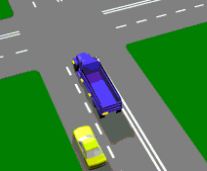
On a single laned road (as shown), you must always overtake another vehicle on its right except when

Diagram for negligent driving practice question 3
  1. AYou are travelling at more than 80 km/h
  2. BThe other vehicle is turning right
  3. CThe other vehicle is going slower than you
Show the answer

Answer: The other vehicle is turning right

If you have good reason to overtake, pass on the right. The rule is relaxed only where your side of the road has two or more lanes, or where the driver ahead has signalled a right turn. On the single lane road pictured, the yellow car may pass the blue car on its left only if the blue car is turning right.

4.

You are approaching the crest (top of a hill) on a narrow road, the safest procedure is to

  1. AKeep to the left and slow down
  2. BFlash your headlights to warn oncoming traffic
  3. CIncrease your speed and sound your horn
Show the answer

Answer: Keep to the left and slow down

You cannot see over a crest, and on a narrow road whatever is coming the other way will be close by the time you do see it. Keep well left on a blind rise and reduce your speed. That puts you on your own side and able to stop inside the piece of road you can actually see.

5.

When overtaking another vehicle you should NOT move back in front of it, unless

  1. AYou can see the overtaken vehicle in your rear vision mirror
  2. BThe driver of the vehicle signals it is safe to do so
  3. CAn oncoming car appears over a hill
Show the answer

Answer: You can see the overtaken vehicle in your rear vision mirror

Once you have passed, get well ahead and ease gently back to the left; cutting in early can force the other driver to brake. The test this paper works to is that you move back in front only when you can see the overtaken vehicle in your rear vision mirror. Another driver's signal never makes it safe for you.

6.

A driver behind you signals their intention to overtake your car. What should you do?

  1. ASpeed up so that the driver will not have to overtake
  2. BSignal the driver to remain behind you if it is travelling too fast
  3. CKeep to the left and let that driver overtake you
Show the answer

Answer: Keep to the left and let that driver overtake you

If you have been glancing in your mirror you will know when a driver behind wants to overtake. Give them the opportunity by moving carefully over to the left within your lane and keep a steady speed while they pass. Do not speed up, and do not try to signal them to stay behind you.

7.

If you are not sure you have enough distance to overtake a vehicle ahead, you should

  1. APut the vehicle in a lower gear and speed up
  2. BWait for a better opportunity with more distance to overtake
  3. CSound your horn to signal the driver ahead to slow down
Show the answer

Answer: Wait for a better opportunity with more distance to overtake

You overtake only when you have seen that the road ahead is clear and satisfied yourself you can pass without excessive speed or danger to others. If you are not sure you have the distance, you do not have it. Stay behind and wait for a better opportunity with more room. A horn or a lower gear creates none.

8.

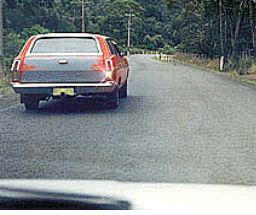
You are driving behind a long vehicle (as shown) which has a sign saying DO NOT OVERTAKE TURNING VEHICLE. The long vehicle indicates that it is going to turn left. You

Diagram for negligent driving practice question 8
  1. AMust let the long vehicle turn first
  2. BMay move to the left-hand side of the road and pass the long vehicle
  3. CMay pass the truck because it cannot turn left from the middle lane
Show the answer

Answer: Must let the long vehicle turn first

A long vehicle needs the width of the road to turn, so the gap on its left closes as it swings round, and it is an offence to overtake at a junction anyway. The truck ahead is signalling left. Hold back behind it and let it complete the turn before you go anywhere near its left side.

9.

If you are convicted of driving with a blood alcohol level that is over the limit for your licence, you could lose your driver’s licence. You may also

  1. ABe restricted to driving an automatic vehicle
  2. BHave a personal speed limit imposed on you
  3. CBe sent to prison
Show the answer

Answer: Be sent to prison

The Highway Code tells you not to drive under the influence of alcohol, but says nothing about penalties. This paper works to the position that driving over the alcohol limit for your licence can cost you the licence and can also send you to prison. It is a criminal offence, not a driving restriction.

10.

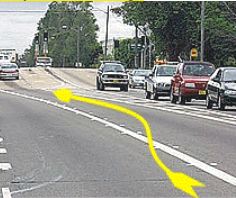
You are travelling in the left lane and wish to turn right at the intersection. You move to the right lane and a driver behind sounds their horn at you. What have you done wrong?

Diagram for negligent driving practice question 10
  1. ACrossed an unbroken lane line
  2. BDriven too slowly
  3. CChanged lanes unnecessarily
Show the answer

Answer: Crossed an unbroken lane line

A continuous line may not be crossed, and that holds for a line between two lanes running the same way just as it does for a centre line. You crossed one to reach the right lane. Change lanes earlier, back where the line is still broken, and then hold your place in the right lane until your turn.

11.

Another vehicle is overtaking you on your right. You commit a traffic offence if you

  1. AKeep the same speed
  2. BSpeed up while the other vehicle is on your right
  3. CSlow down while the other vehicle is on your right
Show the answer

Answer: Speed up while the other vehicle is on your right

When another vehicle is overtaking you, hold a constant speed and move carefully over to the left to give it room. Speeding up while it is alongside stretches out the pass and leaves the other driver stuck on the wrong side of the road. That is the offence. Keeping your speed or easing off is not.

12.

When you have started to overtake the car, you notice that its right indicator is flashing. You should

Diagram for negligent driving practice question 12
  1. ACheck your mirror and move back in behind the car
  2. BAccelerate quickly to get past
  3. CImmediately brake to a stop
Show the answer

Answer: Check your mirror and move back in behind the car

A flashing right indicator says the driver ahead is about to turn right, across the very piece of road you are moving into. Check your mirror, ease off and drop back in behind the car. Go past later, once it has turned and you can see the road ahead is clear.

13.

When entering or leaving a driveway you must

  1. AGive way to bicycles, vehicles and pedestrians
  2. BStop and give way only to vehicles
  3. CBlow your horn to warn other road users
Show the answer

Answer: Give way to bicycles, vehicles and pedestrians

A driveway is not a road, so everyone already using the road keeps their way and you fit in around them. That means pedestrians walking past the entrance, cyclists, and vehicles in both directions. Wait until all of it is clear, then move in or out slowly.

14.

If you are caught speeding through a road work zone you will

  1. AReceive a warning letter in the mail
  2. BBe liable for a speeding fine
  3. CNot receive any penalty as road works speed limits are only advisory
Show the answer

Answer: Be liable for a speeding fine

At road works you must not exceed any temporary maximum speed limit; it is a limit, not advice. What this paper works to is that speeding through a road work zone makes you liable for a speeding fine, the same as speeding anywhere else. A warning letter is not what to expect.

15.

The speed limit on a road is 90 km/h. You have just overtaken a vehicle in the left lane. What should you do next?

  1. AMove into the left lane
  2. BKeep your position in the right lane
  3. CAccelerate away from the other vehicle and keep driving in the right lane
Show the answer

Answer: Move into the left lane

On a road with two or more lanes going the same way you keep left and move right only to overtake or turn right. Once you have passed the vehicle in the left lane and are well ahead, ease gently back into the left lane. Staying in the right lane at 90 km/h, or accelerating away and holding it, is not keeping left.

Study all the questions offline

The app carries these questions and the 2026 papers offline, links every answer to the rule it comes from, and keeps your progress between sittings.