Provisional - Zimbabwe Highway Code, Road Signs & VID Test Prep & lessons

Mixed practice questions

This page gathers 148 mixed questions in the real VID test format, each with its own page carrying the answer and the reason behind it.

Practise a full paper

Every one of the 148 mixed questions is printed below. To practise a paper the shape of the real thing, 25 questions marked against 22, take one of the 2026 papers.

Go to the 2026 papers

All 148 timed quiz questions

Every question on this topic, as it is set. Open the fold under a question to read its answer and why that answer is right, or take the quiz above to have your answers marked.

1.

What should the left-hand lane of a motorway be used for?

  1. ANormal driving
  2. BOvertaking traffic in the middle lane
  3. CVehicles doing the minimum speed limit
Show the answer

Answer: Vehicles doing the minimum speed limit

On a road with two or more lanes going your way you keep left, and move right only to overtake or to turn right. So the left lane is where the slower traffic runs and faster vehicles pass it on the right. The answer this paper takes is the vehicles down at the minimum speed limit.
2.

While driving on a busy main road, you realise that you are travelling against the oncoming flow of traffic. Do you:

  1. APull into a side road nearest to the right before reversing back into the main road in the right direction
  2. BPull into a side road, then turn around
  3. CPerform a three-point turn while in the main road
Show the answer

Answer: Pull into a side road nearest to the right before reversing back into the main road in the right direction

The Code says never drive on the wrong side of the road, and avoid reversing where you can. The answer this paper works to is to turn into the nearest side road on your right, then reverse out so you rejoin the main road facing the right way. A three point turn on a busy main road leaves you across the traffic.

3.

Excessive or uneven tyre wear can be caused by faults in which of the following:

  1. AGearbox
  2. BSuspension
  3. CExhaust system
Show the answer

Answer: Suspension

The suspension holds each wheel square to the road. When a spring, damper or bush is worn, bent or leaking, the tyre no longer sits flat and it wears away in patches instead of evenly. Worn suspension parts must not be used. A gearbox or exhaust fault leaves no mark on a tyre at all.

4.

You are driving in strong winds and wish to overtake a motorcyclist. What should you do?

  1. AOvertake the motorcyclist as wide as possible
  2. BStay close to the motorcyclist while overtaking
  3. CPass with speed to ensure that you complete the overtake quickly
Show the answer

Answer: Overtake the motorcyclist as wide as possible

The Code says reduce speed in windy weather and reminds cyclists that gusts can make them swerve; the same goes for a motorcyclist. Overtake as wide as possible, so that if a gust pushes the rider sideways there is room between you. Passing close or at speed leaves no room for the swerve.

5.

At an accident someone is unconscious, your main priorities should be:

  1. ATake names and details of all those involved
  2. BCheck the person's airways, breathing and stop any heavy bleeding
  3. CSweep up any broken glass or debris that is near them
Show the answer

Answer: Check the person's airways, breathing and stop any heavy bleeding

An unconscious person cannot keep their own airway open, so breathing comes before everything else. Check for danger, then response, then the airway, then breathing, and stop any heavy bleeding you find. Do not move them, and leave names and clearing up until the injured are being looked after.

6.

An accident casualty has injured their arm and they can move it, however, it is bleeding. Why should you instruct them to keep it upright?

  1. AIt will keep it out of your way
  2. BIt will help ease the bleeding
  3. CIt will stop the pain
Show the answer

Answer: It will help ease the bleeding

The Code's first aid rules say comfort and reassure the casualty, but it gives no instruction on bleeding. The reason this paper works to is that holding a bleeding arm up above the heart eases the bleeding. It does not stop the pain, and getting it out of your way is no reason at all.

7.

You wish to park in a 90kph zone which has traffic flowing in both directions. At night time, you should park:

  1. AOn the right side of the road, with parking lights on
  2. BOn the left side of the road, with parking lights on
  3. COn the left side of the road without any lights activated
Show the answer

Answer: On the left side of the road, with parking lights on

You keep left in Zimbabwe, and that holds when you stop as well. If you have to leave the vehicle on the open road at night, pull as far to the left as you can and put your park lights on so a driver coming up behind picks you out in time. Parking on the right puts you facing that traffic.

8.

If turning left to enter a side road, which hazard should you watch out for the most?

  1. AVehicles parked on either side
  2. BIf the side road has a one-way system
  3. CPedestrians
Show the answer

Answer: Pedestrians

A left turn takes you across the pavement where the side road joins, which is exactly where people are crossing on foot, and a vehicle turning left gives precedence to any pedestrian in its path. Look into the side road as you slow down, and let anyone crossing get clear before you turn in.

9.

While driving in foggy conditions, why is it recommended that you stay well behind the vehicle in front of you?

  1. AIn the event that the vehicle's fog lights startle you
  2. BIn the event the vehicle stops abruptly
  3. CIn the event that the vehicle's brake lights startle you
Show the answer

Answer: In the event the vehicle stops abruptly

The Code says keep a longer following distance than normal in adverse weather. In fog you see the vehicle ahead only when you are close to it, so if it stops suddenly a short gap leaves you no room to stop. Stay well back so you can pull up in the distance you can see.

11.

You are one of the first to help a motorcyclist injured in a traffic accident. When should you proceed to remove their helmet?

  1. AIn all circumstances, except if the injured motorcyclist is in a shocked state
  2. BOnly if you deem it essential
  3. CUpon the motorcyclist's request
Show the answer

Answer: Only if you deem it essential

The Code's first aid rules say do not remove a motorcyclist's helmet. Taking it off can make a neck or head injury worse, so leave it on unless it is essential, for instance to keep the rider breathing. Do not take it off just because the rider asks, or as a matter of course.

12.

While driving behind a vehicle on a road that is slippery and wet, what time gap should you leave between their car and yours?

  1. AThree seconds
  2. BFour seconds
  3. CTwo seconds
Show the answer

Answer: Four seconds

The normal following gap is the two second rule, and you are told to leave more than that on a wet or slippery road, because you need far more room to pull up. The Code does not put a figure on the wet gap. The gap this paper works to is four seconds.

13.

You are waiting to emerge at a junction but parked vehicles are restricting your view. What can you do to help you see?

  1. AAsk a passenger to look behind
  2. BLook in a shop window's reflection of traffic
  3. CGet out of the car and look
Show the answer

Answer: Get out of the car and look

The Code says do not enter a junction unless you are satisfied it is safe to do so. When parked vehicles block your view, the answer this paper works to is to get out of the car and look. A shop window reflection or a passenger looking the other way cannot tell you the road is clear.

14.

Your mobile rings while you are driving your vehicle. When is it appropriate for you to accept the call?

  1. AOnce you have stopped in a legally-permitted place
  2. BIf you are confident that your ability to drive will not be compromised by the distraction
  3. CWhile on dual carriageways and motorways
Show the answer

Answer: Once you have stopped in a legally-permitted place

You must not hold a communication device while you are driving, and being sure it will not distract you is not an exception to that. So the call waits. Stop first, somewhere you are allowed to stop, and answer it there with the vehicle standing still.

15.

While waiting at a pelican crossing, an elderly person begins to cross the street. When the traffic lights turn to green, they are only halfway across the road. Do you:

  1. AFlash your headlights so the person is aware you are waiting
  2. BRemain stationary until they have reached a pedestrian footpath
  3. CSound your horn so they hurry up
Show the answer

Answer: Remain stationary until they have reached a pedestrian footpath

A green light lets you go, but it does not take away the precedence of someone already on the crossing, and this person is halfway over with nowhere to go but in front of you. Stay where you are until they have reached the far side and are off the road, then drive on.

16.

You may drive over a footpath if:

  1. AYou need to overtake a slow-moving vehicle in front
  2. BYou are getting to a property
  3. CNo pedestrians are using the footpath
Show the answer

Answer: You are getting to a property

A footpath is built for people on foot, so a vehicle has no business running along one, and an empty footpath is still not a road to overtake on. The one case this paper allows is crossing it to reach a property, done slowly and giving way to anyone walking.

17.

Your vehicle breaks down in a tunnel, what would you do first?

  1. ASwitch on your hazard lights and call your breakdown company
  2. BWait in your car until it gets reported to the police
  3. CGet out of your car and flag down any driver for help
Show the answer

Answer: Switch on your hazard lights and call your breakdown company

The Code says if you break down, use your hazard warning lights to warn other traffic and get the vehicle off the road if possible. In a tunnel you cannot get off the road, so warn traffic first; calling your breakdown company is what this paper adds. Do not stand in the lane flagging drivers down.

18.

What vehicle should you allow extra room for when you overtake?

  1. ACars
  2. BBikes
  3. CTractors
Show the answer

Answer: Tractors

The Highway Code lists tractors among road vehicles but does not say how to overtake one. The answer this paper works to is to allow a tractor extra room. It is wide and slow, often has a trailer or implement behind it, and may turn off into a field or gateway with little warning.

19.

You're involved in an accident with another vehicle. Someone sustains a neck injury and your vehicle is damaged. What should you find out from the other driver involved?

  1. AHow long the driver has been driving for
  2. BThe driver's history of accidents
  3. CThe driver's name, address, number and insurance details
Show the answer

Answer: The driver's name, address, number and insurance details

After a collision each driver owes the other their name and address and those of the vehicle's owner. Someone has been hurt and your vehicle is damaged, so you need the insurance details and a number to reach them on as well. How long they have driven, or crashed before, settles nothing.

20.

You are waiting behind a cyclist at traffic lights, when they change should you:

  1. AAllow the cyclist time and room to move
  2. BDrive as near to them as possible to ensure you get through
  3. CTry to move before the cyclist does
Show the answer

Answer: Allow the cyclist time and room to move

The Code says cyclists are especially vulnerable because they have little protection, and the driver has a special responsibility to them. At the lights, let the cyclist move off first with time and room to get going and balanced. Crowding or moving before them can bring them down.

21.

If you have to slow down quickly on a motorway due to a hazard should you:

  1. ABeep your horn
  2. BFlash headlights
  3. CSwitch on your hazard lights
Show the answer

Answer: Switch on your hazard lights

The Code says use your hazard warning lights to warn other traffic when you have broken down, and gives no rule for slowing quickly on a motorway. The answer this paper works to is to switch on your hazard lights so the traffic behind sees you are slowing hard for a hazard. The horn and headlights say nothing to them.

22.

What driving style will cause risk to all on the road:

  1. ACompetitive
  2. BCautious
  3. CResponsible
Show the answer

Answer: Competitive

The Code says the desire to overtake for the sake of it can become an obsession, and that you must fight it. A competitive driver treats other traffic as something to beat, takes chances and puts everyone on the road at risk. Cautious and responsible driving is what the Code asks for.

23.

You are driving behind a large goods vehicle, it signals right but starts to move left. Should you:

  1. ASlow down and let it turn
  2. BAccelerate and sound your horn
  3. CCarry on and keep to the right
Show the answer

Answer: Slow down and let it turn

The Code says watch the signals of the vehicle ahead and keep a safe following distance. A large goods vehicle turning right often moves left first, because it needs the room to swing into the turn. Slow down and let it turn. Passing on its right or sounding your horn puts you where it is about to go.

24.

A policeman flashes their headlights at you and points left. What should you do?

  1. APull up on the left
  2. BBrake immediately
  3. CTurn left at the next side road
Show the answer

Answer: Pull up on the left

The Code says you must obey signals given by police officers, and their instructions override everything except a traffic light. Flashing headlights and pointing left means pull over and stop on the left. Braking hard in the road or turning off at the next side road is not what was asked.

25.

You are driving but ahead of you is a bus at a designated stop. Should you:

  1. ABe prepared to slow down and give way if the bus suddenly moves
  2. BAccelerate past the bus
  3. CSound your horn to warn the driver
Show the answer

Answer: Be prepared to slow down and give way if the bus suddenly moves

The Code tells you to anticipate what the driver in front is going to do. A bus at a stop can pull out at any moment, and passengers may step out from in front of it or behind it. Be ready to slow down and give way if it moves. Racing past or hooting at the driver is not safe.

26.

You're driving along a country road. A horse and rider are ahead of you. Do you:

  1. AFlash your headlights when passing
  2. BDrive faster to get past quickly
  3. CDrive past slowly and give plenty of room
Show the answer

Answer: Drive past slowly and give plenty of room

Reduce speed whenever you meet animals on the road. A horse takes fright at a vehicle that comes past fast or close, and the rider has very little to hold it with. Slow right down well before you reach them, leave plenty of room as you pass, and do not use your lights or your horn.

27.

Upon driving through a flooded area, what should you do?

  1. AStop the vehicle and check your tyres
  2. BTest your brakes to see they are functioning normally
  3. CStop the vehicle and dry your brakes
Show the answer

Answer: Test your brakes to see they are functioning normally

Water gets into the brakes as you go through, and they will not bite as they should until it has cleared. You do not want to find that out at the next corner. Once you are through the water, press the brakes gently while you are still going slowly, and keep doing so until they pull you up normally.

28.

You are going to reverse into a side road but you aren't sure the area is clear. Should you:

  1. AGet out of the car and check
  2. BAssume it is and go anyway
  3. CCheck your side mirrors only
Show the answer

Answer: Get out of the car and check

The Code says before reversing you must use all mirrors, check the blind spots and look for pedestrians and cyclists behind you, and get someone reliable to direct you if necessary. If you are still not sure the road is clear, get out and check. Side mirrors alone leave a child behind the car unseen.

29.

You have a collision while you're driving, what is the first thing to do?

  1. AStop at the scene
  2. BCall your insurance company
  3. CCarry on driving
Show the answer

Answer: Stop at the scene

After a collision you are obliged to stop immediately, before anything else, and then see whether anyone has been hurt and help them. Driving on is an offence in itself. Your details, the report and the insurance call all come after you have stopped at the scene.

30.

It is unacceptable to reverse:

  1. AFor a longer period of time than you need to
  2. BFor longer than the length of one car
  3. CIn an area with many buildings, as well as stationary and moving vehicles
Show the answer

Answer: For a longer period of time than you need to

The Code says avoid reversing as much as possible and, if you must, choose an appropriate place. Reversing for longer than you need keeps you in a position where your view is poor and the front of the car swings out. There is no fixed length of one car; the rule is to keep it as short as you can.

31.

Following on from the purchase of a new car, when will the first roadworthiness certificate need to be acquired?

  1. AA year
  2. BTwo years
  3. CThree years
Show the answer

Answer: A year

The Code asks you to have your vehicle inspected regularly so that faults are caught before they turn dangerous, but it does not set the interval. The period this paper works to is one year, so the first roadworthiness certificate for a new car falls due a year after you buy it.

32.

If you have a collision what will reduce the risk of neck injury?

  1. AA properly adjusted head restraint
  2. BHaving no seatbelt on
  3. CA collapsible steering wheel
Show the answer

Answer: A properly adjusted head restraint

The Highway Code does not deal with head restraints. The answer this paper works to is that a properly adjusted head restraint stops your head whipping back in a collision, which is what injures the neck. Driving without a seat belt is against the Code, and a collapsible steering wheel protects the chest, not the neck.

33.

On a standard three-lane motorway, what is the purpose of the right-hand lane?

  1. AFor high-speed cruising on the motorway
  2. BFor the purpose of overtaking
  3. CFor texting while driving
Show the answer

Answer: For the purpose of overtaking

On a road with more than one lane going your way you keep left, and move to the right only to overtake or to turn right. So the right hand lane of a three lane road is not a lane to sit in at speed. It is there for passing other vehicles, and you come back to the left once you are by.

34.

How long must you have held your full EC/EEA driving licence for, before supervising a learner driver:

  1. AThree years
  2. BOne year
  3. CTwo years
Show the answer

Answer: One year

The Code says a learner must be accompanied by a fully licensed driver, but gives no length of time the licence must have been held. The figure this paper works to, taken from the EC/EEA rules it names, is one year. In Zimbabwe the person accompanying you simply holds a full licence.

35.

In addition to sentencing for a driving offence, what is the procedure a disqualified driver has to follow to re-obtain a driving licence?

  1. AResit all tests after their period of disqualification has concluded, applying as a new driver
  2. BResit all tests after their period of disqualification has concluded, applying for a duplicate driving licence
  3. CAs soon as they buy a new car
Show the answer

Answer: Resit all tests after their period of disqualification has concluded, applying as a new driver

A disqualification takes the licence away, it does not park it. Once the period of disqualification has ended, the route this paper works to is to apply as a new driver and sit all the tests again. A duplicate licence is only a copy of a licence you still hold, so it is no way back.

36.

You are at a railway level crossing and the red light signal carries on flashing after the train has passed. Should you:

  1. AWait
  2. BCarry on slowly
  3. CSound your horn to tell other drivers
Show the answer

Answer: Wait

Never drive onto a level crossing until the road is clear, and where you have to stop, stop at least 3 metres from the track. A red light still flashing after a train has gone means the crossing is not yet clear, and on double tracks a second train may be coming. Wait for the light to stop.

37.

You are driving down the motorway and planning to turn off at the next junction, however you miss your exit. What should you do?

  1. ACarry on until you reach the next junction you can exit at
  2. BPerform a U-turn at the next gap in the central reservation
  3. CReverse on the hard shoulder back to the exit
Show the answer

Answer: Carry on until you reach the next junction you can exit at

The Code says never make or act on last minute decisions at a junction; rather overrun the junction and return to it. If you miss your exit, carry on to the next one and come back. Reversing on the hard shoulder or turning through the central reservation puts you against fast traffic.

38.

A roof rack fitted to your car will cause:

  1. AYour fuel consumption to decrease
  2. BYour speed to increase
  3. CYour fuel consumption to increase
Show the answer

Answer: Your fuel consumption to increase

A roof rack sits up in the airflow, so the engine has to work harder to push the car through the air at the same speed. That extra work is burnt fuel, whether the rack is loaded or empty. Fitting one puts your fuel consumption up, so take it off when you are not using it.

39.

You forget to switch off your rear fog lights when you have been driving in fog after it clears. This could:

  1. ADamage your car's battery
  2. BLessen your lights' brightness for future use in fog
  3. CBe a breach of the law
Show the answer

Answer: Be a breach of the law

Fog lights are for use when visibility is poor, and the Code tells you to switch them off once visibility improves. Left on in clear air, rear fog lights dazzle the driver behind you and drown out your brake lights. Driving on after the fog has cleared with them still lit breaks that rule.

40.

You see a pedestrian with a red and white stick, what does this tell you about the pedestrian?

  1. AHave epilepsy
  2. BDeaf
  3. CDeaf and blind
Show the answer

Answer: Deaf and blind

The Highway Code asks you to be patient with the blind and assist them, but does not describe sticks. The answer this paper works to is that a red and white stick is carried by a person who is both deaf and blind. They cannot see you and cannot hear your horn, so stop and give them time.

42.

While at a mini-roundabout, you need to:

  1. AGive way to oncoming traffic on your left
  2. BGive way to oncoming traffic on your right
  3. CGive way to oncoming traffic ahead of you
Show the answer

Answer: Give way to oncoming traffic on your right

Traffic in a circle runs clockwise, so a vehicle already going round reaches you from your right, and you must give precedence to it. A small circle is worked the same way as a big one. Look to your right, wait for a gap you can take without making anyone brake, then join.

43.

When approaching an unmarked crossroads, who has right of way?

  1. ANobody
  2. BThe driver travelling on the widest road
  3. CThe driver travelling at the fastest speed
Show the answer

Answer: Nobody

No one holds a right of way at an intersection. A stop or give way sign only takes rights away from the traffic facing it. Where a crossroads carries no signs, no markings and no robot, nobody has priority, so slow down, be ready to stop, and give precedence to the road on your right.

44.

You want to park facing downhill, should you:

  1. APark as close as possible to the car in front
  2. BPark with two wheels up the kerb
  3. CTurn the steering wheel towards the kerb and put on the handbrake
Show the answer

Answer: Turn the steering wheel towards the kerb and put on the handbrake

When you park, put the handbrake on and take whatever other step stops the vehicle rolling. Facing downhill, gravity is pulling the car forwards, so turn the front wheels towards the kerb. If it does creep, the front wheel runs into the kerb instead of out into the traffic.

45.

After heavy rain, the motorway is wet and road spray is affecting visibility and overall driving conditions. What do you do?

  1. AEnsure that your hazard lights have been activated
  2. BEnsure that your front fog lights are turned on
  3. CEnsure that your headlights are on and in a dipped setting
Show the answer

Answer: Ensure that your headlights are on and in a dipped setting

Use your headlights wherever visibility is limited, and rain with spray coming off other vehicles is exactly that. Keep them dipped. Dipped headlights light the road in front of you and let the traffic ahead and behind pick you out of the spray without being dazzled.

46.

You're going down a steep hill, to help control the vehicle you should:

  1. ASelect a low gear and use the brakes carefully
  2. BAccelerate to get down as quickly as possible
  3. CSelect a high gear and use the brakes firmly
Show the answer

Answer: Select a low gear and use the brakes carefully

Going down a steep hill, let the engine hold the vehicle back. Select a low gear before the slope steepens, then use the brakes carefully in short applications. Brakes held on all the way down heat up and fade, and a high gear leaves the engine holding nothing back at all.

47.

In which scenario should you never consider overtaking cyclists?

  1. AOn approach to a roundabout
  2. BImmediately before making a left-hand turn
  3. CWhen the road is narrower than usual
Show the answer

Answer: Immediately before making a left-hand turn

You must not overtake at a junction. If a cyclist is in front of you and your turn is the next one to the left, going past means cutting straight across them as you turn in. Stay behind, let the cyclist get past where the side road joins, and then make your turn.

48.

A roof rack fitted to your car will cause:

  1. AYour fuel consumption to decrease
  2. BYour speed to increase
  3. CYour fuel consumption to increase
Show the answer

Answer: Your fuel consumption to increase

A roof rack sits up in the airflow, so the engine has to work harder to push the car through the air at the same speed. That extra work is burnt fuel, whether the rack is loaded or empty. Fitting one puts your fuel consumption up, so take it off when you are not using it.

49.

You need to make a journey but it is very foggy. What should you do:

  1. AKeep two seconds behind the vehicle in front
  2. BKeep your lights on full beam
  3. CFollow the tail lights of the vehicle in front
Show the answer

Answer: Keep your lights on full beam

In fog use your headlights so you can see and be seen, and leave a longer following distance than you would in clear weather. Two seconds is a fine weather gap, and following the tail lights ahead is driving on another driver's judgement. The Code sets no rule on beam, so this paper answers full beam.

50.

When you drive you should wear sensible footwear. This is because:

  1. AFlat shoes will mean that the pedals will not wear out as quickly
  2. BYou will find it easier to adjust your seat into the right position
  3. CYou will have better control over the pedals
Show the answer

Answer: You will have better control over the pedals

The Highway Code does not mention footwear. The answer this paper works to is that sensible shoes give you better control over the pedals. Loose, thick or slippery shoes can slip off the pedal or catch under it at the moment you need to brake.

51.

Why is there more risk involved in overtaking a lorry than a car:

  1. ABecause lorries are slower than cars
  2. BBecause a lorry is heavier than a car so the brakes are not as good
  3. CBecause a lorry is longer than a car
Show the answer

Answer: Because a lorry is longer than a car

To overtake you need enough clear road to get past and settle back on the left. A lorry is much longer than a car, so you spend far longer alongside it and need a far longer clear stretch to do it in. That length, not its weight or its speed, is what makes it the bigger risk.

52.

You are at the scene of an accident. What should you NOT do:

  1. AOffer someone who is involved a cigarette to calm them down
  2. BWarn other drivers that there is a problem by using your hazard lights
  3. CAsk other drivers to switch their engines off
Show the answer

Answer: Offer someone who is involved a cigarette to calm them down

The Code says at a collision use hazard lights to warn other traffic, and do not give a casualty anything to eat or drink. The answer this paper works to adds a cigarette to that list: with spilt fuel about, a flame at the scene can start a fire. Warning other drivers and asking for engines off are both right.

53.

When must you NOT sound your horn?

  1. AAt any time when you are in a built up area
  2. BWhen you are in a built up area between 7.30am and 11.30pm
  3. CWhen you are in a built up area between 11.30pm and 7.00am
Show the answer

Answer: When you are in a built up area between 11.30pm and 7.00am

The Code says only blow your horn for safety and never in an offensive manner, and gives no hours. The figures this paper works to are that in a built up area the horn may not be sounded between 11.30pm and 7.00am, except to avoid danger. It may be used during the day when there is a real need.

54.

It has been raining and the road is wet. You should leave a distance between yourself and the vehicle in front of:

  1. AThree seconds
  2. BTwo seconds
  3. CFour seconds
Show the answer

Answer: Four seconds

The Code gives the two second rule for normal conditions and tells you to keep a longer following distance in bad weather, but it puts no figure on wet roads. The gap this paper works to, once it has been raining and the road is wet, is four seconds behind the vehicle in front.

55.

You are driving on a motorway and it is foggy. You know where the edge of the left hand lane is because there are reflective studs. What colour are they:

  1. AWhite
  2. BAmber
  3. CGreen
Show the answer

Answer: Amber

The Highway Code does not describe reflective studs. The answer this paper works to is that the studs marking the left hand edge of the motorway are amber, so in fog you can tell the edge from the white studs between lanes. Green marks a slip road joining or leaving.

56.

You are allowed to park on the right hand side of the road at night:

  1. AIf you leave side lights on
  2. BNever
  3. CIf you park under a lamp post
Show the answer

Answer: Never

The Code says if you must stop on the open road at night, pull off as far to the left as you can and use your park lights so others can see you. The answer this paper works to is never park on the right at night: your lights face oncoming drivers and your rear reflectors point the wrong way, lamp post or not.

57.

When you are preparing to turn left off the road, onto a side road, what should you be most wary of?

  1. APedestrians and cyclists
  2. BVehicles parked at the side of the roads
  3. CCongested traffic on the side road
Show the answer

Answer: Pedestrians and cyclists

The Code says a vehicle turning left must give precedence to any pedestrian in the crossing, and that cyclists keep left, so they may be on your inside as you turn. Look for pedestrians about to cross the side road and for a cyclist coming up on your left before you turn.

58.

What could be badly affected if the tyres are under inflated:

  1. AThe suspension
  2. BThe speed of the car
  3. CBraking
Show the answer

Answer: Braking

Your tyres must be correctly inflated to the figures the maker gives. The pressure is what holds the tread flat and firm on the road, and an under inflated tyre lets the tread squirm about instead of gripping. Grip is what stops you, so braking is what suffers first.

59.

If you are at the scene of an accident you should:

  1. AAttend to anyone who is screaming
  2. BMake sure that everybody gets out of their vehicles
  3. CMake sure that you do not put yourself in any danger
Show the answer

Answer: Attend to anyone who is screaming

The Code says if anyone has been injured, give all the help you can, and that you should warm, comfort and reassure the casualty. A person who is screaming is hurt and frightened, so go to them. Do not get everyone out of their vehicles; the Code says not to move a casualty.

60.

You are driving towards traffic lights that have been on green for a while. What should you do:

  1. AStay at the same speed
  2. BBe prepared to stop
  3. CBrake hard so that you can be sure of stopping if they change to red
Show the answer

Answer: Be prepared to stop

The Code says watch the signals ahead and anticipate what is going to happen. A light that has been green for some time is due to change, so approach ready to stop if it goes to amber. Braking hard for a light that is still green catches out the driver behind you.

61.

It is important that you check tyre pressure regularly. This should be done:

  1. AWhen the tyres are hot
  2. BAfter a long journey
  3. CWhen the tyres are cold
Show the answer

Answer: After a long journey

The Code tells you to keep your tyres correctly inflated to the maker's figures and to check them regularly, but it does not say at what moment to take the reading. The time this paper works to is after a long journey.

62.

To be allowed to drive on the roads a learner driver MUST:

  1. AApply to take their driving test within twelve months
  2. BHave not received any penalty points on their licence
  3. CHave a valid, signed provisional licence
Show the answer

Answer: Apply to take their driving test within twelve months

The Code says a learner must hold a learner driver's licence and be accompanied by a fully licensed driver, and sets no time limit. The answer this paper works to is that a learner must apply to take the driving test within twelve months of getting the licence. Penalty points are not part of the rule.

63.

It is possible that an elderly person's driving could be affected because:

  1. ATheir reaction times may not be as quick as they used to be
  2. BThey find it difficult to read road signs and markings
  3. CThey get lost more easily
Show the answer

Answer: Their reaction times may not be as quick as they used to be

The Code asks you to be patient with old people and assist them where possible. The reason this paper works to is that reaction times slow with age, so an older driver may take longer to brake or respond. It is not true that they cannot read signs or get lost more easily.

64.

When are you allowed to wait in a box junction:

  1. AWhen you are waiting to turn right but are prevented from doing so by oncoming traffic
  2. BNever
  3. CWhen you are stuck in a queue of traffic
Show the answer

Answer: When you are waiting to turn right but are prevented from doing so by oncoming traffic

The Code says you must not enter a box junction until your exit road or lane is clear. The answer this paper works to allows one exception: you may wait in the box when turning right and only oncoming traffic is stopping you. You may never sit in the box because the queue ahead has not moved.

65.

You break down on a motorway and need to call for assistance. Why might it be better to use the emergency roadside phone rather than your mobile phone:

  1. AThe emergency roadside phone will put you straight through to a garage that can help
  2. BUsing a mobile phone will interfere with the frequency of the emergency services' radios
  3. CThe emergency roadside phone allows the emergency services to know where you are
Show the answer

Answer: The emergency roadside phone allows the emergency services to know where you are

The Highway Code does not deal with motorway phones. The answer this paper works to is that the emergency roadside phone tells the emergency services exactly where you are, which a mobile phone cannot. Mobiles do not interfere with their radios, and the phone does not connect you to a garage.

66.

You intend to park within a 90 kph area, and there is traffic moving in both directions. During the night, you should park:

  1. AThe right side of the road with your parking lights switched on
  2. BThe right side of the road with your hazard lights on
  3. CThe left side of the road with your hazard lights on
Show the answer

Answer: The left side of the road with your hazard lights on

You keep left, so you park on the left side of the road, facing the way the traffic on your side is going. The Code says that if you must stop on the open road at night you should use your park lights. The answer this paper works to is the left side with your hazard lights on.

67.

Which of these emergency vehicles might have a blue flashing beacon

  1. AAn animal ambulance
  2. BA gritting lorry
  3. CA doctor's car
Show the answer

Answer: An animal ambulance

The Code says fire engines, ambulances and police vehicles use flashing beacons and take precedence over other traffic. The answer this paper works to is that an animal ambulance may also carry a blue flashing beacon. A gritting lorry shows amber, and a doctor's car does not show blue.

68.

What is the most common cause for a vehicle to skid:

  1. ABecause the tyres are worn
  2. BBecause of pedestrians or other drivers
  3. CBecause of other people's actions
Show the answer

Answer: Because the tyres are worn

A skid is your vehicle losing its grip on the road, and grip comes from the tyres. Worn tyres, below the 1mm of tread the Code sets as the minimum, cannot clear water or hold the surface, so they let go first. Other road users do not make your car skid, your tyres do.

69.

Where will you find a crawler lane on a motorway:

  1. AOn a steep gradient
  2. BBefore a service station
  3. CNext to the hard shoulder
Show the answer

Answer: Next to the hard shoulder

A crawler lane is an extra lane for slow heavy vehicles, put in on the left, the side you keep to, so that faster traffic can still get past on the right. That places it on the outside of the road, next to the hard shoulder. The Code does not deal with crawler lanes.

70.

You see a vehicle with a green flashing beacon. Who is this:

  1. AA gritting lorry
  2. BA doctor going to an emergency call
  3. CThe police carrying out duties that are not emergencies
Show the answer

Answer: The police carrying out duties that are not emergencies

The Highway Code does not mention green beacons; it says emergency vehicles use flashing beacons. The answer this paper works to is that a green flashing beacon is the police carrying out duties that are not emergencies. A gritting lorry shows amber, and a doctor's car is not the answer here.

71.

You are driving in very heavy rain. Your stopping distances are likely to be:

  1. ATwice what they are in good conditions
  2. BFive times what they are in good conditions
  3. CThe same as they are in good conditions
Show the answer

Answer: Twice what they are in good conditions

Wet roads take longer to pull up on, and the Code tells you to keep a longer following distance in bad weather without putting a figure on it. The figure this paper works to is that in very heavy rain your stopping distance is twice what the same stop would take in good conditions.

72.

You are driving behind a tractor and would like to get past but you are not sure if it is safe to do so. What should you do:

  1. AOvertake as quickly as possible while flashing your headlights to warn any oncoming traffic that you are coming
  2. BFollow closely behind another car that is overtaking the tractor
  3. CNot overtake until you are certain that it is safe to do so
Show the answer

Answer: Not overtake until you are certain that it is safe to do so

Never overtake until you have seen for yourself that the road ahead is clear, and it is your own responsibility to be sure of that. If you cannot tell whether you can get past the tractor safely, then you have your answer. Stay behind it until you are certain, however long that takes.

74.

Which of these will help to prevent neck injuries in the event of a collision:

  1. AA head restraint that is properly adjusted
  2. BHaving a seat that is air sprung
  3. CHaving a steering wheel that will collapse upon impact
Show the answer

Answer: A head restraint that is properly adjusted

A head restraint adjusted so its top is level with the top of your head stops your head snapping back when the car is hit from behind, which is what injures the neck. An air sprung seat and a collapsing steering wheel protect other parts of you. This is the answer the paper works to; the Code does not cover it.

75.

If you park on the road at night when should you use parking lights:

  1. AIf you park facing oncoming traffic
  2. BIf you park on a road that has a speed limit of more than 50kph
  3. CIf you park on the centre island
Show the answer

Answer: If you park on a road that has a speed limit of more than 50kph

If you have to stop on the open road at night, pull off as far to the left as you can and use your park lights so that others can see you. The figure this paper works to is a speed limit above 50 km/h: on such a road traffic arrives fast, and an unlit parked car is a danger, so the park lights stay on.

76.

If you are driving through a tunnel, you must:

  1. AMake sure that your rear fog light is on
  2. BKeep your eyes open for variable road signs
  3. CCheck your engine lights
Show the answer

Answer: Make sure that your rear fog light is on

The Highway Code says nothing about lights in a tunnel; it only tells you never to overtake in or approaching one. The answer this paper works to is that in the dark of a tunnel your rear lights, including the rear fog light, are on so the driver behind can pick you out.

77.

If you tow a trailer you must ensure that it is hitched securely to the towing vehicle. You could use what as an extra precaution:

  1. AA breakaway cable
  2. BA jockey wheel
  3. CAn extra tow hitch
Show the answer

Answer: A breakaway cable

A trailer must be securely attached, and in addition to the draw bar, safety chains must be fitted. A breakaway cable does the same job as the chains: if the hitch fails it holds the trailer or applies its brakes. A jockey wheel only props the nose when the trailer is unhitched, and a second hitch is no safeguard.

78.

Following too closely behind a large vehicle is not a good idea because:

  1. AYou will have to keep braking and your brakes will overheat
  2. BYou will get pulled along in its slipstream
  3. CYour visibility will be impeded
Show the answer

Answer: Your visibility will be impeded

Keep well back from a large vehicle. Sitting close behind it, the vehicle fills your view and you can see nothing of the road in front of it, so you cannot pick up a hazard early or tell whether it is clear to overtake. Your view is the first thing you lose, and you must see before you move.

79.

You are driving along when you suddenly see a motorcyclist lying, unconscious in the road. There is no other vehicle involved with what has happened. What is the first thing you should do:

  1. AWarn other drivers
  2. BMove the motorcycle out of the road
  3. CGet the motorcyclist out of the road
Show the answer

Answer: Warn other drivers

Other drivers are still coming towards a rider lying in the road. The first thing to do is warn them, with your hazard lights and your warning triangles, so nobody runs into him or into you. Do not move an injured motorcyclist and do not take the helmet off; leave that to the ambulance crew.

80.

The fluid in your car's battery needs topping up. What should you use:

  1. ADistilled water
  2. BEngine oil
  3. CCoolant
Show the answer

Answer: Distilled water

A battery is topped up with distilled water only. Tap water carries minerals that coat the plates, and oil or coolant would ruin the battery outright. The Highway Code does not cover battery care; this is the answer the paper works to.

81.

An ambulance is following you and is using flashing lights and a siren. What should you do:

  1. AStop immediately so that it can get past
  2. BKeep driving normally
  3. CPull over as soon as it is safe to do so
Show the answer

Answer: Pull over as soon as it is safe to do so

Give precedence to an ambulance sounding its siren or flashing its lights: move out of its course and stay stopped until it has passed. Move over and stop as soon as it is safe, not by braking dead in the road, which could put a crash in front of it. Driving on as normal leaves it stuck behind you.

82.

If you use a hands free phone while you are driving you are likely to:

  1. AHave your attention diverted
  2. BHave better concentration
  3. CHave your view restricted
Show the answer

Answer: Have your attention diverted

You must not hold a communication device while driving, and the hand is only half of the trouble. A conversation pulls your mind away from the road, so you look without seeing and act late. A hands free set keeps both hands on the wheel and still takes your attention off the driving.

83.

Before you stop your car you must:

  1. AIndicate and pull over immediately
  2. BIndicate as soon as you think about pulling over until you find a safe place to make the manoeuvre
  3. CCheck your mirrors to see if other road users will be affected by your manoeuvre
Show the answer

Answer: Indicate as soon as you think about pulling over until you find a safe place to make the manoeuvre

Signal well before you brake, and give the stop signal in good time. So indicate as soon as you decide to pull over, and keep the signal on while you look for a safe place to stop. Pulling over at once without looking is dangerous, and checking your mirrors is only one step of the drill, not the whole of it.

84.

You are driving when you come across a pelican crossing that is flashing an amber light. This means that you must:

  1. AStop and give way to allow pedestrians waiting on the kerb to cross
  2. BStop and wait for the green light to show
  3. CStop and give way to pedestrians already on the crossing
Show the answer

Answer: Stop and give way to allow pedestrians waiting on the kerb to cross

At a pedestrian crossing away from a junction you must stop and give precedence to anyone on the crossing or waiting to cross. A flashing amber is not telling you to go. Stop, and let the people standing at the side of the road cross before you drive on.

85.

What kind of road would you be most affected by a side wind:

  1. AOn an open road
  2. BOn a country road
  3. COn a busy road
Show the answer

Answer: On an open road

A side wind pushes hardest where nothing shelters the road. On an open road there are no buildings, hedges or trees to break it, so a gust hits the car full on, worst when you pass a large vehicle or a gap in the trees. A busy road or a country road with hedges gives more shelter. Hold the wheel firmly.

86.

You have had to use the hard shoulder on a motorway but now need to rejoin the carriageway. You should:

  1. AIndicate your intention and then wait for someone to flash their lights at you
  2. BWait for a gap in the traffic, pull onto the carriageway and then build up your speed
  3. CPull onto the carriageway with your hazard lights on so that other traffic is more aware of you
Show the answer

Answer: Wait for a gap in the traffic, pull onto the carriageway and then build up your speed

The Highway Code has no motorway rules, so the answer this paper works to is the rule for joining any fast road: wait for a gap in the traffic, pull onto the carriageway and build up your speed. A flash from another driver gives you no right to move; the Code says such signals never relieve you of the responsibility.

87.

On a motorway where can amber reflective studs be found:

  1. ABetween the carriageway and the hard shoulder
  2. BBetween each lane
  3. CBetween the carriageway and the central reservation
Show the answer

Answer: Between the carriageway and the central reservation

The Highway Code does not describe reflective studs. The colours this paper works to are white between lanes, red along the left edge by the hard shoulder, amber along the right edge beside the central reservation, and green where traffic joins or leaves. So amber marks the right hand edge of the carriageway.

88.

You are driving behind a large vehicle. You should keep well back because:

  1. AYou will be able to take corners and bends more quickly
  2. BYou will be protected by the wind if you keep this position
  3. COtherwise the driver of the large vehicle will not be able to see you through the mirrors
Show the answer

Answer: Otherwise the driver of the large vehicle will not be able to see you through the mirrors

A large vehicle has no view out of the back, so its driver knows you are there only from the wing mirrors. Tucked in close behind, you sit in the space those mirrors do not cover and the driver cannot see you at all. Keep well back and stay where the mirrors reach you.

89.

A long, heavy vehicle is trying to overtake you but it is taking a long time; what should you do:

  1. ASlow down so it can overtake you quickly
  2. BSpeed up so that it can pull back in behind you
  3. CKeep driving at the same speed; it will get past you soon
Show the answer

Answer: Keep driving at the same speed; it will get past you soon

When you are being overtaken, keep well left and maintain a constant speed. Speeding up keeps the heavy vehicle out on the wrong side of the road for longer, and slowing suddenly can confuse its driver as it judges the gap. Hold your speed and let it get past.

90.

You are approaching a right hand bend. You should keep to the left of the road because:

  1. AIt will give you a maximum view of the road
  2. BYou will be better able to cope with the camber of the road
  3. CIt is the polite thing to do: vehicles behind you will be able to overtake you should they wish
Show the answer

Answer: It will give you a maximum view of the road

On a right hand bend the inside of the curve is on your right, and that is where your view is shortest. Keeping well to the left lets you see as far round the bend as possible, so you spot oncoming traffic early, and it keeps you clear of any vehicle cutting the corner. The Code says never cut blind corners.

91.

It is illegal to overload a vehicle. Who is legally responsible for this:

  1. AThe driver of the vehicle
  2. BThe person who loaded the vehicle
  3. CThe registered keeper of the vehicle
Show the answer

Answer: The driver of the vehicle

The driver is answerable for the vehicle on the road. The Code says you must ensure proper control by not overloading it, and you should not tow more than the law allows. Whoever loaded it, and whoever owns it, it is the driver who takes an overloaded vehicle onto the road, so the driver is responsible.

92.

You really need to park but the only place that you can see is the zigzag lines near to a pedestrian crossing. You are allowed to park here:

  1. ABetween dusk and dawn
  2. BNot in rush hour
  3. CNever
Show the answer

Answer: Never

You must not stop or park at or near a pedestrian crossing. A vehicle standing there hides the people waiting to cross from the drivers coming up, and hides the traffic from them. The zigzag lines mark that ground, so it is never a place to park, at any time of day or night.

93.

You need to reverse into a side street. At what point is your car the biggest hazard to passing traffic:

  1. AAs the front of your car swings out
  2. BWhen you have completed the manoeuvre
  3. CWhen you begin the manoeuvre
Show the answer

Answer: When you begin the manoeuvre

Do not reverse into a busy road, and remember that the front of your vehicle swings out as you turn. The moment you begin, your whole car is still across the main road with the front about to swing, and passing traffic has to go round you. That is when you are the biggest hazard, so look all round before you start.

94.

You are driving in icy conditions when you suddenly go into a rear wheel skid. What should you do:

  1. ASteer away from the skid
  2. BSteer into the skid
  3. CBrake hard
Show the answer

Answer: Steer into the skid

The Code does not set out how to get a vehicle out of a skid. The answer this paper works to is to steer into the skid, turning the front wheels the same way the back of the car is sliding, and to stay off the brakes until the car is running straight again.

95.

You are driving and want to use your mobile phone but do NOT have a hands-free set. This is allowed when:

  1. AIf you are driving on a quiet road
  2. BYou are confident that your driving will not be affected
  3. CIf you have stopped and are not driving
Show the answer

Answer: If you have stopped and are not driving

You must not hold any communication device while driving. There is no quiet road exception, and no exception for a driver who believes the call will not affect the driving. Without a hands free set, the call waits until you have stopped somewhere safe and parked properly.

96.

You discover that your fuel consumption is higher than it should be. What is the most likely cause of this:

  1. ASteering too sharply
  2. BDriving over 120kph
  3. CUsing high gears
Show the answer

Answer: Using high gears

An engine pulling in too high a gear for the speed labours, and a labouring engine drinks fuel. Change down and let the engine rev before you change up, above all on hills or with a load on. The Code does not deal with fuel use; using high gears is the cause this paper names.

97.

You are driving in the left hand lane of a motorway. Traffic is approaching from the slip lane. You should:

  1. ASlow down so that they can join the motorway in front of you
  2. BMove into another lane
  3. CKeep at the same speed, they will have to wait for you
Show the answer

Answer: Keep at the same speed, they will have to wait for you

Traffic entering a major road from a minor one gives precedence to the traffic already on it. That holds for a slip lane joining a motorway: you are on the through road, so keep your lane and a steady speed and the joining drivers fit in ahead of or behind you. Slowing or swerving into another lane invites a crash.

98.

You are driving in very heavy rain when suddenly your car starts to slide. This is called:

  1. ASlip streaming
  2. BAquaplaning
  3. CFloating
Show the answer

Answer: Aquaplaning

In heavy rain the water can build up between the tyres and the road faster than the tread can clear it away. The tyres end up riding on a layer of water rather than gripping the surface, and the car slides on with no steering and no braking. That is aquaplaning.

99.

Under what circumstances are you allowed to drive over a footpath:

  1. AWhen you want to get lawful access to a property
  2. BWhen it is wide enough for you to do so
  3. CWhen there are no pedestrians on it
Show the answer

Answer: When you want to get lawful access to a property

A footpath is built for people on foot, and a vehicle has no business on one. The single reason you may drive across it is to get lawful access to a property that it lies across, and then slowly, giving way to anyone walking. A wide path or an empty one is not a reason.

100.

When you drive at night, which glasses should you NOT wear:

  1. ATinted
  2. BBi-focals
  3. CDesigner
Show the answer

Answer: Tinted

At night, do not use anything that obscures your vision unless it has been prescribed for night vision. Tinted lenses cut the little light there is and make dark objects harder to see, so leave them off after dark. Bi-focals and designer frames are a matter of prescription and style; they do not darken your view.

101.

You are driving on a three lane motorway. Which lane should you normally drive in:

  1. AThe left hand lane
  2. BThe right hand lane
  3. CThe middle lane
Show the answer

Answer: The middle lane

The right hand lane of a three lane road is kept clear for overtaking, so it is not a lane to travel in. Of the three lanes running your way, the one this paper marks as the normal driving lane is the middle one, leaving the right hand lane free for traffic that is passing.

102.

If you find somebody unconscious at the scene of an accident, what should you do?

  1. ACheck the person's airways, breathing, and attempt to stop any bleeding
  2. BYou should drive straight past the scene
  3. CGet the names of everybody that was involved with the accident
Show the answer

Answer: Check the person's airways, breathing, and attempt to stop any bleeding

If you are trained in first aid, the Code's drill is DRABC: check for danger and response, then the casualty's airway, then breathing, then chest compressions if there is no pulse. You are also obliged to give all the help you can, and stopping bleeding is part of that. Names come later; driving past is not allowed.

103.

There is a pedestrian nearby who has a red and white stick. What do you know about the pedestrian?

  1. ABlind and deaf
  2. BBlind
  3. CDiabetic
Show the answer

Answer: Blind and deaf

The Code asks you to be patient with the blind and infirm but does not describe sticks. The meaning this paper works to is that a white stick shows a pedestrian is blind, and a white stick with red bands shows the person is blind and deaf. They can neither see nor hear you coming, so give them all the time they need.

104.

You find yourself at a railway level crossing and the red flashing light signal continues even once the train has passed. What do you do?

  1. AGo across the railway intersection as quickly as possible
  2. BDrive across cautiously
  3. CWait
Show the answer

Answer: Wait

Never drive onto a level crossing until the road is clear, and where you have to stop, stop at least 3 metres from the track. The red light still flashing after the train has gone tells you the crossing is not clear yet, and another train may be coming. Wait until the light stops.

105.

You are driving and a policeman flashes his headlights at you from behind. He is pointing to the left. What do you do?

  1. APull up on the left as soon as possible
  2. BTake a left at the next roundabout
  3. CStop your car immediately
Show the answer

Answer: Pull up on the left as soon as possible

You must obey signals given by police officers. A police vehicle behind you flashing its headlights and pointing to the left is telling you to pull over to the left and stop. Do so as soon as you safely can, not by stopping dead where you are, and not by driving on to some other place.

106.

On a regular motorway road, with three lanes, what is the furthest-right lane used for?

  1. AFor overtaking other vehicles
  2. BFor vehicles travelling at high speed
  3. CFor vehicles travelling at lower speeds
Show the answer

Answer: For overtaking other vehicles

On a road with more than one lane going your way, keep left and move to the right only to overtake or to turn right. The furthest right lane of a three lane road is therefore for overtaking. Use it to pass, then settle back to the left as soon as there is room.

107.

If you are driving in very strong wind, and you want to overtake a motorcyclist, how should you go about it?

  1. AStay close to the motorcyclist at all times to protect them from the wind
  2. BOvertake the motorcyclist, giving them as much room as possible
  3. CPass at a low speed
Show the answer

Answer: Overtake the motorcyclist, giving them as much room as possible

In windy weather slow down and be ready for sudden gusts. A gust can blow a motorcyclist a long way across the lane, and your own vehicle first shields the rider from the wind and then hands it back. Give the rider as much room as you can as you go past, and do not linger alongside.

108.

If you are travelling under the speed limit and a driver behind you is flashing their lights, what should you do?

  1. ABrake quickly so that the drivers behind you will see your brake lights
  2. BTurn on the rear fog lights to signal the other driver
  3. CAllow the vehicle to overtake you
Show the answer

Answer: Allow the vehicle to overtake you

If you have been watching your mirror you will know when a driver behind wants to overtake. Give them the opportunity by moving carefully over to the left and keeping a steady speed. Braking hard or flashing fog lights at the driver only invites a collision. Let the vehicle overtake you.

109.

If your vehicle breaks down in a tunnel, what should you go about doing first?

  1. AWait until somebody reports your car as broken down
  2. BGet out of the car and see if any passing drivers can help you.
  3. CTurn on your hazard lights and get in touch with your breakdown company using an emergency telephone or your mobile telephone
Show the answer

Answer: Turn on your hazard lights and get in touch with your breakdown company using an emergency telephone or your mobile telephone

If you break down, the Code says use your hazard warning lights to warn other traffic. In a tunnel there is nowhere to get off the road, so switch the hazard lights on at once and call for help by the emergency telephone or your mobile. Waiting for someone else to report you leaves traffic running into a dark car.

110.

If you are going to reverse onto a side road but you do not know if the road is clear, what should you do?

  1. AGet out of the car and check it is clear
  2. BBe aware that you may have to slow down and give way to pedestrians
  3. CCheck in your side mirrors
Show the answer

Answer: Get out of the car and check it is clear

Before reversing, look carefully behind you and check the blind spots; if you still cannot tell whether the road is clear, the Code says get someone reliable to direct you. If there is nobody, get out and look yourself. Mirrors leave blind spots, and you must know the road is clear before you move, not as you go.

111.

There is a horse and rider in front of you when you are driving on a country road. What do you do in this situation?

  1. ASound your horn
  2. BDrive past slowly and provide plenty of room
  3. CFlash your lights
Show the answer

Answer: Drive past slowly and provide plenty of room

A horse is easily frightened, and a frightened horse can put its rider under your wheels. The horn is only for safety purposes and flashed lights would startle it, so use neither. Hold back until you have room, then go past slowly with plenty of space between you.

113.

As well as sentencing for driving offences, what procedure does a disqualified driver have to follow to obtain another driving licence?

  1. AApply for a duplicate driving licence
  2. BResit all of the tests and driving examinations when the disqualification has ended, applying as a brand new driver
  3. CBribe the police
Show the answer

Answer: Resit all of the tests and driving examinations when the disqualification has ended, applying as a brand new driver

The Highway Code does not cover disqualification. The procedure this paper works to is that once the ban has ended the driver applies as a brand new driver and sits everything again: the test on the rules of the road and signs, then the driving test. A duplicate licence is only for a lost one, and bribery is a crime.

114.

Excessive wear of the tyre can be due to:

  1. AGearbox problems
  2. BHeadlight problems
  3. CSuspension problems
Show the answer

Answer: Suspension problems

Have your vehicle inspected regularly so that faults are found before they become serious. Worn springs, shock absorbers or joints let a wheel sit at the wrong angle and bounce on the road, and the tyre scrubs its tread away unevenly. Suspension trouble shows up as heavy tyre wear.

115.

You are in an accident and another person involved now has a neck injury. Your vehicle has also been damaged. What information do you need from the driver?

  1. AThe occupation of the driver
  2. BHow long the person has been driving
  3. CThe name, address, number and car insurance details of the driver
Show the answer

Answer: The name, address, number and car insurance details of the driver

After a collision the Code obliges each driver to give their name and address, and those of the vehicle's owner, to anyone with reasonable grounds to ask. You must also be insured against injury to third parties. With someone hurt and your car damaged, you need the other driver's name, address, number and insurance.

116.

If you are driving behind a large vehicle, and it moves left after signalling right, what should you do?

  1. AStop in the road
  2. BCarry on and stay to the right
  3. CSlow down and allow the vehicle to turn
Show the answer

Answer: Slow down and allow the vehicle to turn

A long vehicle needs room to turn: to get its length round a right turn it may first swing out to the left. Its right signal tells you where it is going. Do not try to pass on the right, where it is about to swing, and do not stop dead in the road. Slow down, hold back and give it room to complete the turn.

117.

You are at a mini round about. What do you do?

  1. ADrive cautiously across the roundabout
  2. BGive way to your right
  3. CGive way to your left
Show the answer

Answer: Give way to your right

Traffic already going round a circle has absolute priority, and because a traffic circle runs clockwise, that traffic comes at you from your right. A small circle is worked the same way as a large one. Look right, wait for a gap you can take without making anyone brake, then go.

118.

Having a head rest that is adjusted properly will:

  1. AMake sure that you are comfortable
  2. BHelp you to stay relaxed
  3. CHelp to prevent a neck injury
Show the answer

Answer: Help to prevent a neck injury

In a collision from behind your body is pushed forward with the seat while your head stays put, then whips back. A head rest adjusted level with the top of your head catches it and prevents a neck injury. Comfort and relaxation are not what it is for. The Code does not cover this; it is the answer the paper works to.

119.

Imagine you're driving on a country road, and a horse and rider are just in front of you, travelling in the same direction. What do you do?

  1. AFlash your headlights to alert the rider
  2. BDrive quickly to get past the horse as soon as possible
  3. CProvide plenty of room and drive past the horse slowly
Show the answer

Answer: Provide plenty of room and drive past the horse slowly

A horse is easily startled, and a startled horse can throw its rider into the road. Flashed headlights and a quick pass would both frighten it. Stay back until the road gives you room, then go by slowly with plenty of space, ready to stop if the rider signals you to.

120.

If you want to park downhill, what should you do?

  1. APut two of the wheels on the kerb to ensure safety
  2. BTurn your steering wheel in the direction of the kerb, and make sure you turn on the handbrake
  3. CPut one wheel on the kerb to ensure safety
Show the answer

Answer: Turn your steering wheel in the direction of the kerb, and make sure you turn on the handbrake

When you park, use the handbrake and take whatever other step stops the vehicle rolling away. Facing downhill, gravity is pulling the car forwards, so turn the steering wheel towards the kerb. If it does creep, the front wheel meets the kerb instead of running into the traffic.

121.

What kind of driving can cause risk on the road?

  1. ACompetitive
  2. BDefensive
  3. CCautious
Show the answer

Answer: Competitive

Competitive driving is racing the driver beside you, refusing to be overtaken and overtaking for the sake of it, which the Code warns can become an obsession you must fight. Defensive and cautious driving expect other people's mistakes and leave room for them. It is the competitive driver who puts everyone at risk.

122.

When you are approaching a mini roundabout, you need to:

  1. AUse hand signals to decide who should go first
  2. BGive way to coming traffic on your left
  3. CGive way to coming traffic on your right
Show the answer

Answer: Give way to coming traffic on your right

Traffic already circulating has absolute priority, and because a traffic circle runs clockwise, that traffic reaches you from your right. A small circle is no different. Coming up to it, look to your right, wait until you can enter without making anyone brake, and then go.

123.

Ways to minimise fuel consumption while driving include:

  1. AUse air conditioning only when you really need it.
  2. BIf your car's roof rack is removable, take it off when it's not in use.
  3. CAll of these answers are correct
Show the answer

Answer: All of these answers are correct

Both of the steps listed cut the work the engine has to do. A roof rack left on spoils the airflow and burns fuel on every trip, and the air conditioning is driven by the engine, so running it when you do not need it costs fuel too. Neither one is the whole answer, so all of them are right.

124.

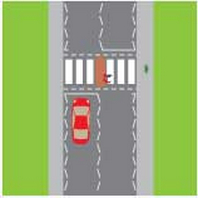
You stop at a zebra crossing with a central island to let a pedestrian cross. When can you proceed?

Diagram for timed quiz practice question 124
  1. AAs soon as the pedestrian has entered the central island
  2. BWhen the pedestrian has completely crossed the road
  3. CImmediately, so long as you avoid the pedestrian
Show the answer

Answer: When the pedestrian has completely crossed the road

At a zebra crossing you stop and give precedence to any pedestrian crossing or waiting to cross. The red car has stopped in the left lane, and the pedestrian is just past the central island, still on the crossing. A person on the crossing is still crossing, island or not, so wait until they have stepped off the road.

125.

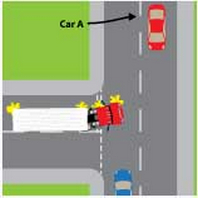
You have arrived at a narrow junction where a lorry is turning. What should you do here?

Diagram for timed quiz practice question 125
  1. ASpeed up to pass the turning lorry.
  2. BContinue on as usual.
  3. CPrepare to stop if the lorry enters your lane.
Show the answer

Answer: Prepare to stop if the lorry enters your lane.

A long vehicle needs the width of the road to turn. The lorry is coming out of the side road on your left and its cab is already swinging across your lane, with a red car coming the other way. You are the blue car. Slow down and be ready to stop so the lorry can finish its turn; speeding up would put you in its path.

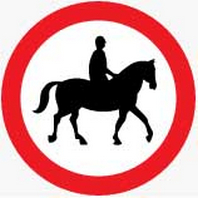
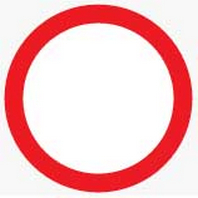
126.

What does this sign mean?

Diagram for timed quiz practice question 126
  1. ANo horses permitted beyond this point.
  2. BEquestrian trail begins.
  3. CWatch out for horses in this area.
Show the answer

Answer: No horses permitted beyond this point.

A red circle round a black symbol prohibits whatever the symbol shows, the same way the overtaking prohibited sign works. This one shows a horse and rider, so ridden horses may not go past this point. A warning that horses may be about would be a red triangle, and a route for horses would be a blue sign.

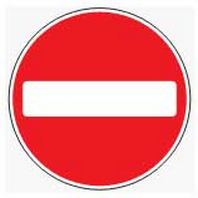
127.

What does this sign mean?

Diagram for timed quiz practice question 127
  1. ANational speed limits now in effect
  2. BRoad work ahead
  3. CNo vehicle entry
Show the answer

Answer: No vehicle entry

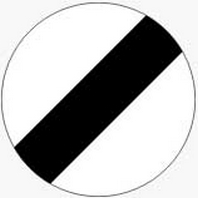
The round red sign with a white bar is the no entry sign: no vehicle may pass it. It stands where you would otherwise drive into a one way road against the traffic, or into a road shut to vehicles. Road works ahead is a red triangle, and the end of a speed limit is a white round sign with a black stripe.

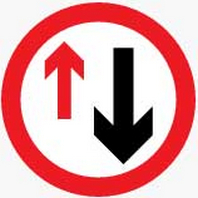
128.

What does this sign mean?

Diagram for timed quiz practice question 128
  1. AWrong way; go back.
  2. BYour lane has priority.
  3. CThe opposing lane has priority.
Show the answer

Answer: The opposing lane has priority.

A red circle is a prohibition sign. The large black arrow pointing towards you is the oncoming traffic; the small red arrow is you, and red is the one held back. Where the road narrows ahead, you give way to vehicles coming the other way. The opposing lane has priority, so wait until it is clear before you go through.

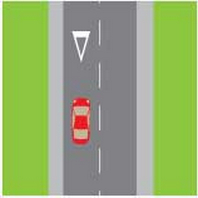
129.

You see a painted triangle on the road ahead. What does this marking mean?

Diagram for timed quiz practice question 129
  1. AYou are on a one-way road.
  2. BYou will have to give way ahead.
  3. CThere is a level crossing ahead.
Show the answer

Answer: You will have to give way ahead.

Road markings are painted to emphasise a regulation ahead. A white triangle painted across your lane, its point towards you, is the give way marking: a junction is coming where you must give precedence to traffic on the road you are joining. Slow down and be ready to stop. A level crossing is warned by a red triangle.

130.

Where will you find this sign?

Diagram for timed quiz practice question 130
  1. AIn an area where you cannot load or unload
  2. BIn an area where you cannot stop, park, load, or unload
  3. CIn an area where you cannot stop or park
Show the answer

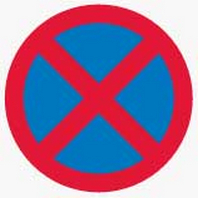
Answer: In an area where you cannot stop, park, load, or unload

The blue round sign with a red ring and a red cross is the no stopping sign. It forbids more than parking: you may not stop here at all, not even for a moment to load, unload or set down a passenger. A red ring with a single red stripe forbids parking only; the cross forbids stopping as well.

131.

You are waiting for a gap in traffic so you can turn right onto a minor road. Where should you wait?

Diagram for timed quiz practice question 131
  1. AIn the centre of your lane
  2. BAnywhere in your lane
  3. CTo the right edge of your lane
Show the answer

Answer: To the right edge of your lane

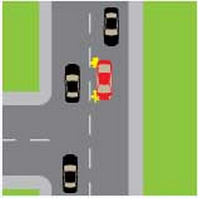
Keep left unless you are about to overtake or turn right. To turn right, move over in good time to the right edge of your lane and signal right. The red car is waiting there for a gap in the oncoming black cars, and traffic behind it can still pass on its left. In the middle of the lane you would block that.

132.

You arrive at an amber traffic light. What should you do?

Diagram for timed quiz practice question 132
  1. ASpeed up to pass through.
  2. BContinue through, but only if you cannot safely stop in time.
  3. CContinue if you can cross the junction before the light turns red.
Show the answer

Answer: Continue through, but only if you cannot safely stop in time.

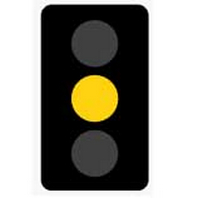
The picture shows the middle lamp lit, with red and green dark. You must stop on the amber, so pull up at the stop line if you can do it safely. The Code does not write out the exception, and the answer this paper works to is to carry on only when you are already too close to stop.

133.

What does this sign mean?

Diagram for timed quiz practice question 133
  1. ANo buses are allowed on this road.
  2. BOnly buses are allowed on this road.
  3. CThere is a bus stop ahead.
Show the answer

Answer: No buses are allowed on this road.

A red circle round a symbol prohibits what the symbol shows. Here the symbol is a bus, so buses may not use this road; every other vehicle may. A road kept for buses alone would be a blue round sign, and a bus stop is never shown by a red circle.

134.

What does this sign mean?

Diagram for timed quiz practice question 134
  1. ANational speed limits now apply.
  2. BThe road is closed ahead.
  3. CThis area is for trams only.
Show the answer

Answer: National speed limits now apply.

This white round sign with a black diagonal stripe ends the limit. The Code's own de-restriction sign puts a red cross over the old message, but the meaning is the same: the lower limit no longer applies and the national limit for that road takes over. The road is not closed, and trams do not come into it.

135.

When can you drive in an operational cycle lane?

Diagram for timed quiz practice question 135
  1. AWhen the cycle lane is bordered by a broken white line and crossing the border is unavoidable
  2. BNever
  3. CWhen the cycle lane is bordered by a solid white line
Show the answer

Answer: When the cycle lane is bordered by a broken white line and crossing the border is unavoidable

A broken white line may be crossed when you are satisfied it is safe; a continuous line may never be crossed. The cycle lane here has a broken line, so the red car may enter it only when there is no other way, say to pass a parked vehicle, and only when no cyclist is there. Behind a solid line it is for cycles alone.

136.

What does this sign mean?

Diagram for timed quiz practice question 136
  1. AYour lane has priority.
  2. BDo not overtake.
  3. CThere is a two-way road ahead.
Show the answer

Answer: Do not overtake.

This is the overtaking prohibited sign: a red circle round two cars side by side. The Code says it tells you not to overtake another vehicle travelling in the same direction, and the ban runs for 500 metres beyond the sign. It says nothing about who has priority or about the road ahead being two way.

137.

What does this sign mean?

Diagram for timed quiz practice question 137
  1. ARoad is uneven ahead
  2. BThere are steep, undulating hills ahead.
  3. CThere are speed bumps ahead.
Show the answer

Answer: Road is uneven ahead

A red triangle warns of a hazard ahead. The symbol is a rough, bumpy surface, so the road ahead is uneven: slow down so the bumps do not throw the car about or bounce a wheel off the road. Speed bumps and steep hills each have their own warning sign.

138.

What does this sign mean?

Diagram for timed quiz practice question 138
  1. AYou can park on either side of the road here.
  2. BMotorists can pass an island or obstacle on either side.
  3. CThere is a Y-junction ahead.
Show the answer

Answer: Motorists can pass an island or obstacle on either side.

A blue round sign gives an instruction. The keep left sign in the Code has one arrow showing which side of an obstacle to pass. This one has an arrow down each side, so you may pass the island or obstacle ahead on either side to reach the same road beyond. It says nothing about parking and is not a junction warning.

139.

Which vehicles are turning correctly at this roundabout?

Diagram for timed quiz practice question 139
  1. ABoth A and B
  2. BB
  3. CA
Show the answer

Answer: Both A and B

Traffic runs clockwise round a circle, with the island on your right. Red car A comes down the top road and follows the circle right round to leave by the road on its right. Blue car B comes up the bottom road and goes straight on. Each keeps left on approach and holds one line, so both are right.

140.

You stop at a pelican crossing with a central island. The light turns green, but someone is still crossing. What should you do?

Diagram for timed quiz practice question 140
  1. AWait for the pedestrian to reach the central island.
  2. BSound your horn to hurry the pedestrian along.
  3. CWait for the pedestrian to finish crossing.
Show the answer

Answer: Wait for the pedestrian to finish crossing.

A green light lets you go, but not drive at a pedestrian. The Code says give the pedestrian a chance to cross the road safely. Here the person is just past the central island and still on the crossing in front of you, so wait until they have finished crossing. Sounding your horn at them is not allowed.

141.

You see this sign by the roadside. What is ahead?

Diagram for timed quiz practice question 141
  1. AA level crossing without a barrier
  2. BA no through road
  3. CA tunnel
Show the answer

Answer: A level crossing without a barrier

The Code's railway crossing sign is a red triangle before the crossing. This red cross is the sign this paper works to at the crossing itself: a level crossing with no gate or barrier, so nothing stops you but your own care. Slow down, look and listen, and stop at least 3 metres from the track if a train comes.

142.

What does this sign mean?

Diagram for timed quiz practice question 142
  1. AThe motorway is closed ahead; exit immediately.
  2. BThe bridge ahead is out; prepare to stop.
  3. CThe motorway ends here.
Show the answer

Answer: The motorway ends here.

A red bar across a sign cancels what the sign shows, the same way the Code's de-restriction signs cancel a limit. The blue sign with a bridge over two carriageways is the motorway symbol, so with the red bar it marks the end of the motorway. It does not close the road or warn of a bridge; ordinary rules apply again.

143.

What is the correct way to navigate multiple mini-roundabouts?

Diagram for timed quiz practice question 143
  1. ATreat each roundabout separately.
  2. BKeep moving until you reach your exit.
  3. CYou must not change roundabouts.
Show the answer

Answer: Treat each roundabout separately.

Small circles set close together are still separate circles, so take them one at a time. At each one, give precedence to the traffic already going round it, which comes from your right, and signal for the exit you want. The red car settles the circle it is at now, then works the next one.

144.

What does this sign mean?

Diagram for timed quiz practice question 144
  1. AThere is a two-way road ahead.
  2. BOncoming vehicles have priority.
  3. CYour lane has priority.
Show the answer

Answer: Your lane has priority.

This is a blue sign, which gives information, not a red circle. The large white arrow pointing your way is you, and the small red arrow is the oncoming traffic, which is the one held back. Where the road narrows ahead, your lane has priority over vehicles coming the other way. The red circle version makes you give way.

145.

Which cars are turning right at a junction? In which scenarios are both cars turning legally?

Diagram for timed quiz practice question 145
  1. AB only
  2. BA only
  3. CBoth A and B
Show the answer

Answer: B only

You must not turn right in front of oncoming traffic, and you keep left of the centre until you turn. In A the red and blue cars cut the corner and each turns across the front of the other. In B they pass each other right side to right side and turn behind one another, each keeping the other on its right. B is legal.

146.

What does this sign mean?

Diagram for timed quiz practice question 146
  1. ANational speed limits now apply.
  2. BNo vehicles are allowed past this point.
  3. CThe road is closed ahead.
Show the answer

Answer: No vehicles are allowed past this point.

A red circle prohibits. With no symbol inside it, the prohibition falls on all vehicles: nothing on wheels may go past this sign, though pedestrians may. The end of a speed limit is a white round sign with a black stripe, and a closed road ahead would be signed in words.

147.

Three cars arrive at a junction. Which cars have priority?

Diagram for timed quiz practice question 147
  1. AA and C
  2. BC
  3. CA
Show the answer

Answer: A and C

Traffic entering a major road from a minor one gives precedence to all the traffic on the major road. Car B is waiting in the side road on the left, behind the broken line across its exit. Car A is coming down the main road and Car C is going up it, so both drive on. Car B waits for both, whichever way it is turning.

148.

You are on a single carriageway with three lanes. Who may drive in the centre lane?

Diagram for timed quiz practice question 148
  1. AOncoming traffic
  2. BOnly vehicles that are turning right
  3. CAny vehicle that is turning right or overtaking
Show the answer

Answer: Any vehicle that is turning right or overtaking

Keep left, and move right only to overtake or turn right. On a three lane road with two way traffic the centre lane is shared by both directions for those two things. The red car keeps to its left lane and the blue car to its own far side; either may use the centre lane to overtake or turn right, never to stay in.

Study all the questions offline

The app carries these questions and the 2026 papers offline, links every answer to the rule it comes from, and keeps your progress between sittings.