Provisional - Zimbabwe Highway Code, Road Signs & VID Test Prep & lessons

Traffic Lights and Lanes Practice Questions

Traffic lights and lane questions test whether you know what each signal and lane marking means, and how to position your vehicle correctly.

10 questions on this topic, all of them printed below. Answer them all and get marked at the end, or take them one at a time with the answer after each.

Mode

Exam is timed and marked at the end, like the real test. Learn marks each answer as you go and shows the right one.

All 10 traffic lights and lanes questions

Every question on this topic, as it is set. Open the fold under a question to read its answer and why that answer is right, or take the quiz above to have your answers marked.

1.

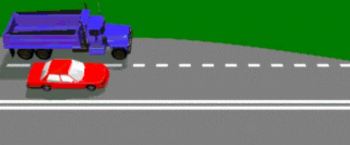
When two lanes merge into one (as shown in the diagram), who should give way?

Diagram for traffic lights and lanes practice question 1
  1. AThe vehicle which has to cross the lane line
  2. BThe faster vehicle
  3. CThe vehicle in the right-hand lane because it is overtaking
Show the answer

Answer: The vehicle which has to cross the lane line

Where two lanes become one, the driver who has to cross the lane line gives way. The truck's lane is the one that runs out, so the truck is the one crossing the broken line into the red car's lane. It waits for a gap and moves over only when it will not get in the red car's way.
2.

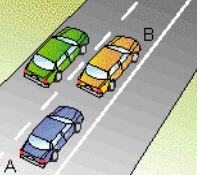
You are in car marked A. You wish to overtake car marked B. You should

Diagram for traffic lights and lanes practice question 2
  1. ACross the unbroken single line and overtake
  2. BWait behind car B until it moves into the left lane
  3. CCross the line and overtake only if it is safe
Show the answer

Answer: Wait behind car B until it moves into the left lane

A continuous line may not be crossed, and here one runs down the right of your lane, so there is no room to pull out and pass car B. The left lane is taken by the green car in any case. Stay behind B until it has moved back into the left lane, and go past only when you have a lane to do it in.

3.

Before changing lanes you should

  1. ASignal for at least two seconds and quickly change lanes
  2. BSpeed up so you are going faster than the traffic in the other lane
  3. CSignal in plenty of time, check your mirrors and look over your shoulder for other vehicles
Show the answer

Answer: Signal in plenty of time, check your mirrors and look over your shoulder for other vehicles

The drill for changing lanes is mirror, blind spot, signal, then move. Signal early enough for the traffic behind to read it, look in your mirrors to see where that traffic is, and turn your head to cover the blind spot the mirrors do not show you. Move over only once all of that is done.

4.

Overtaking another vehicle requires good concentration and judgement. Which of the following statements is correct?

  1. AYou need to watch out for all large, long vehicles which are turning
  2. BIt is best and safest to speed up when a vehicle behind you tries to overtake you
  3. CThe faster the vehicle you are overtaking is going, the less distance you need to overtake
Show the answer

Answer: You need to watch out for all large, long vehicles which are turning

A long vehicle needs the width of the road to get round a corner, and it may be pulling a trailer behind it, so the space beside it closes as it turns. Watch for any large, long vehicle that is turning, keep well clear, and wait until the whole of it has passed before you think about going by.

5.

When driving on a multi-lane road with a speed limit of more than 80 km/h, which lane should you choose?

  1. AThe right lane to avoid slow moving vehicles
  2. BThe left lane unless overtaking
  3. CEither left or right lane
Show the answer

Answer: The left lane unless overtaking

On a road with two or more lanes going the same way, keep left and move right only to overtake or to turn right. The speed limit does not change that. On a multi-lane road with a limit above 80 km/h, drive in the left lane unless you are overtaking.

6.

Signalling is

  1. AAlways required before turning or lane changing
  2. BNot required when turning at T-intersections
  3. CNot required when turning at traffic lights with a green arrow
Show the answer

Answer: Always required before turning or lane changing

You signal so that everyone around you can read what you are about to do, and that is asked of you every time you turn and every time you change lanes. A green arrow or a T junction does not excuse it, because the drivers and pedestrians near you still cannot see your intention. Signal before you move.

7.

How should you merge with traffic when entering a highway?

  1. AStop, then enter the traffic quickly
  2. BSlow down and force your way into the traffic
  3. CWatch for a gap and increase your speed to safely merge with the traffic
Show the answer

Answer: Watch for a gap and increase your speed to safely merge with the traffic

You join a stream of traffic without making anyone in it brake for you, which means being up to its speed by the time you arrive. Watch the traffic, pick a gap, build your speed to match it and move in. Stopping or forcing your way in puts you in front of vehicles that cannot pull up for you.

8.

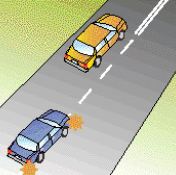
When starting to overtake you see the dividing lines ahead change to double unbroken lines. What should you do?

Diagram for traffic lights and lanes practice question 8
  1. ADo not overtake because you are not permitted to overtake on double lines
  2. BContinue to overtake because you started when the line was broken
  3. CKeep overtaking and cut in in front of the other car as soon as possible
Show the answer

Answer: Do not overtake because you are not permitted to overtake on double lines

A continuous line may not be crossed, and the broken line you started on turns into double unbroken lines just ahead. There is no room left to finish the pass and get back to the left. Ease off, drop in behind the yellow car, and go by later where the line is broken and the road ahead is clear.

9.

If you hear the siren of an emergency vehicle, you must

  1. AFlash your headlights to warn other drivers
  2. BTake whatever action is necessary (with safety) to make way for the emergency vehicle
  3. CIncrease your speed to avoid the vehicle
Show the answer

Answer: Take whatever action is necessary (with safety) to make way for the emergency vehicle

A fire engine, ambulance or police vehicle sounding its siren or flashing its beacon takes precedence over all other traffic. Move out of its course, stop, and stay stopped until it has passed, doing it all safely. Flashing your lights at others or speeding up to keep ahead of it is no help to anyone.

10.

You must use your indicator lights when

  1. AApproaching a curve
  2. BDouble parking
  3. CChanging lanes or turning left or right
Show the answer

Answer: Changing lanes or turning left or right

Indicators are how you tell other road users that you are about to change direction, so they belong on every turn to the left or right and on every lane change. Following a curve is not a change of direction you have chosen. Signal well before you move, and check the indicator returns to neutral.

Study all the questions offline

The app carries these questions and the 2026 papers offline, links every answer to the rule it comes from, and keeps your progress between sittings.