Crossings, works and railways
A railway crossing, road works and a narrow bridge are the same kind of place: the road stops being ordinary, and you slow down before you find out why. Each of them has its own set of questions in the papers.
What the test asks
What you do approaching a level crossing, how far from the track you stop, what a heavy vehicle does at an open boom, what the crossing signs look like, what road works ask of you, and what you may not do on or near a bridge or a blind rise.
The railway level crossing
Approach slowly and be ready to stop. If you have to stop, stop at least 3 m from the track, or immediately behind the stop line where there is one.
Never move onto a crossing until the road beyond it is clear, so that you can get off the other side without stopping on the track. Never try to beat a train. Where the booms are open, look both ways and cross when it is safe, and a heavy vehicle stops first because it needs longer to clear the track than a car does.
Where there are two or more tracks, a train that has just passed can be hiding another, so look and listen again before you move. If the red lights keep flashing after a train has gone by, another one is coming: wait.
The signs you meet first
A railway crossing is warned of in advance by a red triangle with a train on it. At the crossing itself you meet the yellow cross with a red light on each arm.
 The sign that warns a railway crossing is ahead.
You may not overtake on or approaching a level crossing, and you may not park near one.
Road works
Road works ask for the same thing every time. Get into the right lane early, obey the temporary limit, merge in turn where lanes close, and do not drive through an area marked off with cones. Where a lane ends, the road has been narrowed towards the centre and the merge is expected of you, not offered.
Expect grit and mud, which is what puts a motorcyclist down, and expect a queue you cannot see the end of. Watch for traffic entering and leaving the works, and do not slow down to look at what is going on there. Speeding through a works zone is a speeding offence like any other, and the temporary limit is the limit.
Where a sign tells you to expect to be stopped, slow down and be ready to be stopped.
Bridges, rises and bends
A bridge and a blind rise are places where you neither overtake nor park. Keep well to the left on a blind rise and do not cut a blind corner: the road you would need is a road you cannot see.
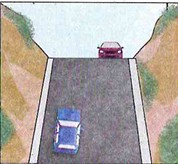 Keep well left on a blind rise, where you cannot see what is coming.
A narrow bridge is a width restriction, and the sign warning of one is asking you to slow down and go through with care. A weight restriction on a bridge is about what the structure can carry. A flyover or a tunnel is a height and a width restriction at once, so a high vehicle reads both.
A bridge under water is not attempted at all.
Pedestrian crossings
A pedestrian crossing away from a junction is the zebra kind, black and white stripes with a warning sign before it, and there you stop and give way to anyone crossing or about to. At a junction the crossing lines belong to the robot or the officer controlling it, and a vehicle turning left or right gives way to anyone already on the crossing.
The mistakes learners make
Stopping on a crossing because the traffic ahead stopped is the one that becomes a headline. Cross when the far side is clear and not before. The stop distance at a track is 3 m, not the length of a car. And an open boom is not a promise: you still look both ways.