Speed limits and distances
Three figures cover almost every speed question in the papers. The rest of this note is about distance: how far you travel before you stop, and how far you sit behind the vehicle in front.
What the test asks
The limit in town, the limit on the open road for a light vehicle and for a heavy one, what a restriction sign does and what a derestriction sign does, the gap to leave at a given speed, and the total stopping distance at 120 km/h. The reaction distance at 60 km/h comes up on its own as well.
The three limits
- 60 km/h in an urban area, for everything, light and heavy alike.
- 80 km/h on the open road for a heavy vehicle, including one drawing two trailers on a wide tarred road.
- 120 km/h on the open road for a light motor vehicle.
Speed limits are the maximum the law allows, not a speed that is safe at any moment. The Code asks you to come down from them at night and at dusk, in rain, mist, smoke, dust or windy weather, when the sun dazzles you, at an intersection, at a level crossing or a bridge, on narrow winding roads, when you meet another vehicle on a strip road, near a school, at a pedestrian crossing, and wherever you may meet animals.
Restriction and derestriction
A restriction sign posts a lower limit and you may not exceed it. A red ringed circle with 100 in it means the road beyond that sign is 100 km/h.
 A speed limit sign: the number inside the red ring is the limit beyond it.
A derestriction sign cancels the message that was posted before it, and that is all it does. It is the sign with a red cross drawn through the message it is cancelling. Once you pass it, the general limit for your class applies again, so a light vehicle is back to 120 km/h and not to any speed it likes.
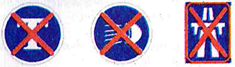 Derestriction signs: the red cross cancels the message underneath it.
How far it takes to stop
Stopping distance is what you cover while you react plus what you cover under braking, and the second part grows far faster than your speed does. It takes the average driver about half a second to begin braking after they register the danger.
| Speed | Reacting | Braking | In total |
|---|---|---|---|
| 40 km/h | 5.6 m | 12.4 m | 18 m |
| 60 km/h | 8.3 m | 27.7 m | 36 m |
| 120 km/h | 16.7 m | 113.3 m | 130 m |
Doubling 60 to 120 does not double the 36. It multiplies it by more than three. In heavy rain, take those figures as roughly twice what the table says.
How far to sit behind
Leave one vehicle length for every 15 km/h you are doing, which is the rule the papers count in. The Code also teaches the two second rule for the same job: pick something at the roadside, and you should pass it at least two seconds after the vehicle in front did.
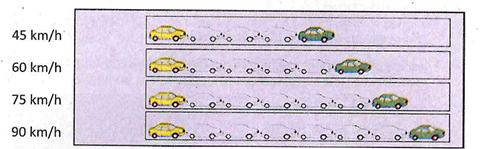 One vehicle length for every 15 km/h, so the gap grows with the speed.
| Speed | Gap |
|---|---|
| 45 km/h | Three vehicle lengths |
| 60 km/h | Four vehicle lengths |
| 75 km/h | Five vehicle lengths |
| 90 km/h | Six vehicle lengths |
In rain, at night, on gravel, or behind something you cannot see past, leave more than the table says.
Other distances worth knowing
- Signal at least 50 m before you turn in town, and 100 m on a main road.
- Put a breakdown triangle 30 m to 50 m behind the vehicle and another the same distance in front, on the same side of the road as the vehicle. A vehicle drawing two trailers carries six of them.
- Park no closer than 7.5 m to a corner. One paper prints the figure as 7 m and another offers both, so keep 7.5 m as the habit and every version of the question is satisfied.
- A warning sign is normally posted about 100 m before the thing it warns you about.
The mistakes learners make
A derestriction sign does not mean drive as fast as you like, it means the posted message is finished with. A limit is a ceiling and not a target. And the gap in front is measured in vehicle lengths at the speed you are actually doing, not at the speed you were doing when you last looked.