Provisional - Zimbabwe Highway Code, Road Signs & VID Test Prep & lessons

Test 16

Twenty five questions from the 2026 paper, in the order they are set. Read them with the answers, or practise the paper and have your answers marked.

Practise this paper online

Questions
25
Pass mark
22
Practise this paper

Marked at the end, then every answer is shown.

All 25 questions in Test 16

The paper as it is set. Open the fold under a question to read its answer and why that answer is right, or practise the paper and have your answers marked.

1.

When traveling at 60km/h, what distance should you leave between your vehicle and the vehicle in front?

  1. A6 vehicle lengths
  2. B5 vehicle lengths
  3. C4 vehicle lengths
Show the answer

Answer: 4 vehicle lengths

Leave one vehicle length for every 15 km/h, so at 60 km/h you need four lengths. That is the room you need to pull up if the driver in front brakes hard.
2.

When a fire engine, ambulance or police vehicle approaches sounding its special warning device, what

  1. AMove as fast as possible
  2. BMove out of its course and stop
  3. CMove slowly on the left side
Show the answer

Answer: Move out of its course and stop

A siren or special warning device means that vehicle is on an emergency call. Move out of its path and stop so it can pass. Speeding up to stay ahead of it only keeps the obstruction in front of it.

3.

What time should persons driving on the road switch on their headlights?

  1. ABetween 5:30pm and 6:30am
  2. BBetween 5:30am and 6:30pm
  3. CAny convenient time
Show the answer

Answer: Between 5:30pm and 6:30am

Headlights must be lit between 5:30 in the afternoon and 6:30 in the morning. The hours are set by law, so you switch on at 5:30pm whether or not it still looks light enough to see.

4.

If you are dazzled by the light of other vehicle, what must you do?

  1. ADip, get out of the way and slow down
  2. BRetaliate
  3. CIncrease your speed
Show the answer

Answer: Dip, get out of the way and slow down

Dip your own lights, slow down and move out of the other driver's course, keeping the left edge of the road in view until your eyes recover. Leaving your bright lights up to answer his blinds you both at once.

5.

When you are driving and feel sleepy, what must you do?

  1. AMaintain a slow speed
  2. BMove off the road and rest
  3. CMaintain a high speed
Show the answer

Answer: Move off the road and rest

Move off the road and rest until you are properly awake. Sleep is not something you can hold off at the wheel, and slowing down does not keep you awake; you can drift off at any speed.

6.

All vehicles shall have:

  1. ARed reflectors in front
  2. BWhite reflectors in front
  3. CEither red or white reflectors in front
Show the answer

Answer: White reflectors in front

Reflectors are white at the front and red at the rear, so a driver coming up in the dark can tell at once which way a stationary vehicle is facing. Red at the front would read as a tail and mislead him.

7.

The law says when driving a motor vehicle at 6.00am the vehicle must have its headlights lit:

  1. AYes
  2. BNo
  3. CDepends on day light
Show the answer

Answer: Yes

Yes. The lighting hours run from 5:30pm to 6:30am, and 6:00am falls inside them, so the headlights must be lit no matter how bright that particular morning looks.

8.

In a traffic circle, I shall indicate:

  1. AWhen going out
  2. BWhen going in
  3. CWhen making a 'U' turn
Show the answer

Answer: When going out

Indicate as you go out of the circle, so the driver waiting to enter behind you knows you are leaving and can move. Going in needs no signal because your path round the circle is already fixed.

9.

A vehicle turning right should

  1. AGive way to window shopping pedestrians
  2. BGive way to oncoming traffic
  3. CGive way to pedestrians standing on the pavement.
Show the answer

Answer: Give way to oncoming traffic

Turning right takes you across the path of traffic coming the other way, so you wait until it is clear. Pedestrians on the pavement or at a shop window have not stepped into the road and are not what you are waiting for.

11.

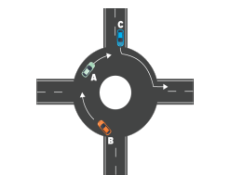
Which car goes last?

Diagram for question 11 of Zimbabwe VID test paper 16
  1. ACar B
  2. BCar A
  3. CCar C
Show the answer

Answer: Car C

Cars A and B are already round on the circle. Car C is still on the approach and has that traffic coming from its right, so C waits for the circle to clear before entering, which puts C last.

12.

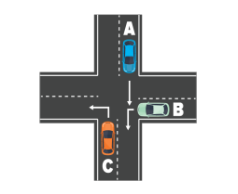
Which car goes last?

Diagram for question 12 of Zimbabwe VID test paper 16
  1. ACar C
  2. BCar B
  3. CCar A
Show the answer

Answer: Car B

Car B comes from the right hand road and turns left into the road car A is coming down, cutting across A's path, and A is on B's right, so B gives way. Car A goes straight with nothing on its right, and car C turns left into its own near lane, so B moves last.

13.

What must you do before you change direction?

  1. ASignal my intention when turning left only
  2. BSignal my intention when turning right only
  3. CSignal my intention before acting and see that the road is clear before changing direction
Show the answer

Answer: Signal my intention before acting and see that the road is clear before changing direction

Signal your intention first, then satisfy yourself the road is clear, then change direction. Every change of direction is signalled, left or right, and the signal announces what you intend; it does not give you the right to move.

14.

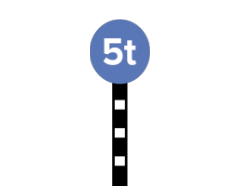
This sign regulates:

Diagram for question 14 of Zimbabwe VID test paper 16
  1. ATime restriction
  2. BSpeed restriction
  3. CWeight restriction
Show the answer

Answer: Weight restriction

The blue round sign marked 5t is a weight restriction: no vehicle heavier than 5 tonnes may pass. It sets nothing about speed, so a car goes through while a loaded lorry has to find another route.

15.

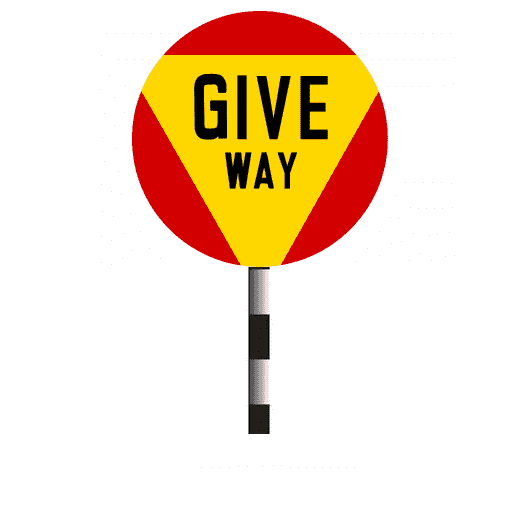
This sign regulates that:

Diagram for question 15 of Zimbabwe VID test paper 16
  1. AVehicles should give precedence to traffic oncoming from the road on the right
  2. BVehicles should give precedence to traffic coming from the left
  3. CVehicles should give precedence to all cross traffic
Show the answer

Answer: Vehicles should give precedence to all cross traffic

This is the GIVE WAY sign, the red round sign with the yellow triangle. It puts you behind everything crossing in front of you, from the left and the right alike, and you move off only once the crossing is clear.

16.

When travelling at 75km/h I must leave a gap of:

  1. AFour vehicle lengths.
  2. BSeven vehicle lengths
  3. CFive vehicle lengths
Show the answer

Answer: Five vehicle lengths

One vehicle length for every 15 km/h. At 75 km/h that comes to five lengths, and closing up to four leaves you without the room to stop if the vehicle in front brakes hard.

17.

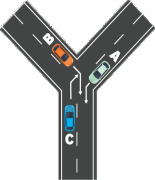
Which car goes last?

Diagram for question 17 of Zimbabwe VID test paper 16
  1. ACar C
  2. BCar A
  3. CCar B
Show the answer

Answer: Car A

The two roads feed into one here. Car A comes down the right hand road with car B approaching from A's right, and traffic from the right has precedence, so A waits and lets B in. Car C is coming up the far side and crosses nobody, so A moves last.

18.

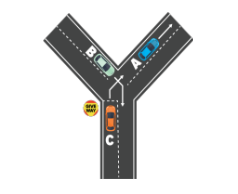
Which car gives right of way?

Diagram for question 18 of Zimbabwe VID test paper 16
  1. ACar A
  2. BCar C
  3. CCar B
Show the answer

Answer: Car C

The GIVE WAY sign stands beside car C where the road C is coming up meets the others, so C is the one that gives way. Car B is coming down the left hand road and car A is running away up the right hand road, and C waits before joining them.

19.

When in a straight ahead lane at an intersection I am not allowed to:

  1. ATurn without indicating
  2. BTurn at all
  3. CTurn without requesting
  4. DTurn without checking blind spots
Show the answer

Answer: Turn at all

A lane marked straight ahead is a lane you may only go straight ahead in, so you may not turn out of it at all, however carefully you indicate or check. The drivers around you are entitled to expect the lane to do what it is painted to do.

20.

At a bridge, I am not allowed to:

  1. AOvertake slow moving vehicles
  2. BSlow down and check the road ahead
  3. CDip my lights even for oncoming vehicles
Show the answer

Answer: Overtake slow moving vehicles

Overtaking on a bridge is forbidden. The road narrows there, there is nowhere to pull back in, and you cannot see what is coming until you are on it. Slowing down and looking ahead is exactly what you should be doing.

21.

A speed restriction sign means:

  1. ADo not exceed the stated speed
  2. BDrive below the stated speed
  3. CWatch out for the police
Show the answer

Answer: Do not exceed the stated speed

A speed restriction sign gives the maximum. You may drive at that speed or under it, never over it, and it holds whether or not there is a police officer anywhere near.

22.

When I intend to stop on the road I must:

  1. AFlash my hazard lights
  2. BSlow down and stop
  3. CSlow down, check the rear view mirror and stop
Show the answer

Answer: Slow down, check the rear view mirror and stop

Slow down, look in the rear view mirror to see what is behind you, then pull over and stop. The driver following is the one you are about to surprise, so look before you brake, not after.

23.

At a rail level crossing with open booms a driver should

  1. AQuickly cross the railway
  2. BLook both sides and cross
  3. CStop and look to the right
Show the answer

Answer: Look both sides and cross

Open booms mean no train has been signalled, but the crossing is still a crossing. Look both ways yourself and cross without hesitating on the rails. The booms are a control, not a guarantee that the line is clear.

24.

The purpose of the parking brake is to

  1. AKeep the vehicle stationary
  2. BKeep the vehicle stationary on a gradient only
  3. CSlow the vehicle down
Show the answer

Answer: Keep the vehicle stationary

The parking brake holds a stopped vehicle where it stands, on the level as much as on a slope. It is not a way of slowing down; the foot brake does that.

25.

At a pedestrian cross every driver must

  1. AWave the pedestrians through
  2. BHoot when it is his turn to go
  3. CWait patiently and proceed when appropriate
Show the answer

Answer: Wait patiently and proceed when appropriate

At a pedestrian crossing the pedestrian goes first. Wait without fuss and move off once the crossing is clear. Waving people over or hooting them across hands your decision to someone who cannot see the traffic behind you.

Practise on your phone

The app sets the same 16 papers, keeps every attempt, gathers the questions you keep missing into a revision set, and works with no network.