Provisional - Zimbabwe Highway Code, Road Signs & VID Test Prep & lessons

Test 15

Twenty five questions from the 2026 paper, in the order they are set. Read them with the answers, or practise the paper and have your answers marked.

Practise this paper online

Questions
25
Pass mark
22
Practise this paper

Marked at the end, then every answer is shown.

All 25 questions in Test 15

The paper as it is set. Open the fold under a question to read its answer and why that answer is right, or practise the paper and have your answers marked.

1.

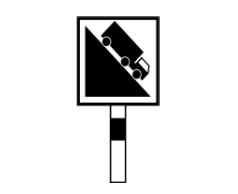
When approaching this sign I am expected to:

Diagram for question 1 of Zimbabwe VID test paper 15
  1. AEngage brakes continuously
  2. BEngage low gear
  3. CEngage high gear
Show the answer

Answer: Engage low gear

The sign shows a lorry on a downhill gradient: a steep descent ahead. Engage a low gear so the engine itself holds the vehicle back. Braking all the way down overheats the brakes and they fade just where you need them most, at the bottom.
2.

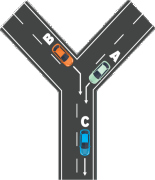
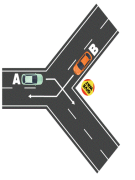
Which car goes first?

Diagram for question 2 of Zimbabwe VID test paper 15
  1. ACar A
  2. BCar B
  3. CCar C
Show the answer

Answer: Car A

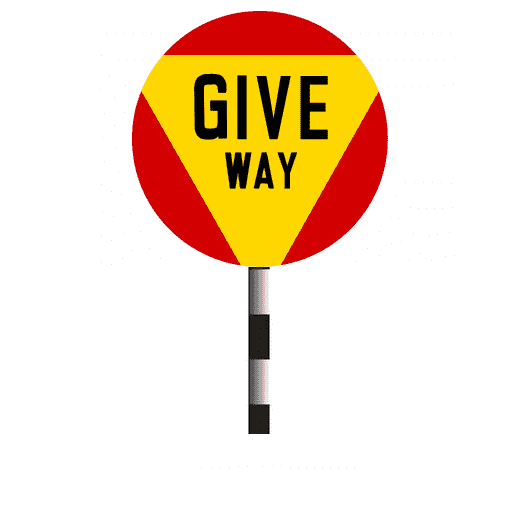
At this Y junction the GIVE WAY sign stands where the road car B is coming down meets the main road, so B must wait until the road it is joining is clear. Car A is already on that road, so A goes first.

3.

At this sign I should:

Diagram for question 3 of Zimbabwe VID test paper 15
  1. AStop and give way to cross traffic
  2. BSlow down and proceed if there is no traffic
  3. CStop and proceed when the road is clear on both sides.
Show the answer

Answer: Slow down and proceed if there is no traffic

This is the GIVE WAY sign, a red round sign with a yellow triangle. Slow down, look along the road you are joining, and carry on if nothing is coming. Only the STOP sign makes you halt every time, whether or not there is traffic.

4.

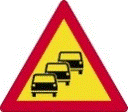
This sign warns of:

Diagram for question 4 of Zimbabwe VID test paper 15
  1. AMany vehicles following behind
  2. BA pile up accident
  3. CPossibility of congestion on road ahead
Show the answer

Answer: Possibility of congestion on road ahead

The triangle showing vehicles queued one behind the other warns that traffic is likely to be congested further on. It warns of a hold up you are about to reach, not of a crash that has already happened.

5.

In case of a rear wheel tyre burst, I

  1. AApply foot brakes immediately
  2. BAvoid braking completely and control the steering whee
  3. CDo whatever comes to mind
Show the answer

Answer: Avoid braking completely and control the steering whee

A burst rear tyre pulls the car sideways, and braking hard turns that pull into a skid. Keep off the brakes, hold the steering wheel firmly and keep the car straight, let it lose speed on its own, then pull off the road.

6.

What are the colours of a private vehicle registration plates?

  1. ARed on white background
  2. BBlack on white background
  3. CBlack on yellow background
Show the answer

Answer: Black on yellow background

Private vehicle registration plates carry black characters on a yellow background. The ground colour, not the number, is what marks the class of vehicle.

7.

When travelling at high speed on a main road, I signal

  1. Aat least 50m before I turn
  2. Bat least 100m before I turn
  3. Cat least 7,5m before I turn
Show the answer

Answer: at least 100m before I turn

At high speed on a main road the driver behind needs long warning, so signal at least 100 metres before you turn. Fifty metres is barely two seconds at that speed, and 7,5 metres is about a car and a half.

8.

Direction arrows used in conjunction with prohibition lines on a road surface:

  1. AAre for information purposes only
  2. BRelate to taxi drivers only
  3. CHave a regulatory effect
Show the answer

Answer: Have a regulatory effect

Direction arrows painted on the road beside prohibition lines have the force of law. The arrow in your lane tells you where that lane may go and you must follow it, and it binds every driver, not only taxi drivers.

9.

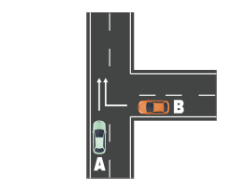
Which car stops?

Diagram for question 9 of Zimbabwe VID test paper 15
  1. ACar A
  2. BCar B
  3. CCar C
Show the answer

Answer: Car A

The two roads run into one here. From car A's seat, coming down the right hand road, car B is approaching from the right, and at a junction with no signs you give precedence to traffic from your right. So A stops and lets B in.

10.

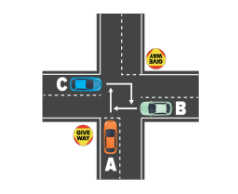
Which car moves last at this intersection?

Diagram for question 10 of Zimbabwe VID test paper 15
  1. ACar A
  2. BCar B
  3. CCar C
Show the answer

Answer: Car A

A GIVE WAY sign faces car A where its road joins the other one, so the road carrying cars B and C has priority. A must wait for the crossing traffic on both sides to clear, which makes A the last of the three to move.

11.

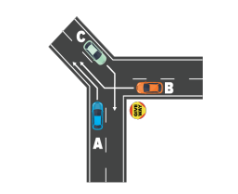
Which car goes last?

Diagram for question 11 of Zimbabwe VID test paper 15
  1. ACar C
  2. BCar B
  3. CCar A
Show the answer

Answer: Car B

The GIVE WAY sign stands where the road car B is on meets the others, so B is the one joining and must wait. Car A coming up from the bottom and car C coming down the diagonal are already on the through road, so B moves last.

12.

A clutch is used to

  1. AIncrease vehicle speed
  2. BDecrease vehicle speed
  3. CAvoid noise when gear changing.
Show the answer

Answer: Avoid noise when gear changing.

The clutch separates the engine from the gearbox so a gear can be selected without the teeth grating. It does not change your speed; the accelerator and the brakes do that.

13.

Converging lanes means

  1. ATwo lanes becoming one
  2. BOne lane becoming two
  3. CA road off a roundabout
Show the answer

Answer: Two lanes becoming one

Converging lanes are two lanes running into one. The traffic has to merge, so match your speed to the lane you are joining and leave a gap for the vehicle coming in beside you.

14.

Hazard perception means

  1. AFollowing directions of police officers
  2. BObeying traffic signals
  3. CReading a traffic situation in advance
Show the answer

Answer: Reading a traffic situation in advance

Hazard perception is reading the traffic ahead and working out what is about to go wrong before it does: the child at the kerb, the bus indicating, the lorry drifting wide. Obeying signals is following instruction, not seeing trouble early.

15.

When you see an animal in the road you

  1. AIncrease speed to run it over
  2. BReduce speed and stop when necessary
  3. CFlash your headlamps and hoot
Show the answer

Answer: Reduce speed and stop when necessary

Reduce speed and be ready to stop. An animal will turn back into the road, and where there is one there is usually a herd or a herder behind it, so give it room and time instead of pressing it with the horn or the lights.

16.

What is the incorrect sequence of a robot?

  1. AGreen, Red, Amber
  2. BAmber, Red, Green
  3. CRed, Green, Amber
Show the answer

Answer: Green, Red, Amber

A robot runs green, then amber, then red, then green again. Amber always sits between green and red to give you time to pull up, so a sequence that goes straight from green to red is the one that never happens.

17.

In an urban area, which car has the right of way?

Diagram for question 17 of Zimbabwe VID test paper 15
  1. ACar A
  2. BCar B
  3. CThe one which enters the intersection first
Show the answer

Answer: Car B

In town, at an intersection with no robot and no sign, precedence goes to the vehicle approaching from the road on your right. Car A is coming up the road and the orange car is joining from the road on A's right, turning right into A's lane. So A waits and Car B has the right of way.

18.

Animal drawn vehicles must always have

  1. AProper working headlights
  2. BWorking tail lights
  3. CReins and a leader
Show the answer

Answer: Reins and a leader

An animal drawn vehicle must have reins and a person leading the animals. Control of the animals is what keeps the cart out of other people's way, and lamps are not what the law asks of it.

19.

When stopping a motor vehicle on a road except in traffic, where will you stop?

  1. AOn the extreme right of the road
  2. BStop in the middle if it is safe to do so
  3. COn the extreme left of the road or in an authorized parking place
Show the answer

Answer: On the extreme left of the road or in an authorized parking place

Stop on the extreme left of the road, or in a place marked for parking, where you are out of the traffic stream and anyone coming up behind can pass. Stopping on the right leaves you against oncoming traffic.

20.

How far from a corner are you forbidden to stop your vehicle?

  1. A7m
  2. B7.5m
  3. C10m
Show the answer

Answer: 7m

You may not stop within 7 metres of a corner. A vehicle standing closer than that hides the traffic turning in, and forces everyone else to swing out around it just where the view is shortest.

21.

When under the influence of drugs or alcohol what must you do?

  1. ADrive slowly to a safe place
  2. BStay off the road
  3. CDrive on the extreme left of the road
Show the answer

Answer: Stay off the road

If you have been drinking or taking drugs, stay off the road. Alcohol slows your reactions and makes you think you are driving better than you are, so driving slowly or hugging the left does not make you any safer, and the offence is the same.

22.

The insignia of a command sign is:

  1. AA triangle
  2. BA rectangle
  3. CA circle
Show the answer

Answer: A circle

A command sign is a blue round sign. It tells you what you must do. A triangle carries a warning and a rectangle carries information, so the shape tells you what kind of instruction you are being given before you read it.

23.

On which side must you overtake animals which are being led:

  1. ALeft hand side
  2. BRight hand side
  3. CWhichever side is safe
Show the answer

Answer: Whichever side is safe

Pass led animals on whichever side is safe. Animals stray across the road and the person leading them may be on either side, so the usual rule about overtaking on the right does not fit. Go slowly, leave room, and do not hoot.

24.

What are the directions given by fixed or flashing amber robot at an intersection?

  1. AGive precedence to all cross traffic
  2. BGive precedence to all vehicles coming from the right
  3. CGive precedence to vehicles coming from the left
Show the answer

Answer: Give precedence to all vehicles coming from the right

A fixed or flashing amber robot means the junction is not being controlled, so the ordinary rule takes over: give precedence to traffic approaching from your right. Treat it as an unmarked intersection, not as a clear run through.

25.

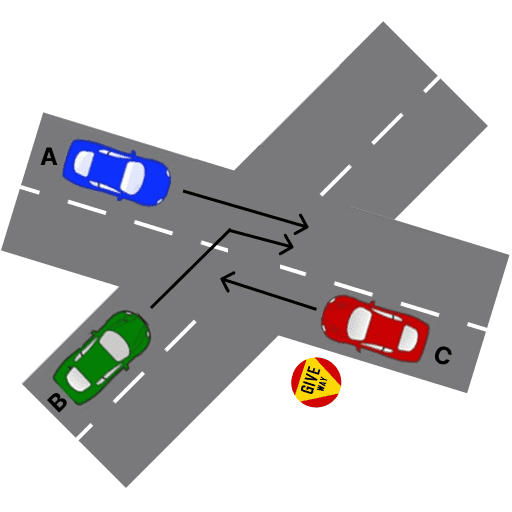
Which car goes first?

Diagram for question 25 of Zimbabwe VID test paper 15
  1. ACar A
  2. BCar B
  3. CCar C
Show the answer

Answer: Car B

A GIVE WAY sign faces car C where the road cars A and C are on meets the crossing road, and car B is also approaching from car A's right. Both A and C must give way, so car B goes first.

Practise on your phone

The app sets the same 16 papers, keeps every attempt, gathers the questions you keep missing into a revision set, and works with no network.