Provisional - Zimbabwe Highway Code, Road Signs & VID Test Prep & lessons

Test 14

Twenty five questions from the 2026 paper, in the order they are set. Read them with the answers, or practise the paper and have your answers marked.

Practise this paper online

Questions
25
Pass mark
22
Practise this paper

Marked at the end, then every answer is shown.

All 25 questions in Test 14

The paper as it is set. Open the fold under a question to read its answer and why that answer is right, or practise the paper and have your answers marked.

1.

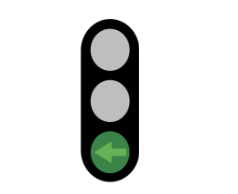
This traffic light regulates that:

Diagram for question 1 of Zimbabwe VID test paper 14
  1. ATraffic turning to the right may filter if the road is clear
  2. BTraffic turning to the left may filter if the road is clear
  3. CTraffic going straight may proceed if road is clear
Show the answer

Answer: Traffic turning to the left may filter if the road is clear

The red and amber lamps are dark and the bottom lamp shows a green arrow pointing left. An arrow releases only the movement it points to, so traffic turning left may filter when the road is clear. Anyone going straight on or turning right waits for the full green.
2.

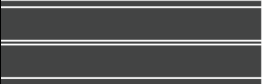
Which statement is true about Double Prohibition lines?

Diagram for question 2 of Zimbabwe VID test paper 14
  1. ANo vehicle may at anytime be driven on the left hand side of this line
  2. BCan not be crossed at anytime
  3. CNo vehicle may at anytime be driven on the right hand side of this line
Show the answer

Answer: No vehicle may at anytime be driven on the right hand side of this line

The picture shows two continuous white lines down the middle of the road. Such a marking says no vehicle may cross the lines or be driven to the right of them. Both hold, but what the double line is really ruling on is which side of it you may drive: you keep left of it at all times.

3.

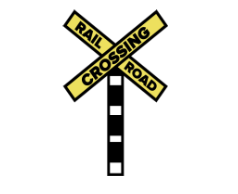
When approaching a level crossing, what must you do?

Diagram for question 3 of Zimbabwe VID test paper 14
  1. AIncrease speed
  2. BReduce speed and be ready to stop
  3. CMaintain speed
Show the answer

Answer: Reduce speed and be ready to stop

The yellow cross reading Rail Road Crossing on a black and white post marks a railway level crossing ahead. Reduce speed and be ready to stop: the crossing may have no gates or lights, and a train cannot stop for you.

4.

What is the maximum speed limit on wide tar roads?

  1. AThere is no maximum speed limit
  2. B100km/h
  3. C120km/h
Show the answer

Answer: 120km/h

The maximum on a wide tarred road outside a built up area is 120 km/h. It is a limit and not a target: rain, mist, load or traffic all mean a lower safe speed.

5.

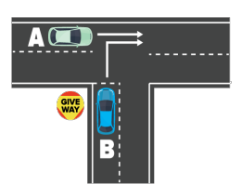
Which car stops?

Diagram for question 5 of Zimbabwe VID test paper 14
  1. AEither of the two
  2. BCar A
  3. CCar B
Show the answer

Answer: Car B

The blue car marked B is coming up the side road to the T junction and faces a give way sign on its approach. The green car marked A is already travelling along the main road across the top, so B stops and lets it go by.

6.

What is the general speed limit in an urban area?

  1. A40km/h
  2. B80km/h
  3. C60km/h
Show the answer

Answer: 60km/h

The general limit in an urban area is 60 km/h, and it applies whether or not a sign is showing. Where a school, a shopping street or roadworks needs less, a lower limit is posted.

7.

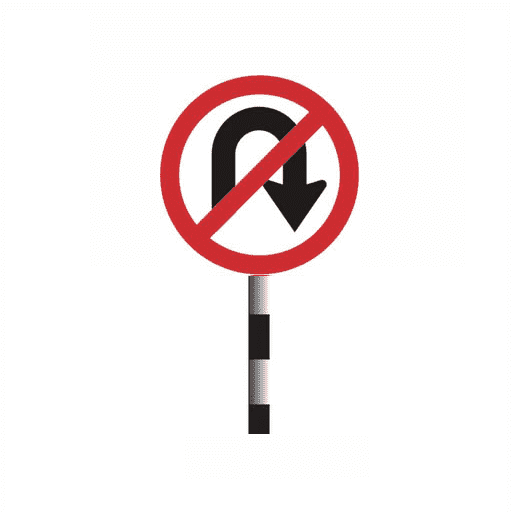
This sign regulates that:

Diagram for question 7 of Zimbabwe VID test paper 14
  1. AAn about turn is prohibited
  2. BRoundabout ahead
  3. CVehicles allowed to turn to the right only
Show the answer

Answer: An about turn is prohibited

A red circle with a red bar drawn across a U shaped arrow prohibits an about turn. You may not turn round there to face the way you came. Carry on and turn where the road allows it.

8.

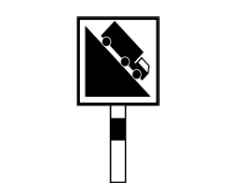
When approaching this sign I should:

Diagram for question 8 of Zimbabwe VID test paper 14
  1. ADisengage gears.
  2. BEngage high gear
  3. CEngage lower gear
Show the answer

Answer: Engage lower gear

The sign shows a lorry on a steep downward slope, warning of a steep descent. Engage a lower gear before you start down so the engine holds the vehicle back. Out of gear or in a high gear, the brakes do all the work, overheat and fade.

9.

When travelling behind another vehicle at night I must:

  1. ASwitch on my spot lights and sidelights
  2. BSwitch on dipped headlights
  3. CSwitch on my full beam
Show the answer

Answer: Switch on dipped headlights

Dipped headlights light your way without throwing a glare into the mirrors of the vehicle in front and dazzling its driver. Full beam is for an open road with nothing ahead of you.

10.

Which is the correct robot light sequence?

  1. AAmber, Red, Green
  2. BRed, Amber, Green
  3. CGreen, Red, Amber
Show the answer

Answer: Amber, Red, Green

The robot runs green, then amber, then red, then green again, so starting at amber the order is amber, red, green. Green never goes straight to red, and here red changes to green with no amber shown alongside it.

11.

A continuous white line in the centre of the road:

  1. AMay cross if there is no oncoming traffic
  2. BMay be crossed in a rural area and game parks
  3. CMay not be crossed under any circumstances.
Show the answer

Answer: May not be crossed under any circumstances.

A continuous white line down the centre is a barrier line. You stay to the left of it and do not cross it, whether the road ahead looks clear or not. It is painted where the view or the width of the road will not allow overtaking.

12.

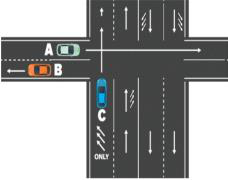
At this intersection which car would be breaking the law?

Diagram for question 12 of Zimbabwe VID test paper 14
  1. ACar B
  2. BCar C
  3. CCar A
Show the answer

Answer: Car C

The blue car marked C sits in the left hand lane of its road, painted with a left turn arrow and the word ONLY, yet its path arrow runs straight on through the intersection. A lane marked for one movement may be used for that movement and no other.

13.

Which of the following vehicles is not subject to carrying a fire extinguisher?

  1. AA pedal cycle
  2. BA motor vehicle which is not yet registered
  3. CA public service vehicle which is not carrying passengers
Show the answer

Answer: A pedal cycle

A pedal cycle is not a motor vehicle and carries no fuel or engine, so no extinguisher is required on it. An unregistered motor vehicle and a public service vehicle with no passengers in it must both still carry one.

14.

A motor vehicle towing two trailers should carry:

  1. A6 breakdown triangles
  2. B3 breakdown triangles
  3. C2 breakdown triangles
Show the answer

Answer: 6 breakdown triangles

Two triangles for the towing vehicle and two for each trailer, so a vehicle pulling two trailers carries six. The longer the combination, the more of the road it blocks when it breaks down and the more warning other drivers need.

15.

Breakdown triangles should be placed within

  1. A20 - 45 meters from the nearest point of the breakdown vehicle
  2. B30 - 50 meters from the nearest point of the breakdown vehicle
  3. C25 - 60 meters from the nearest point of the breakdown vehicle
Show the answer

Answer: 30 - 50 meters from the nearest point of the breakdown vehicle

Set the triangles between 30 and 50 metres from the nearest point of the vehicle, one ahead of it and one behind. Closer than that gives an approaching driver no room to slow down, and further off he will not connect the warning with your vehicle.

16.

To drive a Taxicab you must have reached at least the age of:

  1. ATwenty years and medically fit
  2. BTwenty-five years and medically fit
  3. CTwenty-one years and medically fit
Show the answer

Answer: Twenty-one years and medically fit

A taxicab driver must be at least twenty one and medically fit, because he carries paying passengers and needs the years of driving behind him before he takes on that responsibility.

17.

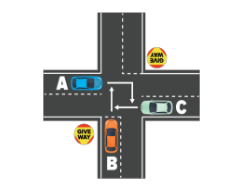
Which car moves SECOND at this intersection?

Diagram for question 17 of Zimbabwe VID test paper 14
  1. ACar A
  2. BCar C
  3. CCar B
Show the answer

Answer: Car A

The green car marked C is coming along the main road and going straight on, so it clears the intersection first. The blue car marked A is turning right across its path and must wait for it, which puts A second. The orange car marked B faces a give way sign on the side road and goes last.

18.

At a robot controlled intersection where you have stopped over pedestrian crossing lines, do you:

  1. AReverse the vehicle
  2. BStay where you are
  3. CDecide to carry on in order not to obstruct
Show the answer

Answer: Stay where you are

Stay where you are. Reversing at an intersection is dangerous and there may well be a vehicle right behind you, and moving forward takes you into the path of the traffic that now has the green. Wait for your green, then move off.

19.

When temporarily parked by the side of the road at night, one must leave:

  1. AYour headlights on bright beam
  2. BYour tail lights and side lights on.
  3. CYour headlamps on low beam
Show the answer

Answer: Your tail lights and side lights on.

Leave the tail lights and side lights burning so that a driver coming up behind sees the outline of a parked vehicle in time to steer round it. Headlights, dipped or bright, dazzle oncoming traffic and flatten your battery.

20.

When approaching an animal drawn vehicle:

  1. AYou blow your horn and pass quickly
  2. BYou flash your headlamps
  3. CYou slow down and pass through the safer side
Show the answer

Answer: You slow down and pass through the safer side

An animal drawn vehicle is slow and the animals shy at noise, so slow down and pass on whichever side gives you the most room and the driver the most warning. A hooter or flashed lights can bolt the team straight into your path.

21.

You may overtake:

  1. AOn a blind rise.
  2. BWhen there is a continuous white line
  3. CWhen there are two or more lanes going in the same direction
Show the answer

Answer: When there are two or more lanes going in the same direction

Where two or more lanes run in the same direction you can pass without entering the path of oncoming traffic. On a blind rise you cannot see what is coming, and a continuous white line may not be crossed, so overtaking is out in both cases.

22.

You may drive without a safety belt:

  1. AWhen you are driving slowly
  2. BWhen reversing
  3. CWhen you are driving very fast
Show the answer

Answer: When reversing

The belt may be off only while you are reversing, because you have to turn in the seat and look properly behind you. At every other time, at any speed, the belt goes on.

23.

The hooter is only used:

  1. AWhen there are animals in the road.
  2. BTo greet friends
  3. CWhen brakes suddenly fail and there is an accident danger.
Show the answer

Answer: When brakes suddenly fail and there is an accident danger.

The hooter is a warning of danger, such as brakes that have failed and no other way of stopping an accident. It is not a greeting, and sounded near animals it startles them into your path.

24.

A weight restriction is usually associated with

  1. ABridges capacity on weight
  2. BWet roads capacity on speed
  3. CStrip roads weight capacity
Show the answer

Answer: Bridges capacity on weight

A weight restriction is posted where a structure cannot carry more than a stated load, and that is almost always a bridge. Taking a heavier vehicle across risks bringing the bridge down under you.

25.

A blind spot on a road is a part of the road

  1. ANot covered by rear view mirror
  2. BWhere visibility is poor due to mist
  3. CDirectly in front of where the vehicle is moving towards
Show the answer

Answer: Not covered by rear view mirror

Your blind spot is the stretch of road the rear view and side mirrors do not show you, off to the side and a little behind. That is why you turn your head and look over your shoulder before you move out or change lanes.

Practise on your phone

The app sets the same 16 papers, keeps every attempt, gathers the questions you keep missing into a revision set, and works with no network.