Provisional - Zimbabwe Highway Code, Road Signs & VID Test Prep & lessons

Test 13

Twenty five questions from the 2026 paper, in the order they are set. Read them with the answers, or practise the paper and have your answers marked.

Practise this paper online

Questions
25
Pass mark
22
Practise this paper

Marked at the end, then every answer is shown.

All 25 questions in Test 13

The paper as it is set. Open the fold under a question to read its answer and why that answer is right, or practise the paper and have your answers marked.

1.

When a vehicle starts skidding, I should

  1. ABrake harder
  2. BIncrease speed
  3. CRelease brakes
Show the answer

Answer: Release brakes

Locked wheels cannot grip and cannot steer. Release the brakes so the wheels turn again, steer gently in the direction the back of the car is sliding, then slow down once the tyres have taken hold. Braking harder only keeps the wheels locked and the skid running.
2.

You are going to reverse but you are not sure the area is clear. You should

  1. AAssume it is clear and reverse anywhere
  2. BCheck only the rear view mirrors
  3. CGet out of the car and check
Show the answer

Answer: Get out of the car and check

The mirrors leave a large blind area directly behind the car, low enough to hide a small child or a bollard. If you are not certain the whole area is clear, get out and walk round the vehicle before you reverse.

3.

You come across stray animals on the road. You ..

  1. AFlash your headlights when passing
  2. BSound horn to alert them
  3. CDrive past slowly and give them plenty of room
Show the answer

Answer: Drive past slowly and give them plenty of room

Stray animals startle easily and can bolt into your path without warning. Pass slowly, leave plenty of room and be ready to stop. A hooter or flashed headlights frightens them and can send them under your wheels.

4.

When towing caravan trailers safest mirrors to use are?

  1. AExtended arm side mirrors
  2. BInterior wide angle mirrors
  3. COrdinary mirrors
Show the answer

Answer: Extended arm side mirrors

A caravan or trailer is wider than the car pulling it and fills the view in the ordinary mirrors. Extended arm side mirrors reach out past the load, so you can see the road behind and alongside the trailer before you turn or overtake.

5.

When overtaking a bike rider in windy weather give more room because

  1. AHe may accelerate
  2. BHe can be blown off course
  3. CHe may not see you
Show the answer

Answer: He can be blown off course

A gust of wind, or the wash of air off your own vehicle as you pass, can blow a rider sideways out of his line. Give him plenty of room so that a swerve of a metre still leaves him clear of you.

6.

To facilitate easy movement going uphill you have to

  1. ASelect lower gear
  2. BSelect highest gear
  3. CAccelerate
Show the answer

Answer: Select lower gear

A lower gear gives the wheels more pulling power, which is what a climb needs. In a high gear the engine labours and the car loses speed, and more accelerator will not make up for the wrong gear.

7.

Engine braking effect is felt when you

  1. ASelect low gear
  2. BSelect neutral
  3. CYou apply your handbrake
Show the answer

Answer: Select low gear

Engine braking is the drag of the engine working against the wheels. A low gear puts that drag to work and holds your speed down without touching the brakes. In neutral the engine is disconnected from the wheels, so there is no drag at all.

8.

When going down a long descent, keeping clutch down too long can cause

  1. AMore fuel consumption
  2. BBrake overheating
  3. CCar can loose control
Show the answer

Answer: Car can loose control

Holding the clutch down leaves you rolling along with the gears out. The engine no longer holds the vehicle back, so it gathers speed and you have neither the gears nor the engine to help you, which is how control is lost on a long descent. Stay in a low gear instead.

9.

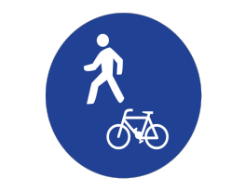
This sign indicates:

Diagram for question 9 of Zimbabwe VID test paper 13
  1. APortion of road is set aside for pedestrians and pedal cyclists
  2. BPortion of road set aside for motor cyclists and pedestrians
  3. CPedal cyclists and pedestrians should yield right of way
Show the answer

Answer: Portion of road is set aside for pedestrians and pedal cyclists

The blue circle shows a walking figure and a pedal cycle. A blue circle commands rather than warns, so it tells you that portion of the road is set aside for pedestrians and pedal cyclists. It asks nobody to yield.

10.

Labelling on abnormal load vehicle reads

  1. AAbnormal vehicle
  2. BAbnormal load
  3. CAbnormal size vehicle
Show the answer

Answer: Abnormal load

The boards carried front and rear read Abnormal Load, because it is the load that is out of the ordinary and not the vehicle under it. Hold well back from one: it may swing wide and take up more than its own lane.

11.

Abnormal load vehicles

  1. AMust have escort
  2. BMay not have escort
  3. CMust have red flash beacon light
Show the answer

Answer: Must have escort

An abnormal load is wider, longer or heavier than the road allows for, so it must travel with an escort that warns oncoming traffic and controls its passage. Follow the escort's directions and wait until it signals you past. Its beacon is amber, not red.

12.

You are waiting behind a cyclist at a traffic light. When it changes, you should..

  1. ABeep your hooter a drive through before the cyclist does
  2. BTry to move before the cyclist does
  3. CAllow cyclist room and time to move
Show the answer

Answer: Allow cyclist room and time to move

A cyclist needs a moment to get the pedals turning and he wobbles wide as he starts. Give him the room and the time to move off before you pull away. Hooting or pushing past forces him towards the kerb.

13.

The reaction distance increases because of ...

  1. AOld age
  2. BEngine speed
  3. CSpongy brakes
Show the answer

Answer: Old age

Reaction distance is the ground you cover between seeing the hazard and touching the brake. Age slows reactions, as do tiredness, alcohol and drugs. Worn or spongy brakes lengthen the braking distance instead, not the time you take to react.

14.

When approaching a traffic light that has been green for long

  1. AAccelerate quickly
  2. BMaintain your speed
  3. CBe prepared to stop
Show the answer

Answer: Be prepared to stop

A robot that has been green for a long time is close to changing. Ease off and be ready to stop rather than trying to beat the amber, or you reach the line with no room left to pull up safely.

15.

When should a cellphone be used during driving:

  1. AIn an emergency
  2. BWhen traffic density is low
  3. CNever
Show the answer

Answer: Never

A phone takes your mind off the road even when the traffic is light and even in a hands free cradle, so it is never used while the vehicle is moving. If a call has to be made, stop first in a safe and lawful place.

16.

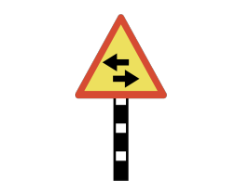
This sign warns of:

Diagram for question 16 of Zimbabwe VID test paper 13
  1. ADual carriageway ahead
  2. BTwo way carriageway
  3. COne way street
Show the answer

Answer: Two way carriageway

The red triangle carries two black arrows pointing in opposite directions, warning of a two way carriageway ahead: traffic runs both ways on the one road. On a dual carriageway the two directions are kept apart, so do not expect that here. Keep left and do not overtake blind.

17.

When meeting a breakdown vehicle flashing its beacon light every driver must

  1. APull off the road completely
  2. BKeep to the extreme left and pass as fast as possible
  3. CSlow down and proceed with caution.
Show the answer

Answer: Slow down and proceed with caution.

A flashing beacon means people and equipment are working close to the traffic. Slow down and pass with care, ready to stop if someone steps out. Pushing past at speed puts you nearest the men at work with no time to react.

18.

How many passengers are allowed to be carried in a vehicle being driven by a learner driver?

  1. ATwo
  2. BThe instructor and one other
  3. CNo passengers
Show the answer

Answer: No passengers

A learner may carry no passengers at all. The licensed driver who must sit beside you is there to supervise and is not counted as a passenger, and nobody else may ride with you until you hold a full licence.

19.

What should be remembered when approaching a pedestrian crossing?

  1. AMaintain constant speed
  2. BPay special attention to pedestrians
  3. CIncrease speed
Show the answer

Answer: Pay special attention to pedestrians

Pedestrians have the right of way on the crossing, and children and the elderly step out without looking. Approach slowly, watch the pavement on both sides and be ready to pull up short of the lines.

20.

At the age of 17 years a person can drive motor vehicles classes of

  1. AHeavy vehicles
  2. BLight motor vehicles
  3. CAgricultural tractors
Show the answer

Answer: Light motor vehicles

At seventeen a person may drive light motor vehicles, code B in the new system. The heavy classes, now the C codes, carry a higher minimum age, because the size of the vehicle and its load calls for more years of driving behind you.

21.

At night, in well lit areas, drivers should drive with

  1. AHeadlamps on high beam
  2. BSpot lights on
  3. CHeadlamps on low beam
Show the answer

Answer: Headlamps on low beam

Where the street lighting already shows up the road, low beam is enough and it keeps you from dazzling the drivers ahead of you and those coming towards you. High beam or spot lights in a lit street blind other road users.

22.

An accident has just happened, you being the first at the scene, what are you expected to do?

  1. ARender first aid and drive away
  2. BRender first aid and report to the nearest police
  3. CObserve from afar and phone the roads department.
Show the answer

Answer: Render first aid and report to the nearest police

The first driver on the scene must help the injured as far as he safely can and then report the accident at the nearest police station. Giving first aid and driving on leaves the accident unreported, which is an offence.

23.

When stopping a motor vehicle on a road except in traffic, where will you stop?

  1. AOn the extreme right of the road
  2. BStop in the middle if it is safe to do so
  3. COn the extreme left of the road or in an authorized parking place
Show the answer

Answer: On the extreme left of the road or in an authorized parking place

We drive on the left, so a vehicle you have stopped belongs on the extreme left of the road or in an authorised parking place, out of the traffic stream. Stopping on the right leaves you facing traffic that does not expect you.

24.

When following a heavy box body goods vehicle, avoid following closely so as.

  1. ATo avoid thrown litter
  2. BTo be seen by crossing animals
  3. CTo allow safe overtaking and to be visible
Show the answer

Answer: To allow safe overtaking and to be visible

A high box body blocks everything in front of it. Stay well back so you can see past it down the road, and so the lorry driver can see you in his mirrors. That is also the only way you get the view you need to overtake safely.

25.

...to move forward from behind a parked vehicle?

  1. AApply signal
  2. BUse all the mirrors, exercise caution and drive off.
  3. CJust check your blind spot
Show the answer

Answer: Use all the mirrors, exercise caution and drive off.

A parked vehicle hides you from traffic that is already moving. Use all the mirrors, check the blind spot over your shoulder and pull out slowly only when the road is clear. A signal on its own tells you nothing about what is coming.

Practise on your phone

The app sets the same 16 papers, keeps every attempt, gathers the questions you keep missing into a revision set, and works with no network.