Provisional - Zimbabwe Highway Code, Road Signs & VID Test Prep & lessons

Test 12

Twenty five questions from the 2026 paper, in the order they are set. Read them with the answers, or practise the paper and have your answers marked.

Practise this paper online

Questions
25
Pass mark
22
Practise this paper

Marked at the end, then every answer is shown.

All 25 questions in Test 12

The paper as it is set. Open the fold under a question to read its answer and why that answer is right, or practise the paper and have your answers marked.

1.

When you are temporarily parked by the side of the road at night, you are to leave

  1. AYour headlights on bright beam
  2. BYour tail lights and side lights on.
  3. CYour headlamps on low beam
Show the answer

Answer: Your tail lights and side lights on.

Parked at the roadside in the dark you leave the side lights and tail lights on, so a driver coming up behind picks the vehicle out without being blinded. Headlights, bright or dipped, dazzle oncoming traffic and flatten the battery.
2.

When approaching an animal drawn vehicle

  1. AYou blow your horn and pass quickly
  2. BYou flash your headlamps
  3. CYou slow down and pass through the safer side
Show the answer

Answer: You slow down and pass through the safer side

Animals startle. Slow right down, give the cart plenty of room and pass on the side with the most room and the best view, then pick up speed again. Hooting or flashing at the animals is exactly what puts them across the road.

3.

You may overtake

  1. AOn a blind rise.
  2. BWhen there is a continuous white line
  3. CWhen there are two or more lanes going in the same direction
Show the answer

Answer: When there are two or more lanes going in the same direction

Overtaking needs road you know is yours, and two or more lanes running the same way give you that. A blind rise hides whatever is coming, and a continuous white line means the road ahead is not clear enough to pass.

4.

You may drive without a safety belt

  1. AWhen you are driving slowly
  2. BWhen reversing
  3. CWhen you are driving very fast
Show the answer

Answer: When reversing

The belt comes off only while reversing, because you have to turn in the seat and look out through the back. Speed makes no difference to the rule: driving forwards at any speed, the belt stays on.

5.

The hooter is used:

  1. ATo greet friends
  2. BIn an emergency only
  3. CWhen there are animals in the road.
Show the answer

Answer: In an emergency only

The hooter is a warning of danger, for when there is no other way to prevent an accident. Greeting people with it is not what it is for, and blasting at animals in the road tends to send them the wrong way rather than off it.

6.

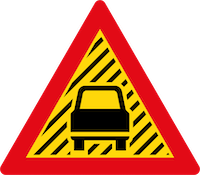
The sign indicates:

Diagram for question 6 of Zimbabwe VID test paper 12
  1. ARainy weather ahead
  2. BRainy area ahead
  3. CReduced visibility in the road ahead
Show the answer

Answer: Reduced visibility in the road ahead

The sign is a red bordered triangle on a yellow ground showing a car half lost behind slanting streaks: visibility on the road ahead is cut down, by mist, dust or spray. It warns about what you will be able to see, not about rain falling.

7.

When facing a red robot with an illuminated straight ahead Green arrow, I may:

  1. AProceed straight ahead
  2. BTurn right should I wish
  3. CNot proceed
Show the answer

Answer: Proceed straight ahead

A green arrow releases traffic in the one direction it points, and this one points straight ahead, so you may go straight through while the red is showing. The red still holds for every other movement, so a right turn is not allowed.

8.

We use heavy gears when

  1. AGoing uphill
  2. BIn muddy area only
  3. CStarting from rest only
Show the answer

Answer: Going uphill

Heavy gears are the low gears, where the engine turns fastest for the road speed and pulls hardest. That pull is what a climb needs. They are not for mud alone, and not only for moving off from rest.

9.

Which is not true if we need to save on fuel?

  1. AAvoid heavy gears
  2. BAvoid very high speeds
  3. CGears and speed have nothing to do with fuel consumption
Show the answer

Answer: Gears and speed have nothing to do with fuel consumption

Gears and speed decide how much fuel you burn: struggling in a heavy gear and running at very high speed both push consumption up. The statement that they have nothing to do with it is the wrong one.

10.

Vehicle pre-driving checks include

  1. AChecking rear view mirrors are properly adjusted
  2. BChecking underneath and around the vehicle for animals and children
  3. CMaking sure we have carried the registration book
Show the answer

Answer: Checking rear view mirrors are properly adjusted

Setting the mirrors before you move is part of the drill you do in the seat, with the doors, the seat and the belt. You cannot adjust and check what is behind you once the vehicle is rolling.

11.

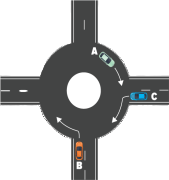
Which car(s) has/have the right of way in this traffic circle?

Diagram for question 11 of Zimbabwe VID test paper 12
  1. ACar A only
  2. BCar B only
  3. CBoth Car A and B
Show the answer

Answer: Both Car A and B

Car A is already in the circle, so it keeps its right of way. Car B, entering from the bottom, has nothing in the circle on its right and leaves by the first exit, so it may go as well. Car C must wait, because car A is coming round to leave by the very road car C is on.

12.

What must be avoided when raining?

  1. ADriving at high speed
  2. BReducing speed
  3. CSwitching on wipers
Show the answer

Answer: Driving at high speed

Speed is the thing to cut in the rain. Water lifts the tyres off the road surface and stopping distances stretch, so high speed is what must go. Slowing down and switching on the wipers are what you should be doing.

13.

In which circumstances would I proceed against a red robot?

  1. AWhen there is no approaching traffic
  2. BWhen the road is clear on the right
  3. CWhen the green arrow is illuminated
Show the answer

Answer: When the green arrow is illuminated

A red robot means stop, and the only exception is an illuminated green arrow, which releases traffic in the direction it points and nothing else. A clear road or no oncoming traffic gives you nothing while the red is showing.

14.

A broken yellow line on the left hand side of the road indicates:

  1. AIt may be straddled to overtake traffic which is turning right
  2. BIt may be straddled to overtake cyclists
  3. CIt may not be straddled
Show the answer

Answer: It may be straddled to overtake traffic which is turning right

The broken yellow line marks the edge lane on your left, and broken means it may be crossed. One proper use is to pass on the left of a vehicle that is held up in the lane waiting to turn right. It is not there for pushing past cyclists.

15.

A motor vehicle may tow

  1. AAny number of trailers
  2. BA vehicle of any size if it is able
  3. CA vehicle only if it has good brakes
Show the answer

Answer: A vehicle only if it has good brakes

The vehicle being towed must have brakes in working order, because the towing vehicle cannot stop both on its own. Number and size are limited too, so a string of trailers, or anything you happen to be able to pull, is not allowed.

16.

If involved in a serious accident, I must:

  1. AReport to the police within 24 hours
  2. BReport to a hospital or fire brigade
  3. CReport to the police within 48 hours
Show the answer

Answer: Report to the police within 24 hours

A serious accident is reported to the police within 24 hours, in person. A hospital or the fire brigade may treat and rescue but they do not take the report, and 48 hours is outside the limit.

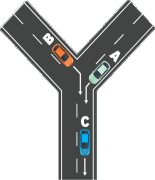
17.

Which car stops?

Diagram for question 17 of Zimbabwe VID test paper 12
  1. ACar A
  2. BCar B
  3. CCar C
Show the answer

Answer: Car A

The two roads merge into one here. Car B comes down the left hand road, which puts it on car A's right, and at a merge you give way to the right, so car A holds back and follows it in. Car C is already on the joined road, ahead of both of them.

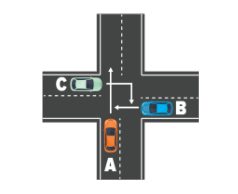
18.

Which car moves last at this intersection?

Diagram for question 18 of Zimbabwe VID test paper 12
  1. ACar C
  2. BCar B
  3. CCar A
Show the answer

Answer: Car A

Nothing controls this crossing, so give way to the right decides it. Car B is on car A's right and crosses first, and car C is turning right through the junction, which leaves car A, going straight ahead from the bottom, waiting and moving off last.

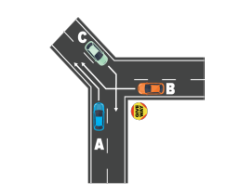
19.

Which car goes last?

Diagram for question 19 of Zimbabwe VID test paper 12
  1. ACar C
  2. BCar B
  3. CCar A
Show the answer

Answer: Car B

The give way sign at the corner faces car B, on the side road coming in from the right, so car B waits. Car A coming up the bottom road and car C coming down from the top left are both on the through road that bends round the corner, and they go first.

20.

A clutch is used to:

  1. AIncrease vehicle speed
  2. BDecrease vehicle speed
  3. CAvoid noise when gear changing.
Show the answer

Answer: Avoid noise when gear changing.

The clutch separates the engine from the gearbox so a gear can be selected without the gears clashing and grinding. It does not make the vehicle faster or slower; the accelerator and the brakes do that.

21.

Diverging lanes means

  1. ATwo lanes becoming one
  2. BOne lane becoming two
  3. CA road off a roundabout
Show the answer

Answer: One lane becoming two

Diverging means splitting: one lane opens into two and you pick one and keep to it. Two lanes becoming one is merging, which is the opposite.

22.

Hazard perception means

  1. AFollowing directions of police officers
  2. BObeying traffic signals
  3. CReading a traffic situation in advance
Show the answer

Answer: Reading a traffic situation in advance

Hazard perception is reading the road ahead and working out what may go wrong before it does: the child near the kerb, the bus about to pull out. Obeying signals is a separate duty and it warns you of nothing.

23.

When you see a rabbit crossing the road in the rural areas, you:

  1. AIncrease speed to run it over
  2. BReduce speed and stop when necessary
  3. CFlash your headlamps and hoot
Show the answer

Answer: Reduce speed and stop when necessary

Slow down and be ready to stop. Where one animal has crossed there are often more, and at speed the swerve or the hard braking is what turns it into a crash. Never drive at an animal, and hooting can send it back under your wheels.

24.

A weight restriction is usually associated with

  1. ABridges capacity on weight
  2. BWet roads capacity on speed
  3. CStrip roads
Show the answer

Answer: Bridges capacity on weight

A weight restriction states what a structure can carry, and it is nearly always a bridge. A vehicle whose loaded mass is over the figure shown must find another route, or the bridge is what fails.

25.

A blind spot on a road is a part of the road

  1. ADirectly in front of where the vehicle is moving towards
  2. BNot covered by rear view mirror
  3. CWhere visibility is poor due to mist
Show the answer

Answer: Not covered by rear view mirror

A blind spot is the piece of road your mirrors do not show you, generally just behind and to the side of the vehicle. That is why you glance over your shoulder before moving off, changing lane or turning.

Practise on your phone

The app sets the same 16 papers, keeps every attempt, gathers the questions you keep missing into a revision set, and works with no network.