Provisional - Zimbabwe Highway Code, Road Signs & VID Test Prep & lessons

Test 11

Twenty five questions from the 2026 paper, in the order they are set. Read them with the answers, or practise the paper and have your answers marked.

Practise this paper online

Questions
25
Pass mark
22
Practise this paper

Marked at the end, then every answer is shown.

All 25 questions in Test 11

The paper as it is set. Open the fold under a question to read its answer and why that answer is right, or practise the paper and have your answers marked.

1.

Which statement is not true?

  1. AAll road tests in Zimbabwe are strictly with manual vehicle
  2. BHeavy vehicles must have a net mass of 5000kg and above for road test purpose
  3. CDual footbrake pedals may be required for driving school vehicles
Show the answer

Answer: All road tests in Zimbabwe are strictly with manual vehicle

A test may be taken in an automatic vehicle, the licence then being restricted to automatics, so the claim that every road test uses a manual is the wrong one. The 5000kg net mass for a heavy vehicle test and the dual footbrake fitted to driving school cars are both correct.
2.

When approaching a give way sign:

  1. AI am obliged to stop before proceeding
  2. BI am obliged to give way to traffic approaching the intersection on my right only
  3. CI may proceed with caution and without stopping provided there is no other approaching traffic
Show the answer

Answer: I may proceed with caution and without stopping provided there is no other approaching traffic

A give way sign does not order you to stop. Slow down, look, and if nothing is coming you may carry on without stopping. It is not only traffic from your right that counts: you give way to everything already on the road you are joining.

3.

Which statement is true?

  1. APedestrians enjoy right of way only at a pedestrian crossing
  2. BA person pushing a wheelbarrow is a motorist
  3. CAll motorists must be courteous to the old, disabled and children when using the roads
Show the answer

Answer: All motorists must be courteous to the old, disabled and children when using the roads

The Code asks every driver for courtesy and consideration towards other road users, and puts a special responsibility on the driver towards those with little protection, so courtesy to the old, the disabled and children is required of all motorists. A person pushing a wheelbarrow is a pedestrian, not a motorist.

4.

In rural areas where traffic is not controlled, I should give precedence to:

  1. ATraffic approaching from the road on the left
  2. BTraffic approaching from the road on the right
  3. CTraffic already in the intersection regardless of which side it is coming from.
Show the answer

Answer: Traffic already in the intersection regardless of which side it is coming from.

A vehicle already in the intersection has committed itself and everyone else waits, whichever side it came from. Only once the intersection is clear does the give way to the right rule decide who enters next.

5.

During rainy weather

  1. AMake sure a vehicle is fitted with good tyres
  2. BGood hand brake is important
  3. CInternal lights need to be functioning properly
Show the answer

Answer: Make sure a vehicle is fitted with good tyres

Wet roads come down to grip. Tyres with proper tread cut through the water and hold the road, while worn tyres let the vehicle slide or aquaplane. The handbrake and the interior lights do nothing for grip in the rain.

6.

When approaching a narrow bridge, I must pay attention to:

  1. AHeight restriction
  2. BLength restriction
  3. CWidth restriction
Show the answer

Answer: Width restriction

A narrow bridge is narrow, so width is what matters: whether two vehicles can pass on it at all, and how wide your own vehicle or load is. Height limits belong to structures you drive under, not to a bridge you drive across.

7.

Whilst driving when do you take a mobile phone call?

  1. AOnce you have stopped in a legally permitted place
  2. BWhilst travelling in rural areas which do not have much traffic
  3. CIf you are confident that your ability will not be compromised by the distraction
Show the answer

Answer: Once you have stopped in a legally permitted place

A call is taken only after you have pulled up somewhere it is legal to stop. Using a hand held phone while the vehicle is moving is an offence, and an empty rural road changes nothing: the danger is the distraction, not the amount of traffic.

8.

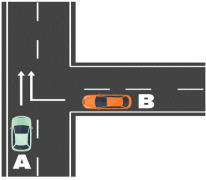
Which car stops?

Diagram for question 8 of Zimbabwe VID test paper 11
  1. ACar B
  2. BCar A
Show the answer

Answer: Car B

The road Car B is on is the narrow one that ends at this T junction, and joining a bigger road from a small one means giving precedence to all the traffic on it. B is turning right, so it has to cross into the very lane the green car is coming up. Car B is the one that stops.

9.

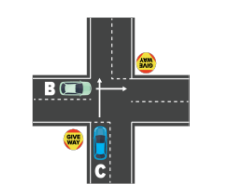
Which car is breaking the law if both are moving?

Diagram for question 9 of Zimbabwe VID test paper 11
  1. ACar B
  2. BCar C
  3. CBoth cars
Show the answer

Answer: Car C

Both give way signs face the road running from top to bottom, the road car C is on, which makes the road car B is crossing on the priority road. Car C must wait for car B, so a car C that is moving is the one breaking the law.

10.

A car sun visor provides a shield against

  1. ASun glare
  2. BStreet lights
  3. CRain
Show the answer

Answer: Sun glare

A sun visor folds down to block low sun from your eyes, mostly early morning and late afternoon when the sun sits straight ahead of you. It does nothing about rain, and it is not there for street lights.

11.

In which of the following situations should you never overtake cyclists?

  1. AWhen approaching right hand bend
  2. BImmediately before making a left turn
  3. COn approach to a round about
Show the answer

Answer: Immediately before making a left turn

Never overtake a cyclist just before turning left: you would pass and then cut straight across the line the cyclist is riding on. Hold back, let the cyclist go on, and turn behind them.

12.

When in a straight ahead lane at an intersection I am not allowed to:

  1. ATurn without indicating
  2. BTurn at all
  3. CTurn without checking blind spots
  4. DTurn without requesting
Show the answer

Answer: Turn at all

The lane you are in decides your direction. A straight ahead lane means straight ahead only, so no turn is allowed out of it, indicated or not. If you need to turn, move into the turning lane in good time.

13.

On approaching a narrow bridge I am allowed to

  1. AFlash my lights even for oncoming vehicles
  2. BOvertake slow moving vehicles
  3. CSlow down and proceed with caution.
Show the answer

Answer: Slow down and proceed with caution.

A narrow bridge takes one vehicle at a time or leaves very little room, so you slow down, look for anything already on it and cross with care. Overtaking on or near it is out, and flashing your lights decides nothing about who has the room.

14.

A speed restriction sign means:

  1. ADo not exceed the stated speed
  2. BDrive below the stated speed
  3. CWatch out for the police
Show the answer

Answer: Do not exceed the stated speed

A speed restriction sign states the maximum. You may drive at that speed or below it when conditions allow, but never above it. It is not an instruction to drive very slowly, and it applies whether or not there is a police officer about.

15.

When I intend to stop on the road I must:

  1. ACheck blind spots and brake hard
  2. BFlash my hazard lights
  3. CSlow down, check the rear view mirror, pull off the road and stop
Show the answer

Answer: Slow down, check the rear view mirror, pull off the road and stop

Stopping is planned, not sudden: check the mirror, signal, slow down, pull right off the road and stop clear of the traffic lane. Braking hard in the lane invites the vehicle behind into your boot, and hazard lights do not give you the road.

16.

At a rail level crossing with open booms a heavy vehicle driver should

  1. AQuickly cross the railway
  2. BStop, look both sides and cross when safe
  3. CStop and look to the right
Show the answer

Answer: Stop, look both sides and cross when safe

Open booms do not clear a heavy vehicle. It stops short of the rails, looks along the line in both directions, and crosses only when it can get right over without having to stop, because a heavy vehicle is slow to clear a crossing.

17.

The purpose of the parking brake is to

  1. AKeep the vehicle stationary
  2. BKeep the vehicle stationary on a gradient only
  3. CSlow the vehicle down
Show the answer

Answer: Keep the vehicle stationary

The parking brake holds a stopped vehicle still, on level ground as much as on a slope. It is not a brake for slowing down while you are moving; the footbrake does that.

18.

At a pedestrian crossing every driver must

  1. AWave the pedestrians through
  2. BHoot when it is his turn to go
  3. CWait patiently and proceed when appropriate
Show the answer

Answer: Wait patiently and proceed when appropriate

At a pedestrian crossing the pedestrian has right of way. Wait behind the line until the crossing is clear, then move off. Waving people across or hooting at them hurries someone into the path of a vehicle you cannot see.

19.

Fog lights are to be used

  1. AIn dusty areas only
  2. BIn heavy mist
  3. CAt night
Show the answer

Answer: In heavy mist

Fog lights are for the times visibility collapses, in heavy mist or fog, when headlights alone are thrown back at you. They are not general night lights, and left on in clear air they dazzle the drivers around you.

20.

A 'one way' sign is a

  1. AWarning sign
  2. BDanger sign
  3. CCommand sign
Show the answer

Answer: Command sign

Command signs tell you what you must do, and a one way sign commands the direction of travel on that road. Warning and danger signs only alert you to something ahead; this one leaves you no choice.

21.

All vehicles shall have

  1. ARed reflectors in front
  2. BWhite reflectors in front
  3. CEither red or white reflectors in front
Show the answer

Answer: White reflectors in front

Reflectors are white at the front and red at the rear, so a driver can tell in the dark which way a stationary vehicle is facing. Red showing towards you means you are looking at the back of a vehicle.

22.

When driving a motor vehicle at 06.00am the vehicle must have its headlights lit.

  1. AYes
  2. BNo
  3. CDepends on day light
Show the answer

Answer: Yes

The Code says you must have your headlights on between 5.30pm and 6.30am, and 06.00 falls inside that stretch, so they must be lit. The rule runs on the clock, not on how light you judge the morning to be.

23.

In a traffic circle, I shall indicate

  1. AWhen going out
  2. BWhen going in
  3. CWhen making a 'U' turn
Show the answer

Answer: When going out

You indicate left as you come to your exit, so the drivers waiting to enter can see the gap coming. Going in needs no signal, because traffic in a circle can only travel one way round it.

24.

A vehicle turning right should

  1. AGive way to window shopping pedestrians
  2. BGive way to oncoming traffic
  3. CGive way to pedestrians standing on the pavement.
Show the answer

Answer: Give way to oncoming traffic

Turning right takes you across the path of everything coming the other way, so you wait for oncoming traffic and turn only in a clear gap. Pedestrians on the pavement or at a shop window are not in your path.

Practise on your phone

The app sets the same 16 papers, keeps every attempt, gathers the questions you keep missing into a revision set, and works with no network.