Intersections, and which kind you are at
An intersection is a point where two or more roads meet, and every question about one turns on the same first step: decide which kind it is. Controlled or uncontrolled, and the rest follows.
What the test asks
Which car goes at an uncontrolled crossroads, who goes first at a four way stop, what you give precedence to in a rural area, what happens at a traffic circle and when you signal in one, whether you may overtake at a junction, and whether you may ever be inside one with nowhere to go.
Controlled: a robot, a sign or an officer
A controlled intersection is governed by something: a robot, a stop or give way sign, or a police officer. You do what the control says, and the order the cars go in is settled before you look at the shape of the junction. Turning left or right at one does not give you the crossing: you still give way to people walking across the road you are turning into.
A red light or a stop sign gives nobody a right of way. It takes rights away from the traffic facing it, which is not the same thing, and it is why the Code tells you to approach every intersection as though no one has right of way.
The Code's own drill for an intersection is four words: know, slow, show and go. Know what is there, slow enough to act on it, show what you intend, then go.
The four way stop
Every driver stops, and the first to stop is the first to go. It does not matter which side they came from. You stay stopped until every vehicle that stopped before you has cleared the junction.
If the stop sign has no line painted with it, stop as close to the intersection as you safely can. If you have already stopped for somebody on a pedestrian crossing before the line, you still stop again at the line.
Uncontrolled: the road on your right
An uncontrolled intersection has none of those. Nothing tells anyone to wait, so the road itself decides, and the six rules in the note on car diagrams are how you work it out. The first of them is the whole of the law in one line: give way to traffic coming from the road on your right, cycles included.
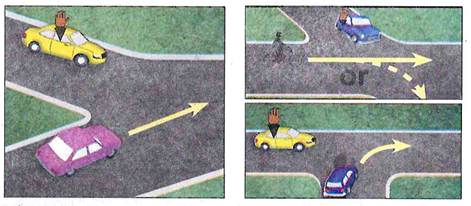 Giving precedence at an intersection, and the arm signal that says you are slowing for it.
Coming out of a minor road onto a major one, give precedence to all the cross traffic, whichever side it is on.
Traffic circles
A traffic circle is its own case. Traffic already going round has absolute priority, so you give way on the way in. That does not mean waiting for the circle to empty: you may enter ahead of a circulating vehicle as long as you do not get in its way or make its driver brake.
You signal on the way out, just after you pass the exit before the one you want.
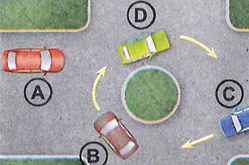 Four cars at a traffic circle, and the way the traffic in it runs.
A traffic circle turns clockwise, because we keep left. Green Car A waits for orange Car B, which is already going round, then enters bearing left and signals left to leave.
The Y junction
A Y junction has no road on anyone's right in the ordinary sense, because the roads meet at an angle. Read it as the road that continues straight having precedence over the road that joins it.
Where two roads join into one, a driver joining gives way to the traffic already on the road. Orange Car B comes down the left hand road and waits while blue Car C, coming up from the bottom, turns off into it, then Car B joins the road going down.
In a rural area
Where an intersection outside town is uncontrolled, the papers ask you to give precedence to traffic already in the intersection, whichever side it is coming from. That sits on top of the rule, it does not replace it: give way to the road on your right decides who may enter, and a vehicle already inside is let out first.
Blocking a junction, and overtaking in one
You may block an intersection under no circumstances. If the road beyond is full, you wait behind the line until there is room to cross the whole thing in one movement. Where a junction is painted as a box, the rule is written on the road: do not enter until your exit is clear.
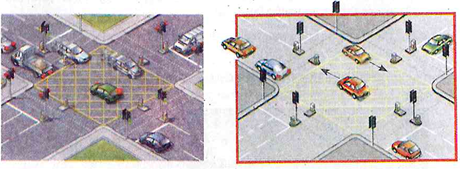 At a box junction you do not enter until the road you are leaving by is clear.
Overtaking at a junction is dangerous because your view is blocked, and it is an offence, with three exceptions the papers ask about: the side road is controlled by a stop or give way sign and your road has more than two lanes; the traffic is being directed by a robot or a police officer; or the other driver has signalled that they are turning.
The mistakes learners make
Deciding who arrived first, at a junction where nobody stopped, answers a different question from the one being asked. Treating a traffic circle as a crossroads and looking only to the right misses the traffic already going round, which has priority over everything. And entering a junction you cannot leave is an offence even when the lights were green when you started.