Before you set off
The checks come before the key, and the papers ask about them because this is where the cheap collisions happen. Most of them cost nothing but a walk round the vehicle and a turn of the head.
What the test asks
What you do before you set the vehicle in motion, what a pre driving check covers, what a blind spot is, what you do when you cannot see behind you, which papers the vehicle carries, how much free play a steering wheel may have, and who has to wear a safety belt.
Look around and under the vehicle
Make it a habit never to set the vehicle in motion until you have looked around it and under it. Children and small animals sit where you cannot see them from the seat, and nothing you do afterwards recovers from setting off over one.
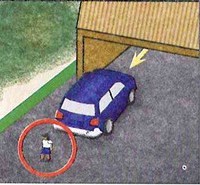 Look around and under the vehicle before you move it.
Then do not drive onto the road until it is clear, or until you are sure you can join it without putting anyone else in difficulty.
The seat, the mirrors and the blind spot
Adjust the seat before anything else, so you can reach the pedals and the wheel properly, and adjust the mirrors after it. A pre driving check that the papers ask about by name is that the rear view mirrors are properly set.
The blind spot is the part of the road beside you that no mirror covers, and the only way to check it is to turn your head. It appears in the lane change drill, in the pull away drill, and in the question about what a blind spot actually is.
Reversing
Avoid it where you can, and never reverse into a busy road. Before you reverse, use all the mirrors, check the blind spots, and look for people, cyclists and anything else behind you. Reverse slowly, looking mainly through the rear window, and remember the front of the vehicle swings out as you turn.
If you are not sure the space behind you is clear, the answer the papers want is the plain one: get out of the vehicle and look.
The papers the vehicle carries
Registration book, insurance and vehicle licence, before it goes on a public road at all. A vehicle used to teach learners carries a certificate of fitness and comprehensive insurance on top of that.
The vehicle itself
Steering with more than 45 degrees of free play is faulty steering and the vehicle should not be driven; the backlash should stay inside about an eighth of the steering wheel's travel. Brakes must be effective, the hooter must work, the lights and indicators must all light, and the windscreen and wipers must leave you a clear view.
Tyres need tread and the right pressure. In the rains they are the whole of your grip, and worn tread on a wet road is the most common reason a car goes straight on where the driver turned. Under inflated tyres show up first in the braking, and pressure is worth checking after a long run and before you set off loaded.
Before a long journey, check fuel, oil, water and the tyres together, and raise the pressure to what the maker recommends if the vehicle is fully loaded.
Passengers and belts
Everyone wears a safety belt where one is fitted, and the driver is responsible for seeing that a child does. The exemptions the papers ask about are narrow: a driver while reversing, an instructor while giving a lesson, an ambulance driver in the course of their work, and a holder of a medical exemption certificate. A learner carries no passengers at all.
A baby travels in a proper restraint fitted to an anchorage point made for it. Passengers are generally not carried in a goods vehicle, and where they are permitted, they stay seated and under control while the vehicle is moving. No one rides on a bumper, a bonnet, a mudguard or the side.
The mistakes learners make
Adjusting the mirrors after moving off is the wrong order, and so is checking the blind spot with a mirror. When the question says you are not sure the road behind is clear, the answer is to get out and look, not to reverse slowly and hope. And a vehicle without its registration book, insurance and licence is not roadworthy in the sense the papers mean, however well it drives.