When something goes wrong
A brake failure, a burst tyre, a skid, a breakdown and a collision each have one answer the papers accept. They are worth learning as a set, because they come up as single questions and the wrong answer is usually the one that feels natural.
What the test asks
What you do when the brakes fail, when a tyre bursts, when the vehicle skids, when you are dazzled, when the road ahead is under water, when you break down, and when you have been in a collision. First aid comes up too, and the answer there is narrow.
The brakes fail
Sound the horn to warn everyone around you, change down through the gears to let the engine slow you, and pull the handbrake up slowly rather than all at once. This is one of the two times the papers allow the horn: warning another road user, and an emergency such as this one.
A tyre bursts
Hold the wheel straight and do not brake. Braking a vehicle that is already unbalanced is what turns a burst into a spin. Slow gradually and pull off when you have control. That answer is the same for a rear wheel as for a front one.
The vehicle skids
Come off the brakes and steer into the skid. A locked wheel steers nothing. The most common cause of a skid is worn tyres, which is why the tyre check belongs in the same head as the skid answer.
Heavy braking on a wet road is what starts most of them. In wet weather the vehicle takes longer and further to stop, so the gap in front doubles and the speed comes down before the corner rather than in it.
You are dazzled
Slow down, look at the left edge of the road rather than at the lights, and stop if you cannot see. You may flick your own lights once to remind the other driver. You never answer main beam with main beam.
Water on the road
A flooded bridge or drift is not attempted. You cannot see what the water has done to the surface underneath, and there is no way to find out from the driving seat. Where you have driven through standing water, test the brakes gently before you rely on them again.
Going down a long hill
Select a low gear and use the brakes carefully, so the engine holds the vehicle back. Sitting with the clutch down through a long descent leaves the vehicle rolling with nothing driving it, and that is how control goes. The same gear that helps you up a hill helps you down it.
A breakdown
Get the vehicle off the road if you can, put the hazard lights on, and set a warning triangle 30 m to 50 m behind it and another the same distance in front. Both stand on the same side of the road as the vehicle. The red reflective triangle is the warning sign for a broken down vehicle, and it is what the question is asking for by name.
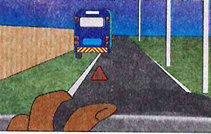 The warning triangle stands on the road behind the vehicle, 30 m to 50 m back.
Meeting a breakdown vehicle with its beacon flashing, slow down and go past with care.
A collision
Stop immediately. See whether anyone has been killed or injured, and give what help you can. Give your name and address, and the owner's, to anyone with reason to ask. If for any reason you cannot, report it to the police as soon as you reasonably can, and in any case within twenty four hours, at the station nearest to where it happened.
Being first at the scene, the papers want two things: give first aid and report it to the nearest police.
Someone is injured
Warm and reassure them, and leave them where they are. Do not move a casualty, do not take a motorcyclist's helmet off, and give them nothing to eat or drink. Where somebody is unconscious, check that they are breathing clearly. If you are trained, work through danger, response, airway, breathing, compressions.
The mistakes learners make
Braking is the instinct in a burst and a skid, and it is wrong in both. Moving an injured person to a more comfortable place is the kind thing to do and the wrong thing to do. And a collision reported the next week is a collision not reported: the limit is twenty four hours.