Turning, changing lane, pulling off
Every manoeuvre in the test is the same short routine, and the order of the steps is what is being marked. Look, tell people, then move, and never in a different order.
What the test asks
The order of the steps for a turn, for a lane change and for pulling off, how far ahead you signal, where you position the vehicle for each turn, which side you overtake on and the exceptions to it, and the list of places where you may not overtake at all.
Turning
Mirror, signal, slow down, select the gear, then turn. The signal goes on early enough to be useful: at least 50 m in town and 100 m on a main road. You never change direction until you have signalled your intention and made sure the road is clear.
Changing lane
The Code's drill is mirror, blind spot, signal, then move. The blind spot is the part of the road beside you that your mirrors do not cover, and the only way to see it is to turn your head. Where a paper leaves the mirror out of the options it is still asking the same thing: you look before you signal, and the move comes last.
Choose the lane for your route early and stay in it. Do not cut from one lane to another because the traffic in yours has slowed. Where two lanes become one, the vehicle that has to cross the lane line is the one that gives way.
Pulling off and stopping
Pulling off from the kerb: mirror, blind spot, signal, then move off when there is a gap. The last thing you do before you move is look over your shoulder. Coming back in to stop: mirror, signal, slow down, pull off the road and stop.
Where you sit for a turn
Turning left, keep well to the left and turn into the near lane of the road you are entering. Turning right, move as far right as the markings allow within your own lane, and wait for a gap rather than blocking the junction.
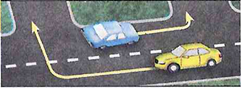 The correct position for each turn: well left for a left turn, far right within your lane for a right one.
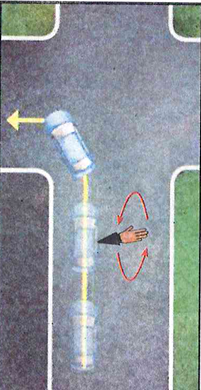 Turning left: well over to the left, with the arm signal for the turn.
Turning right, you give way to oncoming traffic going straight on. That rule does not bend for anything.
Overtaking, and the two exceptions
Overtaking is on the right. There are two exceptions: your side of the road has two or more lanes, or the driver ahead has signalled a right turn. In both you may pass on the left, and in neither may you assume it is safe.
Even then, you may not pass on the left if it means using the shoulder of the road, or moving into a lane that is not fully clear.
Before you pull out: see that the road ahead is clear, take the lane changing steps, let the driver ahead know you are there, and satisfy yourself you can get past without an unreasonable speed. Never assume the driver ahead will slow down for you. Get past, then ease back to the left once you can see the vehicle you passed in your mirror.
Where you never overtake
At a junction, on a bend, on a blind rise, at a pedestrian crossing, at a level crossing, on or approaching a bridge or a tunnel, where the road narrows, in poor visibility, behind a vehicle that has stopped to let people cross, and wherever the line on your side is continuous. Each of those is a place where the road you would need is a road you cannot see.
There is one more that catches people out: never overtake a cyclist immediately before you turn left, because you will be turning across the wheel you have just passed.
The mistakes learners make
Signalling and then looking is the wrong way round, and it is the order most often chosen. Moving into the right hand lane by crossing an unbroken lane line is an offence even when the turn ahead is a right turn. And speeding up while someone is overtaking you is itself an offence, not a defence of your place in the queue.