Stopping and parking
Where you leave a vehicle is examined as closely as how you drive it. Two things carry most of the marks: how far back from a corner you stop, and the fact that you stop at the extreme left of the road.
What the test asks
How close to a corner you may park, where on the road you stop, the order of the steps you take when stopping, which way the front wheels point on a hill, where a vehicle may never be left, and what the parking brake is for.
How far from a corner
7.5 m from a corner is the figure to hold. Closer than that and your vehicle hides traffic turning in and blocks the view of anyone coming out, which is why the distance is set rather than left to judgement. One paper prints the figure as 7 m and another offers every version at once, so keeping 7.5 m as the habit answers all of them.
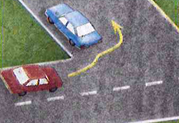 Parking near a corner hides the traffic turning in and the driver coming out.
Where you stop
At the extreme left of the road, in the direction of travel, or in a marked parking place. Never on the right hand side of the road at night. Where the road has double dividing lines down the middle, keep at least 3 m clear of them.
How you stop
Slow down, check the mirror, signal your intention, pull off the road and stop. The signal comes early enough to be useful to the driver behind you, and the papers mark the order as much as the steps. Do not stop suddenly except in an emergency.
Leave the vehicle in gear with the handbrake on. The parking brake has one job, which is to keep the vehicle standing still, and it is not a way of slowing down.
On a hill
Point the front wheels so that a vehicle that rolls goes into the kerb rather than into the road.
- Facing downhill: wheels turned towards the kerb, reverse gear selected, handbrake on.
- Facing uphill: wheels turned away from the kerb, first gear selected, handbrake on.
The gear is part of the answer in both cases. A vehicle left in neutral on a slope is held by the handbrake alone.
Where you may never leave a vehicle
- on or near an intersection or a corner,
- on a bridge, in a subway or on a blind rise,
- at or near a pedestrian crossing or a bus stop,
- alongside a traffic refuge, road works, or another stationary vehicle,
- where it would obstruct traffic or hide a traffic sign,
- on a continuous yellow line, or where it would block a fire hydrant or a driveway,
- on the carriageway of any road outside an urban area.
You also may not leave a parked vehicle unattended with the engine running.
Getting out
Check the mirrors and the blind spot before you open the door, and get out on the near side where you can. A door opened into a cyclist is one of the commonest crashes in town, and it is always the door's fault.
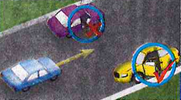 Get out on the near side, and only once you are sure the road beside you is clear.
Pulling away again is the same drill in reverse: mirrors, the blind spot, the signal, then move when there is a gap. Moving off from behind a parked vehicle means using every mirror you have, because the road you are joining is the road that vehicle was hiding.
The mistakes learners make
Wheels turned the wrong way on a hill is the classic one: facing downhill the wheels point at the kerb, so the vehicle rolls into it and stops. Parking on a bend for a minute is still parking on a bend. And a vehicle parked on the right hand side of the road at night is facing the wrong way and shows the wrong colour reflectors to everyone coming towards it.