Reflectors, kit and the vehicle
Reflectors are read as a colour code, and the colour tells another driver which end of a vehicle they are looking at. White is a front, red is a back, and yellow along the side belongs to something long.
What the test asks
What colour reflectors a vehicle carries and where, what a heavy vehicle carries that a car does not, which vehicles are excused a fire extinguisher and a reverse gear, what a motorcycle needs before it takes a passenger, what is fitted when you tow, how much free play a steering wheel may have, and what uneven tyre wear is telling you.
The colour code
- A light motor vehicle carries two: white at the front and red at the back.
- A heavy vehicle carries three: white reflective strips at the front, yellow strips along the sides, and a red and yellow chevron at the rear.
- A bus has side lights of its own, so it does not carry the yellow side reflectors.
- A motorcycle carries white at the front and red at the back, and a red reflector with its stop light and indicators.
- An animal drawn vehicle carries two white reflectors at the front and red at the rear, and the person driving it wears reflectors too.
Any load that sticks out behind the vehicle is marked with a red cloth by day and a red lamp or red reflective material at night.
The motorcycle
A pillion seat and footrests must be fitted before it carries a passenger, and a helmet is worn by both rider and passenger. One passenger on the pillion, two in a side car. It needs no fire extinguisher, it has no reverse gear, and it has no sun visor. A machine of 350 cubic centimetres or more carries crash bars.
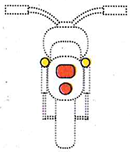 A motorcycle's rear: indicators either side, the stop light, and the red reflector.
Towing
A trailer is coupled with safety chains as well as the draw bar, and a heavy vehicle may draw no more than three trailers. The towed vehicle carries a white reflective T on the right at the front and a red reflective T on the right at the rear, so a driver behind knows there is more vehicle than they can see.
You may not tow something heavier than the vehicle towing it, and the gap between the two may not be more than 4 m. If your mirror does not show you the road behind what you are towing, fit extended arm side mirrors.
Warning triangles
The warning sign for a broken down vehicle is the red reflective triangle. Set one 30 m to 50 m behind the vehicle and another the same distance in front, both on the same side of the road as the vehicle. A vehicle drawing two trailers carries six of them.
The vehicle itself
Steering with more than 45 degrees of free play is faulty steering and the vehicle should not be driven; the backlash should stay inside about an eighth of the steering wheel's travel. Tyres need at least 1 mm of tread and the pressure the maker asks for. Brakes must be effective. The exhaust must not leak, because exhaust gases have no smell and are poisonous. Sun visors are for glare, and they are not fitted to every vehicle.
Uneven tyre wear is a suspension or an alignment fault rather than a tyre fault. Worn shock absorbers let a wheel bounce, and a bouncing wheel scrubs the tread away instead of rolling on it. Under inflated tyres show up first in the braking.
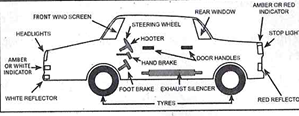 The points a vehicle check covers, and the reflector at each end: white at the front, red at the back.
The mistakes learners make
The chevron at the back of a heavy vehicle is red and yellow, not red alone. The fire extinguisher and reverse gear questions are answered by the motorcycle and the pedal cycle, not by any vehicle that simply looks small. And a vehicle wearing worn tyres in the rains is the most common reason a car goes straight on where the driver turned.