Night driving and dipping
Lights go on between 5.30 in the evening and 6.30 in the morning, and any other time you cannot see clearly. Those two times are the figures the papers ask for, and they are asked more than once.
What the test asks
The hours, what you do behind another vehicle at night, what you do in a well lit street, what you do when an oncoming driver has left their lights on main beam, and what you leave on when you are parked at the side of the road after dark. A question that gives you a clock time, such as six in the morning, is asking whether you know the hours well enough to place it inside them.
The hours
Between 5.30pm and 6.30am your headlights are on. Six in the morning is inside that window, so the answer to whether a vehicle driving at six needs its lights lit is yes. Outside the hours, the test is whether you can see clearly: rain, mist, dust and smoke all put the lights on whatever the clock says.
Main beam and dipped
Headlights have two positions. Main beam is for an empty road. Dipped lights do not reach as far, so slow down enough to stop inside the piece of road they light. That is the reason the Code gives, and it is worth holding on to, because it turns dipping from a courtesy into a speed decision.
The four times you dip
- meeting oncoming traffic,
- following another vehicle,
- in a well lit street,
- approaching a police officer directing traffic.
The first two are about not blinding somebody. In a well lit street the papers also want the spot lights off, not just the beam down.
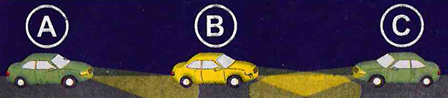 Where the beam falls when you dip for a vehicle you are meeting and for one you are following.
When you are dazzled
Slow down, and look at the left edge of the road rather than at the lights. Stop if you have to. You may flick your own lights up and down once to remind the other driver, and you never leave your own on main beam to answer them. A driver who keeps going at the same speed while unable to see is driving blind.
Stopping at night
Get right off the road. If you cannot, pull as far left as you can and put your park lights on so the vehicle can be seen. Your tail lights and side lights stay on while you are standing there. Something dark and unlit at the edge of a road is what other drivers hit.
Park on the left, in the direction of travel, and never on the right hand side of the road at night.
Rain, mist and dust
Use the headlights when visibility drops, on low beam rather than main, since main beam bounces back off mist and blinds you rather than the other driver. Fog lights go on in heavy mist and off again when it clears. Keep a longer gap than you would by day, and expect the stopping distances in the speed note to be roughly twice what the table says.
Fatigue
Night journeys are where tiredness catches drivers. If you begin to feel sleepy there is one answer the papers accept: move off the road and rest. Not coffee, not a window down, not pushing on to the next town.
The mistakes learners make
The hours are 5.30pm to 6.30am, not six to six, and a question set at six in the morning is testing exactly that. Following another vehicle at night means dipping, not switching off. And a vehicle parked at the roadside after dark without its park lights on is the single most avoidable night collision there is.