Six rules for a car diagram
Nearly ninety questions in the papers are the same picture: a junction, two or three cars, and one question about which of them goes. Work them with these six rules, in order, and the diagram answers itself.
What the test asks
The wording changes but the picture does not. Which car has the right of way, which car gives right of way, which car goes first, which car moves second, which car goes last, which car stops, which car is breaking the law, which car is not breaking the law. Read the question twice: the answer to who goes first and the answer to who goes last are different cars in the same picture.
1. Give way to the road on your right
At an uncontrolled crossroads, the car with nothing coming from its own right side is the one that moves. This is the whole of the law in one line, and it is the first thing to test in any diagram that has no signs and no lights.
Test 1, question 1
Which car has the right of way?
This is Test 1, question 1. The rule lives in the six rules for a car diagram.
Here C is coming up the bottom road and B is coming in from C's right. C gives way, and B goes first.
At an uncontrolled crossroads you give way to traffic on your right. Orange Car B, from the right, has nothing on its right and keeps its speed. Green Car A, from the bottom, has Car B on its right, so it waits and goes behind it.
2. Never turn right in front of oncoming traffic
A car turning right across another car's path waits, whatever else is true of the junction. Having nothing on your right does not buy you a right turn across somebody who is coming straight on. The Code states this on its own, separately from the give way rule, because it survives every other rule in the picture.
A driver turning right gives way to oncoming traffic. Orange Car B, from the top, is going straight through and keeps its speed. Green Car A waits for it to pass, then turns right.
3. A car with nothing on its right may move to the centre, and if it is turning right it is second out
It has the space to wait in and it takes it, so it is not the car that stops, but it is not the car that clears the junction first either. This is the rule the diagrams with three cars usually turn on, and it is why a question asking who moves second is worth reading carefully.
4. Cars on the same road move together
Two cars facing each other on the same road are not in each other's way, unless one of them is turning right across the other's path. When a diagram puts two cars nose to nose and asks which may move, the answer is often both of them.
5. A car facing a stop or a give way sign goes last
A sign in the picture settles the order before any of the other rules are needed. Look for the signs first, then for the cars.
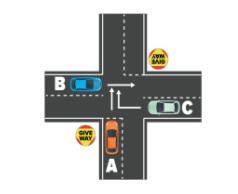 Which car goes last
A faces a give way sign, so wherever the other cars are, A waits.
6. At a traffic circle, give way to what is already going round and to the road on your right
Traffic already circulating has absolute priority. You may enter ahead of a circulating vehicle only if you can do it without getting in its way or making its driver brake, and you signal when you leave.
Test 1, question 3
Which car should stop? (A traffic circle)
This is Test 1, question 3. The rule lives in the six rules for a car diagram.
A is already on the circle, in from the road on the left. B is still on the approach from the top, and A is on B's right. B stops.
When two rules disagree
The sign wins over the shape of the junction, and the oncoming traffic wins over the right turn. So a car facing a give way sign waits even though nothing is on its right, and a car turning right waits even though it reached the junction first.
The mistakes learners make
The commonest is answering from who arrived first. At an uncontrolled crossroads that has no bearing on anything: the road on your right decides it. Arriving first only settles a four way stop, where every driver has stopped and the order of stopping is the order of going.
The second is reading the question as who goes first when it asks who goes last, or who moves second. The picture supports all three questions and the papers ask all three.
The third is looking at the cars before the signs. A give way sign or a stop sign in the corner of the drawing decides the whole thing, and it is easy to miss at the size these pictures print.