Road markings
A line on the road is an instruction, and the line that matters is the one on your own side of the middle of the road. Read that one and the rest of the picture answers itself.
What the test asks
What a continuous white line means, what a broken one means, what the two of them together mean, what a double continuous line means, when a yellow line may be straddled and when it may not, what a painted arrow does, and what a line across the road means when the sign that went with it has gone.
White lines run along the middle
- A broken white line may be crossed, and you may overtake when it is safe to do so.
- A continuous white line on your side means no overtaking, and it may not be crossed for that purpose at all.
- A double continuous white line, whether the two lines sit side by side or have a broken line between them, means no vehicle crosses it at any time and no vehicle is driven to the right of it.
- Where one line is broken and the other continuous, read the one nearest you: broken on your side, you may overtake; continuous on your side, you may not.
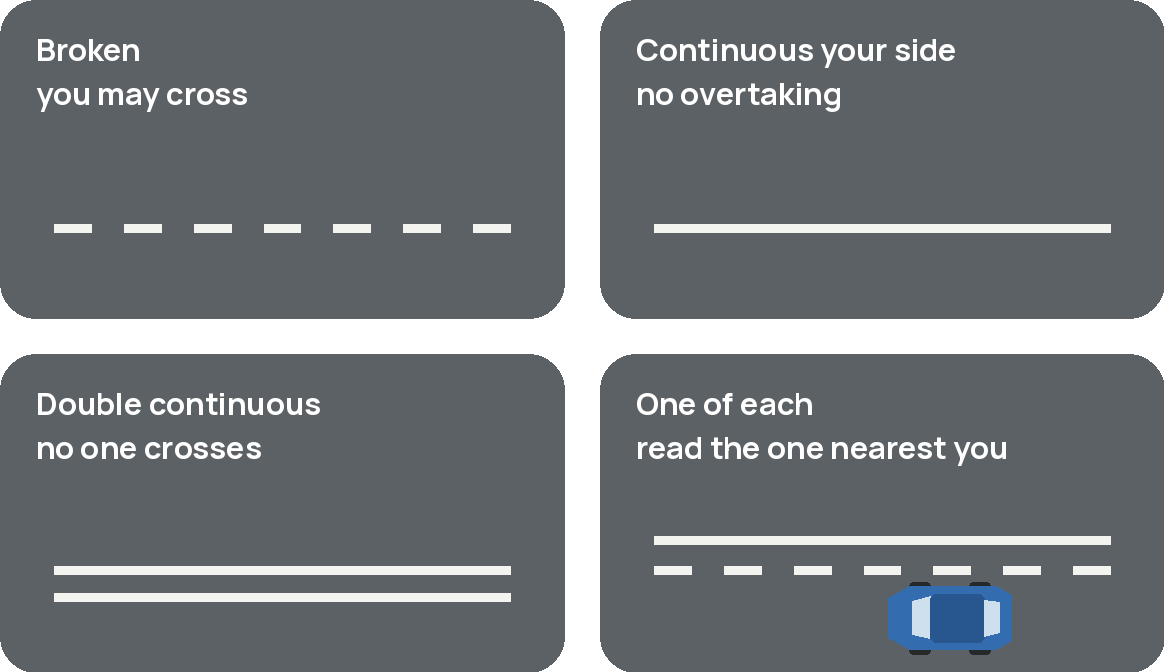 The four white centre lines, and what each one lets you do.
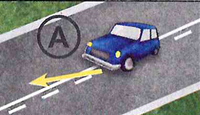 Car A may cross, because the broken line is on its side of the road.
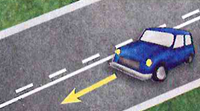 Car B may not, because the continuous line is on its side.
Where the line turns continuous
The line turns continuous where you cannot see far enough ahead to get back to your own side, which is why it does it on a rise and on a bend. That is the whole reason for it, and it is why crossing one is treated as seriously as it is.
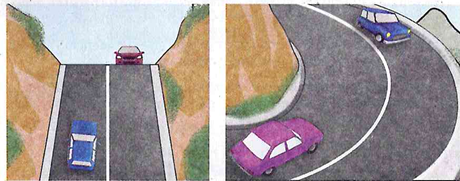 On a hill and on a bend, the continuous line holds each driver to their own side.
Yellow lines mark the edge of the road
- A broken yellow line may be crossed or straddled, but only for two things: to let a vehicle turning right go past you, and to stop.
- A continuous yellow line is a prohibition. It reserves the space beside it, at a fire hydrant or a bus stop for example, and you neither cross it nor straddle it nor stop on it.
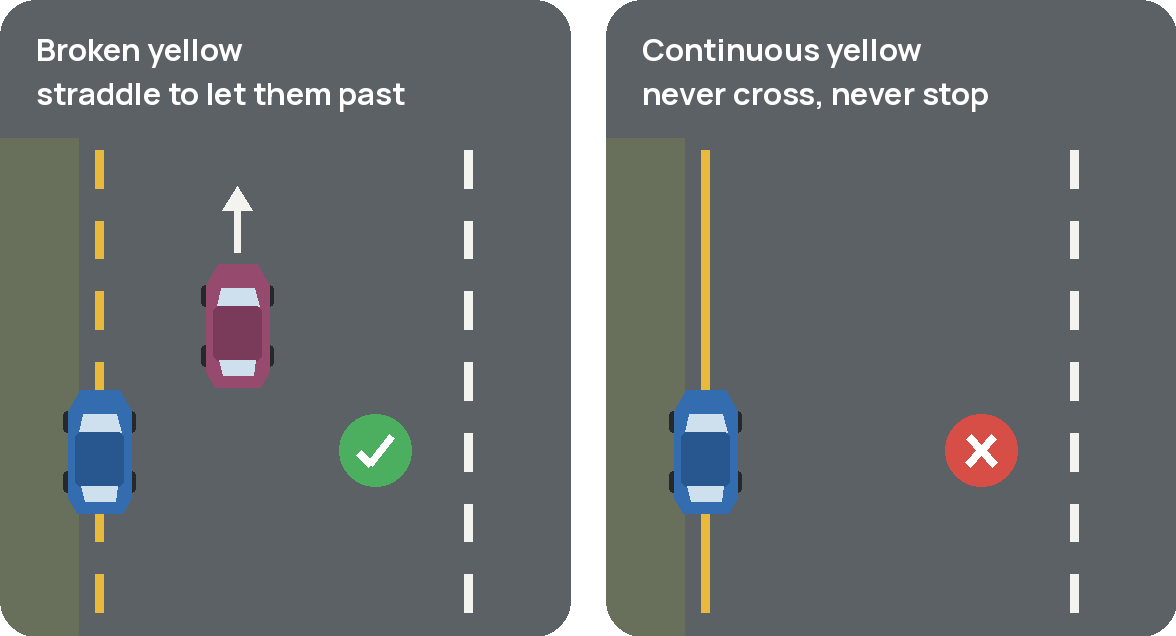 The same manoeuvre, two lines: allowed on the broken yellow, never on the continuous one.
Note the difference from the white lines in the middle: those are never straddled at all. Straddling is something the broken yellow line at the edge allows you, and only for those two purposes.
Lines across the road
A stop line is where you stop, not where you would like to have stopped. Overshooting it is the fault, even if you stopped afterwards. Where a stop sign has a line painted with it, you stop immediately behind the line; where there is no line, you stop as close to the intersection as you safely can.
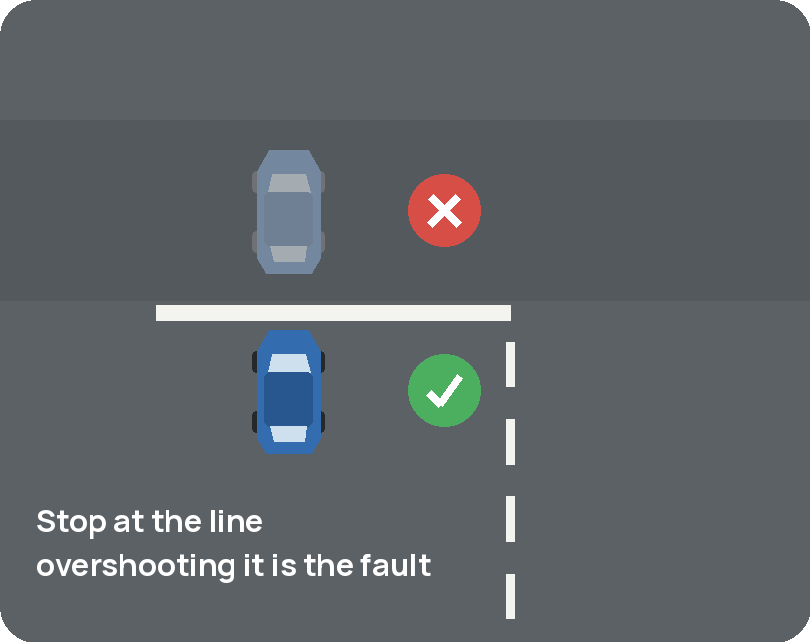 The near side of the line is where the car stops.
A line across the road carries the message of the sign it belongs to. If a stop or give way sign has been knocked down in a collision, the line is still there and it still means what the sign meant. A stop or give way line at a pedestrian crossing has that same effect.
Arrows painted on the road
Arrows painted between the lines that run along the road are regulatory. They are not advice about which lane is convenient. An arrow that says left means the lane turns left, and a driver in a straight ahead lane may not turn at all.
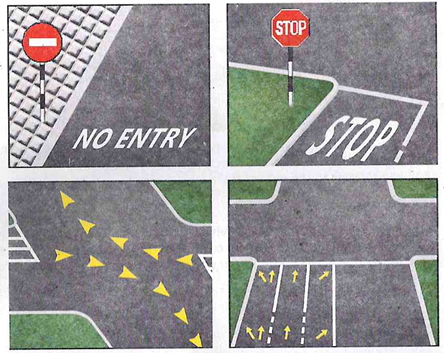 Yellow arrows give an order. White arrows only inform.
Yellow markings around a parking area mean the space is subject to a parking or stopping restriction, usually because something behind them has to stay reachable.
The mistakes learners make
The line on the far side of the road is not your line. A broken line beside a continuous one is a common picture in the papers precisely because half of the room reads the wrong one. And a painted arrow is as binding as a sign on a post, which is what the question about direction arrows and prohibition lines is checking.