Provisional - Zimbabwe Highway Code, Road Signs & VID Test Prep & lessons

Test 2

Twenty five questions from the 2026 paper, in the order they are set. Read them with the answers, or practise the paper and have your answers marked.

Practise this paper online

Questions
25
Pass mark
22
Practise this paper

Marked at the end, then every answer is shown.

All 25 questions in Test 2

The paper as it is set. Open the fold under a question to read its answer and why that answer is right, or practise the paper and have your answers marked.

1.

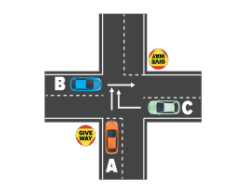
Which car goes last?

Diagram for question 1 of Zimbabwe VID test paper 2
  1. ACar C
  2. BCar A
  3. CCar B
Show the answer

Answer: Car A

The give way sign at the bottom faces Car A, so Car A gives way to the road that crosses it. Car B is coming through from the left and Car C is turning in from the right, both on the priority road, so Car A moves only once both have gone.
2.

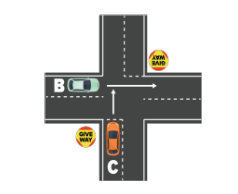
Which car is breaking the law assuming vehicles are moving?

Diagram for question 2 of Zimbabwe VID test paper 2
  1. ACar A
  2. BCar C
  3. CCar B
Show the answer

Answer: Car C

Car C has a give way sign on its approach at the bottom of the picture and must wait for the crossing road. Car B is on that crossing road, coming through from the left. With everything moving, Car C is the one entering the intersection with no right to.

3.

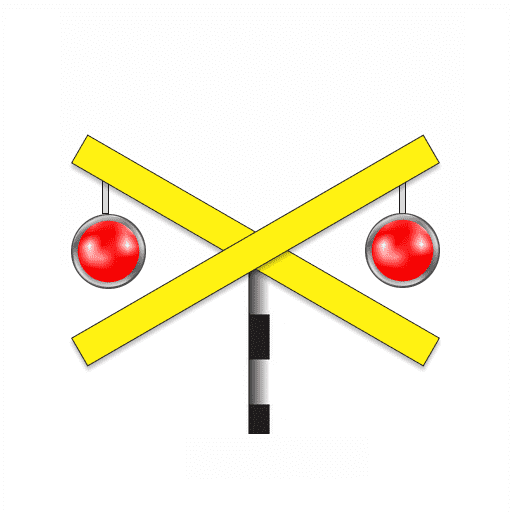
This sign indicates?

Diagram for question 3 of Zimbabwe VID test paper 2
  1. ARailway station
  2. BRail-road level crossing
  3. CAn intersection
Show the answer

Answer: Rail-road level crossing

Two yellow bars crossed like the letter X, with a red light on each side, mark a railway level crossing. Stop while the red lights flash, and when they are dark still slow, look and listen both ways before you cross the rails.

4.

The driver may not park closer to the corner than:

  1. A6.5m
  2. B7m
  3. CAll of the above
Show the answer

Answer: All of the above

The Code says do not stop or park on or near a corner or an intersection, but it sets no distance for it. The distance this paper works to is 7.5 metres, and neither 6.5 metres nor 7 metres reaches that, so a vehicle left at either one is parked too close to the corner.

5.

Cyclists should ride:

  1. AAs many as possible abreast
  2. BTwo abreast
  3. CSingle file.
Show the answer

Answer: Single file.

The Code says never ride more than two abreast, and that single file is much safer. Two abreast is the limit you must not pass, single file is how you should ride, since riding side by side pushes every overtaking vehicle across the centre of the road.

6.

When facing a red robot with an illuminated straight ahead Green arrow, I may:

  1. AProceed straight ahead
  2. BTurn right should I wish
  3. CNot proceed
Show the answer

Answer: Proceed straight ahead

A green arrow pointing straight ahead releases that one direction while the main light is still red. You may go straight ahead only. A right turn would need its own arrow pointing right.

7.

Which is the correct light sequence at a robot?

  1. AAmber, Red, Green
  2. BRed, Amber, Green
  3. CGreen, Red, Amber
Show the answer

Answer: Amber, Red, Green

The robot cycles amber, then red, then green, then round again. The amber before red warns you that you are about to be stopped, and green follows red directly, with no red and amber shown together.

8.

A continuous white line in the center of the road may:

  1. ABe crossed if the road ahead is clear
  2. BNot be crossed for the purposes of overtaking
  3. CBe crossed only on highways
Show the answer

Answer: Not be crossed for the purposes of overtaking

A continuous white line down the centre may not be crossed in order to overtake, however clear the road looks. The line is painted exactly where the view ahead is too short for the manoeuvre to be finished safely.

9.

Direction arrows used in conjunction with prohibition lines on a road surface:

  1. AAre for information purposes only
  2. BRelate to taxi drivers only
  3. CHave a regulatory effect
Show the answer

Answer: Have a regulatory effect

Arrows painted on the road surface alongside prohibition lines are orders, not advice. If the arrow in your lane points left, you turn left, and taking any other direction is an offence in the same way that crossing the line is.

10.

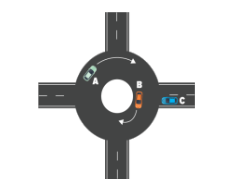
Which cars can move without breaking the law?

Diagram for question 10 of Zimbabwe VID test paper 2
  1. ACar A and Car C
  2. BCar B only
  3. CBoth Car A and B
Show the answer

Answer: Both Car A and B

Car A is round the top left of the circle and Car B is on the right of it, both already on the circle, and traffic already on a circle keeps moving. Car C is still out on the approach road at the right and must give way to both before it enters.

11.

I should always yield right of way to

  1. AAmbulance and fire engine sounding a siren
  2. BPresidential motorcade
  3. CAll of the above
Show the answer

Answer: All of the above

You yield to an ambulance or fire engine sounding a siren and to the presidential motorcade, so to all of them. Pull over to the left as far as it is safe to go, stop if you have to, and let them through.

12.

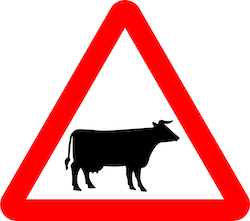
This sign indicates?

Diagram for question 12 of Zimbabwe VID test paper 2
  1. ADanger of stray animals
  2. BDanger of wild animals
  3. CDanger of farm animals
Show the answer

Answer: Danger of farm animals

The red triangle carries a cow, which warns of farm animals on or near the road. Wild game is shown by a kudu on the same triangle. Slow down and be ready for a whole herd to cross without warning.

13.

A solid yellow line on the left hand side of the road indicates:

  1. AIt may be straddled to overtake traffic which is turning right
  2. BIt may be straddled to overtake cyclists
  3. CIt may not be straddled
Show the answer

Answer: It may not be straddled

A solid yellow line at the left hand edge of the roadway may not be straddled or crossed at all. It is the broken version of that line that you may straddle briefly, to pass a vehicle waiting to turn right.

14.

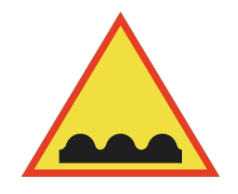
This sign indicates?

Diagram for question 14 of Zimbabwe VID test paper 2
  1. AHump ahead
  2. BDip or ridge ahead
  3. CMountains ahead
Show the answer

Answer: Dip or ridge ahead

The triangle carries a run of bumps in the road surface, warning that the surface ahead dips and rises. Slow down before you reach it: taking a dip or ridge at speed throws the vehicle off line and can ground it.

15.

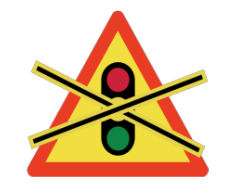
This sign means that:

Diagram for question 15 of Zimbabwe VID test paper 2
  1. ARail road level crossing ahead
  2. BTraffic lights and rail road crossing ahead
  3. CTraffic lights out of order
Show the answer

Answer: Traffic lights out of order

The warning triangle holds a robot with a black bar drawn through it, which tells you the robot at the intersection ahead is out of order. Treat that intersection as uncontrolled: slow right down and give way to traffic on your right.

16.

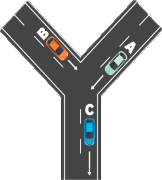
Which car stops?

Diagram for question 16 of Zimbabwe VID test paper 2
  1. ACar A
  2. BCar B
  3. CCar C
Show the answer

Answer: Car A

The two forks merge into one road. Car B is coming down the left fork and Car A down the right fork, which puts Car B on Car A's right, so Car A stops and lets Car B in. Car C is already away down the shared road and is in nobody's way.

17.

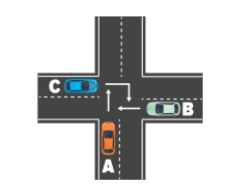
Which car moves last at this intersection?

Diagram for question 17 of Zimbabwe VID test paper 2
  1. ACar B
  2. BCar A
  3. CCar C
Show the answer

Answer: Car A

At an uncontrolled crossroads you give way to traffic on your right. The green car crosses from the road on A's right, so A lets it pass. The blue car turns right from the left hand road into the road A is on, cutting across A as well. Car A moves last.

18.

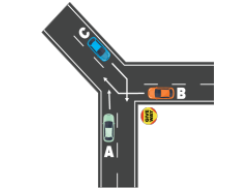
Which car goes last?

Diagram for question 18 of Zimbabwe VID test paper 2
  1. ACar C
  2. BCar B
  3. CCar A
Show the answer

Answer: Car B

Car B is on the right hand road, and the give way sign on that approach faces it, so Car B waits for the other two. Car A is coming up from the bottom and Car C down the fork to the left, both of them on the road that has priority.

19.

When traveling at 90km/h I must leave a gap of:

  1. ASix vehicle lengths
  2. BFive vehicle lengths
  3. CSeven vehicle lengths
Show the answer

Answer: Six vehicle lengths

Leave one vehicle length for every 15 km/h you are doing. At 90 km/h that is six vehicle lengths, which is the room you need to pull up if the vehicle in front brakes hard.

20.

When approaching a give way sign:

  1. AI am obliged to stop before proceeding
  2. BI am obliged to give way to traffic approaching the intersection on my right only
  3. CI may proceed with caution and without stopping provided there is no other traffic
Show the answer

Answer: I may proceed with caution and without stopping provided there is no other traffic

A give way sign does not oblige you to stop. Slow to a speed at which you could stop, look both ways, and if nothing is coming you may drive on without stopping. The stop sign is the one that demands a halt every time.

21.

I must dip my headlamps:

  1. AWhen approaching a railway level crossing.
  2. BWhen driving in a well lit area
  3. CWhen approaching an urban area
Show the answer

Answer: When driving in a well lit area

Dip your headlamps wherever the road is already well lit, because main beam adds nothing there and dazzles everyone coming towards you. Dip as well when you meet oncoming traffic and when you close up behind another vehicle.

22.

In rural areas where traffic is not controlled, I should give precedence to:

  1. ATraffic approaching from a road on the left.
  2. BTraffic approaching from a road on the right.
  3. CTraffic already in the intersection regardless of which side it is coming from
Show the answer

Answer: Traffic already in the intersection regardless of which side it is coming from

Where there are no signs and no robot, a vehicle that is already in the intersection has precedence, whichever side it came from. Once it is clear the ordinary rule takes over and you give way to traffic on your right.

23.

The insignia of a warning sign is:

  1. AA triangle
  2. BA circle
  3. CA rectangle
Show the answer

Answer: A triangle

Warning signs are triangular, with a red border. The shape alone tells you a hazard is ahead before you have read the symbol inside it. A circle gives an order and a rectangle gives information.

24.

When approaching a narrow bridge, I must pay attention to:

  1. AHeight restriction
  2. BLength restriction
  3. CWidth restriction
Show the answer

Answer: Width restriction

A narrow bridge is a width restriction: the roadway narrows and two vehicles may not be able to pass on it. Read the width plate, slow down, and if a vehicle is already on the bridge wait at your end until it is off.

25.

At a robot-controlled intersection where you have stopped over the pedestrian crossing lines, what do

  1. ADecide to carry on
  2. BReverse the vehicle
  3. CStay where you are
Show the answer

Answer: Stay where you are

Stay where you are. Reversing off the crossing takes you into traffic and pedestrians you cannot see behind you, and driving on against the red is an offence. Wait for green, then move off, and stop further back next time.

Practise on your phone

The app sets the same 16 papers, keeps every attempt, gathers the questions you keep missing into a revision set, and works with no network.