Provisional - Zimbabwe Highway Code, Road Signs & VID Test Prep & lessons

Test 3

Twenty five questions from the 2026 paper, in the order they are set. Read them with the answers, or practise the paper and have your answers marked.

Practise this paper online

Questions
25
Pass mark
22
Practise this paper

Marked at the end, then every answer is shown.

All 25 questions in Test 3

The paper as it is set. Open the fold under a question to read its answer and why that answer is right, or practise the paper and have your answers marked.

1.

Before driving a motor vehicle on a public road, it must have the following:

  1. ACertificate of fitness and a repair card.
  2. BLearner's licence.
  3. CRegistration book, insurance and a vehicle licence.
Show the answer

Answer: Registration book, insurance and a vehicle licence.

A vehicle on a public road must be registered, insured and licensed, so it needs the registration book, third party insurance and a current vehicle licence. A certificate of fitness is only required for classes such as public service and goods vehicles, not for every car.
2.

The correct sequence of a robot traffic light is:

  1. AAmber, Green, Red.
  2. BGreen, Amber, Red.
  3. CRed, Amber, Green
Show the answer

Answer: Green, Amber, Red.

The cycle runs green, then amber, then red, and from red it goes straight back to green. Amber follows green as the warning that you must pull up for the red that is coming.

3.

When approaching a pedestrian crossing you should:

  1. ASound the horn.
  2. BAccelerate quickly over it.
  3. CSlow down and prepare to stop.
Show the answer

Answer: Slow down and prepare to stop.

Pedestrians on the crossing have the right of way, so you come up to it at a speed that lets you stop. Hooting does not give you the right to keep going, and you may not overtake another vehicle on the approach to a crossing.

4.

For cyclists not to interfere with other road users they should ride:

  1. ATwo to three abreast.
  2. BSingle file.
  3. CCompletely off the road.
Show the answer

Answer: Single file.

Riding two or three abreast takes up the room overtaking traffic needs, and the Code says single file is much safer. Ride one behind the other and vehicles can pass you without leaving the lane. Cyclists are entitled to use the road, so riding right off it is not asked of them.

5.

A heavy vehicle towing independent trailers must have:

  1. ASafety chains fitted to the trailers.
  2. BMore pulling power.
  3. CAs many spare wheels as possible.
Show the answer

Answer: Safety chains fitted to the trailers.

Every independent trailer must be coupled with safety chains as well as the tow hitch. If the coupling lets go, the chains hold the trailer to the towing vehicle instead of letting it run loose into other traffic.

6.

When approaching a slow moving combine harvester going in my direction of travel

  1. AI increase speed and overtake it
  2. BI slow down and give it space to pass
  3. CI slow down and keep behind until its safe to overtake
Show the answer

Answer: I slow down and keep behind until its safe to overtake

A combine harvester is wide and slow and it blocks your view of the road ahead. Stay behind it where you can see past, and only pull out when you can see far enough to be certain of getting back in.

7.

To drive a heavy vehicle you must have reached the age of:

  1. ANineteen years.
  2. BEighteen years.
  3. CSeventeen years.
Show the answer

Answer: Eighteen years.

You must be eighteen to drive a heavy vehicle. Sixteen only takes you as far as learning on a light motor vehicle, and no heavy class is issued below eighteen. The new system calls the heavy classes the C codes, and eighteen still stands.

8.

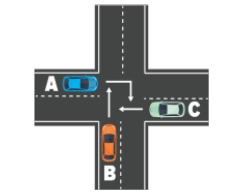
Which car moves second at this intersection?

Diagram for question 8 of Zimbabwe VID test paper 3
  1. ACar A
  2. BCar B
  3. CCar C
Show the answer

Answer: Car A

Nothing controls this crossroads, so each driver gives way to the right. Car C, the green car coming from the east and going straight on, has nothing on its right and clears first. Car A, the blue car turning right out of the west arm, follows, and Car B, going straight up from the south, is last.

9.

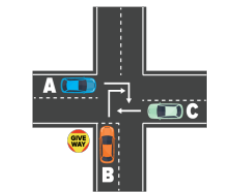
Which car moves first at this intersection?

Diagram for question 9 of Zimbabwe VID test paper 3
  1. ACar A
  2. BCar B
  3. CCar C
Show the answer

Answer: Car C

The give way sign faces Car B, so the orange car from the south waits. Car A, the blue car from the west, is turning right across the path of Car C. Car C, the green car coming from the east and going straight through, has nobody to give way to, so it moves first.

10.

Which car stops?

Diagram for question 10 of Zimbabwe VID test paper 3
  1. ACar A
  2. BCar B
  3. CCar C
Show the answer

Answer: Car B

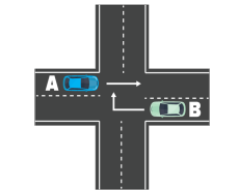
Car B, the green car from the east, is turning right into the road going north, and a driver turning right gives way to oncoming traffic. Blue Car A is coming straight at it from the west, so Car B stops and waits for A to pass.

11.

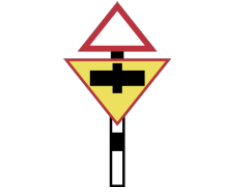
This sign warns of:

Diagram for question 11 of Zimbabwe VID test paper 3
  1. ACross road ahead.
  2. BRail and level crossing ahead.
  3. CStop or give way sign ahead.
Show the answer

Answer: Stop or give way sign ahead.

The empty red triangle warns you about whatever is shown on the yellow plate below it, and that black cross is the symbol carried on the stop and give way signs. A control sign is coming, so be ready to pull up.

12.

At this sign I should:

Diagram for question 12 of Zimbabwe VID test paper 3
  1. AStop and give way to traffic coming from my right.
  2. BSlow down and proceed if there is no crossing traffic.
  3. CStop and proceed when the road is clear on both sides.
Show the answer

Answer: Slow down and proceed if there is no crossing traffic.

This is the give way sign, a yellow triangle inside a red circle. It does not order a full stop. Slow down, look both ways, and carry on without stopping if nothing is crossing or close enough to be a danger.

13.

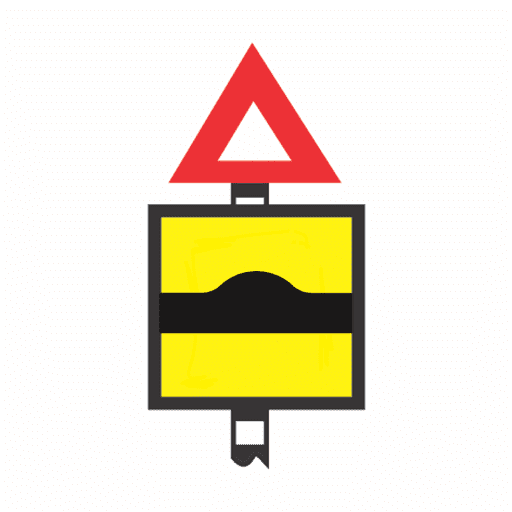
This sign warns of:

Diagram for question 13 of Zimbabwe VID test paper 3
  1. AA mountainous area ahead.
  2. BA hump in the road ahead.
  3. CLarge waves in the river ahead.
Show the answer

Answer: A hump in the road ahead.

The red triangle warns of a hazard and the yellow plate under it carries the raised black hump. The road ahead lifts into a hump, so lose your speed before you reach it rather than on top of it.

14.

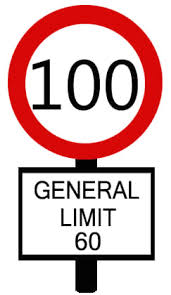
This sign regulates that:

Diagram for question 14 of Zimbabwe VID test paper 3
  1. ASpeed limit on this road is 60 km/h
  2. BSpeed limit on this road is between 60 km/h and 100 km/h.
  3. CSpeed limit on this road is 100 km/h
Show the answer

Answer: Speed limit on this road is 100 km/h

The red circle around 100 sets the limit on this road at 100 km/h. The white plate under it only states the general limit of 60 km/h that applies where nothing is posted, and it does not cut the 100 down.

15.

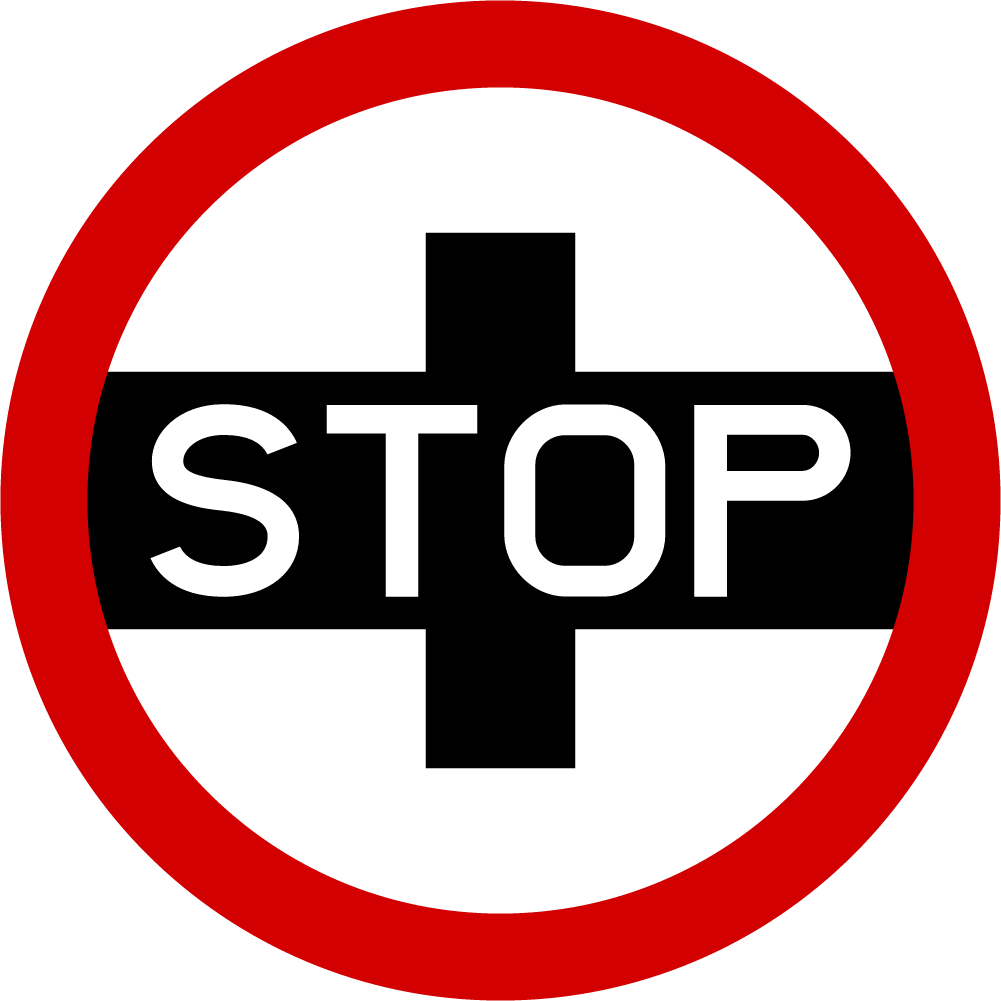
This sign is:

Diagram for question 15 of Zimbabwe VID test paper 3
  1. AA danger warning sign
  2. BA regulatory sign
  3. CAn informative sign
Show the answer

Answer: A regulatory sign

The red circle with the black cross and the word STOP is the stop sign, and it orders you to do something. Signs that give an order are regulatory. Danger warning signs are triangles.

16.

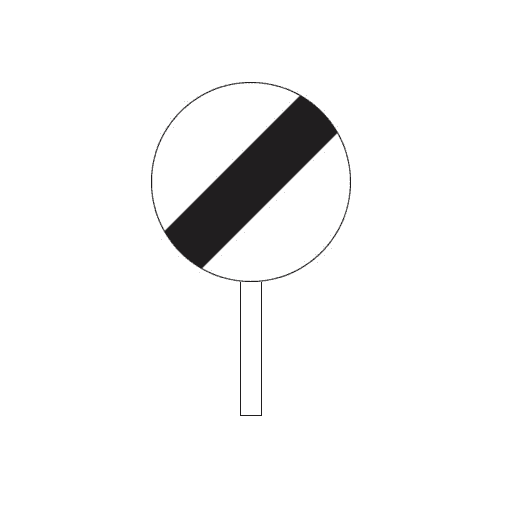
This sign is:

Diagram for question 16 of Zimbabwe VID test paper 3
  1. AA carriageway marking.
  2. BAn informative sign
  3. CA danger warning sign
Show the answer

Answer: An informative sign

The white round sign with the black diagonal bar tells you that the speed restriction you were driving under has ended. It carries information about the road rather than warning of a hazard, and it stands on a post, so it is not a carriageway marking.

17.

The warning sign of a broken down vehicle is:

  1. AThe driver waving to the other road users.
  2. BThe flashing of indicators.
  3. CThe red reflective triangle.
Show the answer

Answer: The red reflective triangle.

A vehicle that has broken down is marked with the red reflective triangle, stood on the road behind it so that drivers coming up see it from a distance. Indicators fail with the electrics and are not the warning the law asks for.

18.

On meeting an abnormal load vehicle under escort :

  1. AI should slow down and exercise caution
  2. BI should sound my horn and flash my lights to alert him of my presence
  3. CI should do nothing
Show the answer

Answer: I should slow down and exercise caution

An abnormal load is wide, long or slow, and the escort is there to warn traffic. Slow down, keep well to the left and be ready to stop or pull off the road so that it can get past. Hooting and flashing lights will not make room for it.

19.

When riding a motorcycle you must wear:

  1. AA pair of cycle clips.
  2. BA pair of sun glasses.
  3. CA crash helmet
Show the answer

Answer: A crash helmet

A rider must wear a crash helmet, properly fastened. It is the one item on the list that protects the head, which is what gets hurt when a rider comes off.

20.

When turning left at a robot controlled intersection I should :

  1. AYield to pedestrians to go through
  2. BGive right of way to traffic from the right
  3. CSound the horn.
Show the answer

Answer: Yield to pedestrians to go through

Pedestrians crossing the road you are turning into have the right of way, so you wait for them to clear even though your light is green. Traffic from the right is being held by the robot, so it is not what you give way to here.

21.

When an oncoming vehicle lights are on bright beam, what do you do?

  1. APull down the sun visor.
  2. BSlow down and look slightly to the left.
  3. CSwitch spot lights on.
Show the answer

Answer: Slow down and look slightly to the left.

Do not look into the lights, because you lose your night vision and cannot see the road. Slow down and look slightly to the left, using the kerb or the edge of the road to hold your line until the vehicle has gone past.

22.

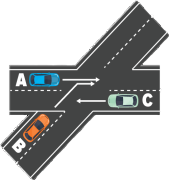
Which car stops?

Diagram for question 22 of Zimbabwe VID test paper 3
  1. ACar C
  2. BCar A
  3. CCar B
Show the answer

Answer: Car B

Car B is the orange car coming up the side road from the bottom left and crossing the road that A and C are on. Car C, the green car travelling west, is on Car B's right, so Car B stops and lets the through road clear.

23.

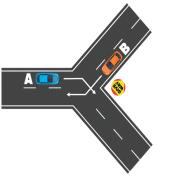
Which car goes last?

Diagram for question 23 of Zimbabwe VID test paper 3
  1. ACar B
  2. BCar A
  3. CCar C
Show the answer

Answer: Car B

The give way sign faces Car B, the orange car coming down the road from the top right. It has to let Car A, the blue car on the arm with no sign, take the junction first, so Car B goes last.

24.

In rural areas, where traffic is not controlled, you should give precedence to:

  1. ATraffic from the road on the right.
  2. BTo all crossing traffic.
  3. CTraffic already in the intersection regardless of which side it is coming from.
Show the answer

Answer: Traffic already in the intersection regardless of which side it is coming from.

A vehicle already in the intersection has taken it, and you let it finish crossing whichever side it came from. Give way to the right decides who goes first between vehicles arriving together, not who is already inside.

Practise on your phone

The app sets the same 16 papers, keeps every attempt, gathers the questions you keep missing into a revision set, and works with no network.