Provisional - Zimbabwe Highway Code, Road Signs & VID Test Prep & lessons

Test 4

Twenty five questions from the 2026 paper, in the order they are set. Read them with the answers, or practise the paper and have your answers marked.

Practise this paper online

Questions
25
Pass mark
22
Practise this paper

Marked at the end, then every answer is shown.

All 25 questions in Test 4

The paper as it is set. Open the fold under a question to read its answer and why that answer is right, or practise the paper and have your answers marked.

1.

At an uncontrolled intersection, I should give right of way to:

  1. AOncoming traffic.
  2. BTraffic approaching from a road on the left.
  3. CTraffic approaching from a road on the right.
Show the answer

Answer: Traffic approaching from a road on the right.

With no robot, sign or officer at the intersection the rule is give way to the right. You let the vehicle approaching from the road on your right go through, and the driver on your left gives way to you in the same way.
2.

I may not overtake:

  1. AOn a blind rise.
  2. BWhen travelling on four lane traffic.
  3. CNear the post office.
Show the answer

Answer: On a blind rise.

You may not overtake anywhere you cannot see that the road ahead is clear. A blind rise hides everything beyond the crest, so an oncoming vehicle appears with no room left for you to get back in.

3.

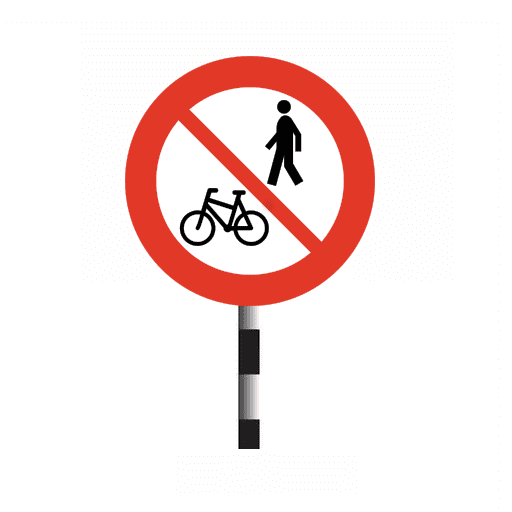
This sign indicates that

Diagram for question 3 of Zimbabwe VID test paper 4
  1. ACyclists may not proceed beyond this
  2. BBoth cyclists and pedestrians are prohibited beyond this sign.
  3. CPedestrians find alternative route with their bicycles
Show the answer

Answer: Both cyclists and pedestrians are prohibited beyond this sign.

A red circle with a bar through it forbids whatever is drawn inside, and inside this one are a walking figure and a bicycle. People on foot and people on bicycles are both kept out beyond the sign.

4.

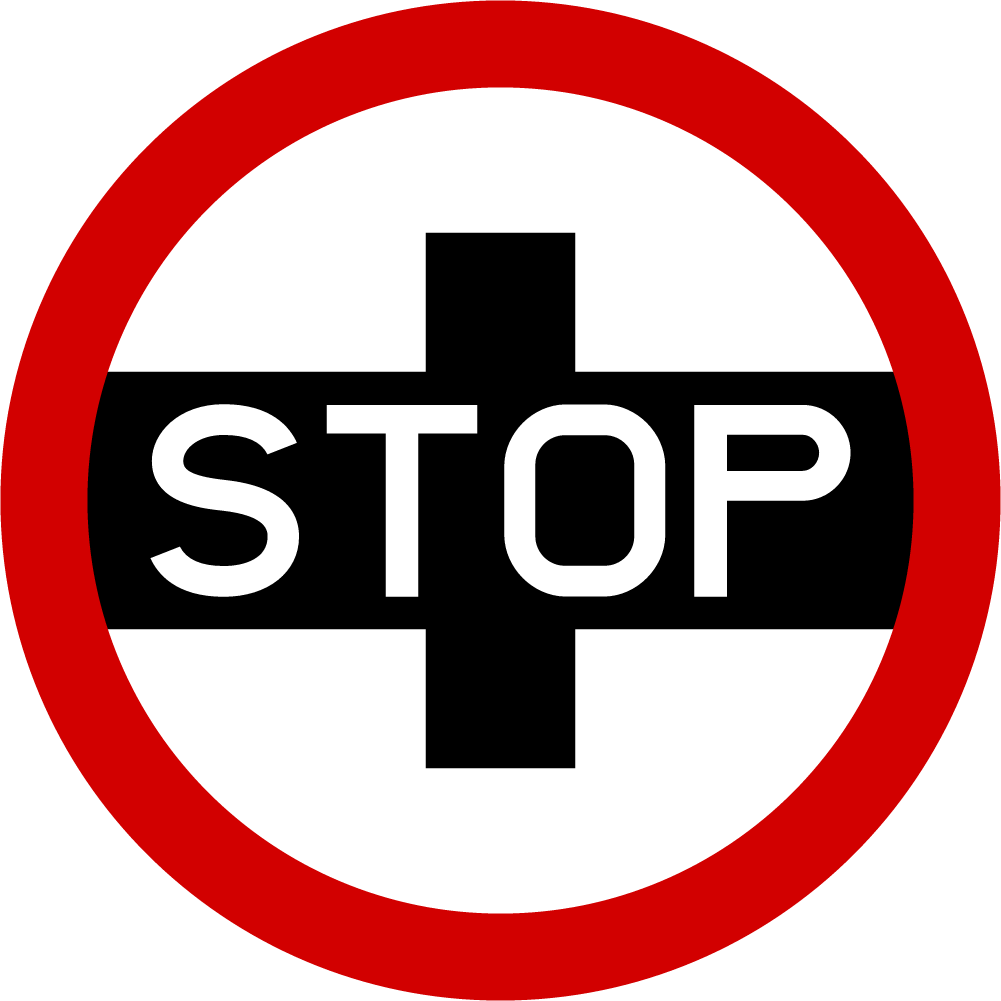
At this sign I should:

Diagram for question 4 of Zimbabwe VID test paper 4
  1. AStop, and wait until the road ahead is clear on both sides.
  2. BGive right of way to vehicles from the left
  3. CGive right of way to vehicles from the right
Show the answer

Answer: Stop, and wait until the road ahead is clear on both sides.

The red circle with the black cross and the word STOP is the stop sign. You bring the vehicle to a complete stop at the line every time, even on an empty road, and move off only once you can see the way is clear on both sides.

5.

A yellow line on the left hand side of the road:

  1. AMay not be crossed under any circumstances.
  2. BMay be crossed to overtake traffic which is turning to the right.
  3. CMay be crossed to overtake slow traffic.
Show the answer

Answer: May be crossed to overtake traffic which is turning to the right.

The yellow line marks off the left edge of the carriageway. You may cross it to pass a vehicle that has slowed or pulled out to turn right, when it is safe to do so. It is not a spare lane for getting past slow traffic.

6.

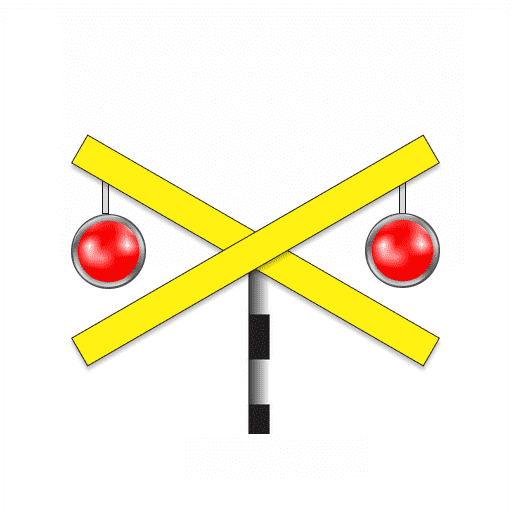
This sign means:

Diagram for question 6 of Zimbabwe VID test paper 4
  1. ARed Cross station ahead.
  2. BCross road ahead.
  3. CRailway level crossing.
Show the answer

Answer: Railway level crossing.

Two yellow boards crossed like a letter X with a red light on each side is the railway level crossing sign. Approach ready to stop, and when the red lights show, a train is coming and you must wait.

7.

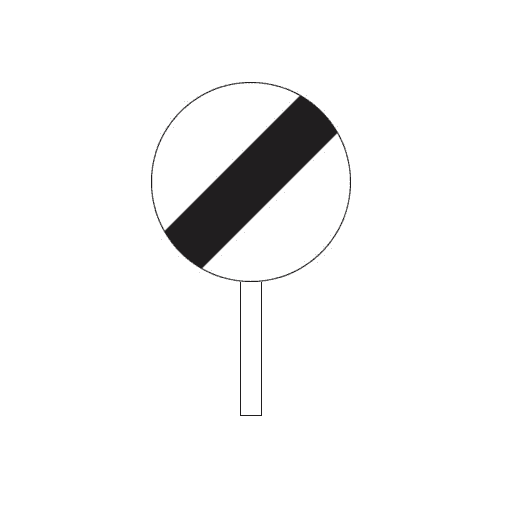
This sign means:

Diagram for question 7 of Zimbabwe VID test paper 4
  1. AHospital ahead.
  2. BNo entry.
  3. CSpeed de-restriction.
Show the answer

Answer: Speed de-restriction.

The plain white round sign with a single black diagonal bar lifts the speed restriction you have been driving under. Past it the general limit for that road applies again.

8.

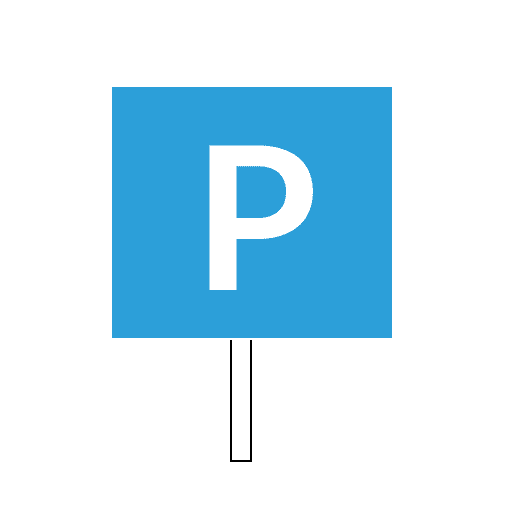
This sign indicates, I may:

Diagram for question 8 of Zimbabwe VID test paper 4
  1. AExpect to find a 'Lay-By' ahead.
  2. BPark my vehicle.
  3. CNot park my vehicle.
Show the answer

Answer: Park my vehicle.

The blue plate with the white P marks parking, so you may leave your vehicle here. A ban on parking would be a red circle with a bar through it, not a plain blue plate.

9.

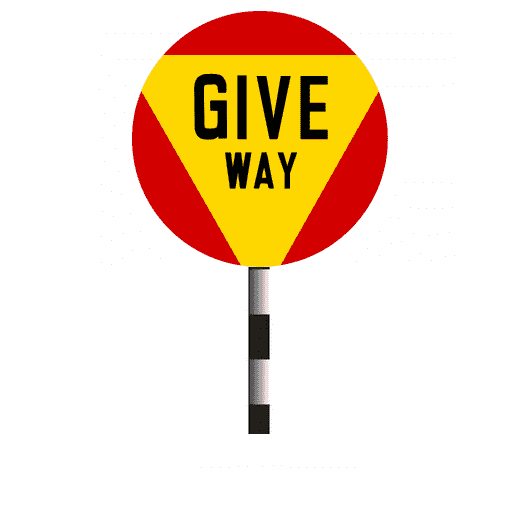
At this sign I would:

Diagram for question 9 of Zimbabwe VID test paper 4
  1. ADisengage gears.
  2. BSound my hooter.
  3. CProceed with caution and stop if necessary.
Show the answer

Answer: Proceed with caution and stop if necessary.

This is the give way sign, and it does not order a stop every time. Come down to a speed that lets you look properly into the junction, carry on if it is clear, and stop if anything is close enough to be a danger.

10.

I must never change direction until I have:

  1. AFlashed my headlamps.
  2. BSounded my hooter.
  3. CIndicated my intention and ascertained that the road is clear.
Show the answer

Answer: Indicated my intention and ascertained that the road is clear.

You signal in good time and then satisfy yourself that the road is clear, in the mirrors and over your shoulder, before you move across. The indicator only asks for the change, it does not give you the right to take it.

11.

I must take a habit of never setting my vehicle in motion until I have:

  1. AChecked the rear view mirror.
  2. BChecked the petrol.
  3. CChecked for children and animals around.
Show the answer

Answer: Checked for children and animals around.

Small children and animals stand low and close to the sides of the vehicle, where no mirror shows them. Walk round the vehicle before you get in and look again before you pull away, because the mirror on its own will not find them.

12.

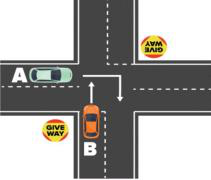
Which car is not breaking the law?

Diagram for question 12 of Zimbabwe VID test paper 4
  1. ACar B
  2. BCar A
  3. CCar C
Show the answer

Answer: Car A

Give way signs face the road Car B is on, so the orange car coming up from the south must wait, and it has moved into the intersection anyway. Car A, the green car turning right off the road that has priority, is doing nothing wrong.

13.

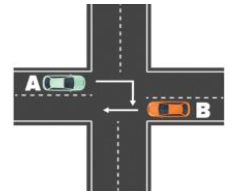
Which car stops?

Diagram for question 13 of Zimbabwe VID test paper 4
  1. ACar A
  2. BCar B
  3. CNone
Show the answer

Answer: Car A

Car A, the green car coming from the west, is turning right across the road. A driver turning right gives way to oncoming traffic, and Car B is coming straight at it from the east, so Car A stops until B has gone by.

14.

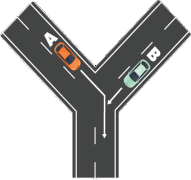
Which car has right of way?

Diagram for question 14 of Zimbabwe VID test paper 4
  1. ACar B
  2. BCar A
  3. CThe fastest
Show the answer

Answer: Car A

The two roads run together into one. Car B, the green car on the right hand arm, has Car A coming in on its right, and you give way to the right. So Car A, the orange car on the left arm, keeps its way and Car B follows it in.

15.

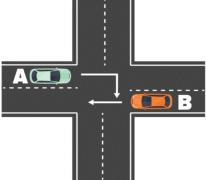
Which car has no right of way?

Diagram for question 15 of Zimbabwe VID test paper 4
  1. ACar A
  2. BMercedes Benz
  3. CCar B
Show the answer

Answer: Car A

Car A, the green car from the west, is turning right across the road, and a driver turning right gives way to oncoming traffic. Car B is coming straight through from the east, so Car A has no right of way and waits for it.

16.

When filling my tank with petrol, I should:

  1. AEngage in reverse gear.
  2. BSwitch off the engine.
  3. CClose the choke.
Show the answer

Answer: Switch off the engine.

Switch the engine off before any fuel goes into the tank. A running engine has hot parts and a live electrical system alongside petrol fumes, and the fumes are what catch alight.

17.

When travelling at 75 km/h, I must leave a gap of:

  1. AFour vehicle lengths.
  2. BSeven vehicle lengths
  3. CFive vehicle lengths
Show the answer

Answer: Five vehicle lengths

Leave one vehicle length for every 15 km/h you are doing. At 75 km/h that is five lengths, and it is the room you need to pull up if the vehicle in front stops without warning.

18.

When turning at an intersection, I must:

  1. AHoot.
  2. BGive way to persons within the pedestrian crossing.
  3. CGive way to oncoming traffic
Show the answer

Answer: Give way to oncoming traffic

Traffic coming the other way keeps its way while you turn across it, so you hold back until there is a gap long enough to finish the turn without making anyone slow for you.

19.

I may dip my head lamps:

  1. AWhen approaching a hospital.
  2. BWhen approaching a railway level crossing.
  3. CFor oncoming traffic.
Show the answer

Answer: For oncoming traffic.

You dip for a driver coming towards you so that your main beam does not blind them. Dip in good time, well before the vehicle reaches you, and keep your speed down while you are on dipped beam.

20.

The general driving rule in Zimbabwe's highway code is

  1. ACommon sense
  2. BDrive on the left within your lane
  3. CDrive on the left beyond yellow line if there is congestion
Show the answer

Answer: Drive on the left within your lane

Zimbabwe drives on the left, and you stay inside your own lane while you do it. Crossing the yellow line to get past a queue is not allowed, and common sense is not a rule that can be applied or enforced.

21.

Which is not the correct robot light sequence?

  1. ARed, Green, Amber
  2. BGreen, Amber, Red.
  3. CAmber, Green, Red.
Show the answer

Answer: Amber, Green, Red.

The lights run green, amber, red and back to green, so red, green, amber is that same cycle started at a different point. Amber, green, red is the one that cannot happen, because amber always comes after green, never before it.

22.

The correct position of a motor cycle on the road is

  1. ARight of lane
  2. BLeft of lane
  3. CMiddle of lane.
Show the answer

Answer: Middle of lane.

Ride in the middle of your lane. It keeps you where the drivers ahead and behind can see you, away from the loose gravel and drains at the edge, and it stops a car trying to push past you inside your own lane.

23.

The rider of a motor cycle has right to

  1. AUse of a full lane
  2. BOvertake from any side as he or she wishes
  3. CWeaving in and out where road space permits
Show the answer

Answer: Use of a full lane

A motorcycle is entitled to the full width of a lane, the same as any other vehicle, and nobody may share that lane with the rider. The right does not stretch to weaving between vehicles or passing on whichever side suits.

24.

A person riding a motorbike must wear

  1. AMine helmet
  2. BAny cap
  3. CA crash helmet
Show the answer

Answer: A crash helmet

A crash helmet, properly fastened, is the only headgear that counts. A cap or a helmet made for mining work is not built to take the impact of a head hitting the road.

25.

When approaching this sign:

Diagram for question 25 of Zimbabwe VID test paper 4
  1. AI should not worry because it is not one of the known road signs
  2. BI am being warned the hazard ahead is of a variable nature
  3. CIt is a surprise sign because you have just passed a hazard
Show the answer

Answer: I am being warned the hazard ahead is of a variable nature

The red triangle with the black exclamation mark is the general warning sign. It is used where the danger ahead changes from time to time or has no symbol of its own, so slow down and look for what it is pointing at.

Practise on your phone

The app sets the same 16 papers, keeps every attempt, gathers the questions you keep missing into a revision set, and works with no network.