Provisional - Zimbabwe Highway Code, Road Signs & VID Test Prep & lessons

Test 6

Twenty five questions from the 2026 paper, in the order they are set. Read them with the answers, or practise the paper and have your answers marked.

Practise this paper online

Questions
25
Pass mark
22
Practise this paper

Marked at the end, then every answer is shown.

All 25 questions in Test 6

The paper as it is set. Open the fold under a question to read its answer and why that answer is right, or practise the paper and have your answers marked.

1.

When in a straight ahead lane at an intersection I am allowed to:

  1. ATurn without indicating
  2. BGo straight
  3. CChange lanes without checking blind spots.
Show the answer

Answer: Go straight

A lane marked for straight ahead may be used for exactly that. Turning out of it cuts across the drivers who lined up properly, and leaving it for another lane still needs a mirror, a signal and a blind spot check first.
2.

At a four way junction which car goes first?

  1. AThe car on the left
  2. BThe car on the right
  3. CThe first car to stop whether on the right or left
Show the answer

Answer: The first car to stop whether on the right or left

A four way stop runs first come, first served: whoever stopped first moves off first, whichever arm he came from. Only when two vehicles stop together does the question of who sits on whose side arise.

3.

A speed derestriction sign means I may:

  1. ADo not exceed the stated speed
  2. BExceed previous speed limit
  3. CNot exceed a speed of 130km/h
Show the answer

Answer: Exceed previous speed limit

A derestriction sign ends the limit you were held to, so from that point the general limit for that class of road applies and you may go faster than before. Faster is not free: on a wide tar road that general limit is 120km/h for a light vehicle.

4.

When meeting a breakdown vehicle flashing its beacon lights I must:

  1. APull off the road completely
  2. BKeep to the extreme left and pass as fast as possible.
  3. CProceed with caution
Show the answer

Answer: Proceed with caution

Flashing beacons mean a damaged vehicle and men working at the roadside. Slow right down, leave the scene room and be ready for someone stepping out into your path. Racing past close to it is exactly what puts a recovery worker under your wheels.

5.

When I intend to stop on the road I must:

  1. ASlow down check my rear view mirrors and stop.
  2. BSlow down, check mirror, indicate intention, pull off the road and stop
  3. CFlash my hazards and apply emergency brakes
Show the answer

Answer: Slow down, check mirror, indicate intention, pull off the road and stop

Stopping is a manoeuvre like any other: slow down, check the mirror for what is behind, signal so that it knows, then pull clear off the road and stop. Braking in the lane with no warning leaves the driver behind nowhere to go.

6.

The position of a motor cyclist travelling on a highway in rural areas is

  1. AExtreme left of lane
  2. BCentre of lane
  3. CExtreme right of lane
Show the answer

Answer: Centre of lane

On an open rural road the rider holds the middle of his lane, where he is easiest to see, clear of the loose gravel and broken edge at the side, and where no driver can push past him within the same lane.

7.

When approaching an animal drawn vehicle I must:

  1. ABlow my horn and pass
  2. BSlow down and pass on the safest side
  3. CFlash headlights and pass
Show the answer

Answer: Slow down and pass on the safest side

Animals bolt at noise. Come down to a very slow speed, wait until you can see past the animals and the vehicle they are pulling, and pass on whichever side leaves the most room. A horn or a flash of the headlights can send the team straight across your bonnet.

8.

How many passengers are permitted to be carried by a motor cycle with a side car attached?

  1. ATwo
  2. BOne
  3. CThree
Show the answer

Answer: Two

Passengers ride only in the sidecar or astride the pillion, and the Code puts the sidecar's limit at two people and the pillion's at one. The figure this question is after is what the sidecar itself may carry, which is two.

9.

You may overtake:

  1. AOn a blind rise.
  2. BWhere there is a continuous line and a broken line on your side
  3. CWhen there are two lanes going opposite directions.
Show the answer

Answer: Where there is a continuous line and a broken line on your side

You go by the line nearest you. Where the broken half of the pair is on your side you may cross it to overtake if the road ahead is clear; where the solid half faces you it stays uncrossed. A blind rise hides oncoming traffic and is never a place to pass.

10.

What should you remember when approaching a pedestrian crossing?

  1. AMaintain your speed at 60km/h
  2. BPrepare to stop regardless that there are no pedestrians
  3. CIncrease speed so that you pass quickly
Show the answer

Answer: Prepare to stop regardless that there are no pedestrians

Come to a crossing at a speed that lets you stop for it, whether or not anyone is standing there. A pedestrian steps off the kerb without looking, and a child is hidden by a parked car until the last moment. Speeding up to clear it is how people are knocked down.

11.

A vehicle turning right should

  1. AGive way to oncoming traffic proceeding straight
  2. BGive way to pedestrians leaving the pavement
  3. CGive way to cyclists going straight ahead
Show the answer

Answer: Give way to oncoming traffic proceeding straight

The right turn crosses the path of everything coming the other way, so you hold at the turning point until the oncoming traffic going straight has passed. It is staying on its own road; you are the one leaving yours.

12.

A special medical certificate for public service vehicle drivers expires after:

  1. ATwelve months
  2. BEighteen months
  3. CFive years
Show the answer

Answer: Twelve months

The special medical certificate runs for twelve months. A public service driver has to be examined afresh each year to keep his authority to carry passengers.

13.

At the age of 17 years a person is allowed to drive

  1. ALight motor vehicles only
  2. BMinibuses and light cars
  3. CBoth heavy and light provided he/she is a holder of a class two driving licence
Show the answer

Answer: Light motor vehicles only

At seventeen a driver may hold a licence for light motor vehicles and nothing more, which the new system calls code B. Heavy vehicles and the classes that carry passengers call for a higher minimum age and more years behind the wheel, so no class two licence is issued at that age.

14.

A tractor drivers permit is issued to a person who is aged:

  1. A18 and above before obtaining a licence
  2. BAnyone as and when it is required.
  3. CAbove 20 years who is not a holder of any licence
Show the answer

Answer: 18 and above before obtaining a licence

The tractor driver's permit is for a person of eighteen or more who does not yet hold a driving licence: it lets him work a tractor on the road while he is still without one. The new system keeps the permit, and a full tractor licence is now code BÊ.

15.

A 'one way' sign is:

  1. AA danger warning sign
  2. BA parking sign
  3. CAn informative sign
Show the answer

Answer: An informative sign

The one way plate is a blue rectangle with a white arrow on it, and rectangular plates inform: this one tells you which way the roadway runs. Signs that give orders are round, and the warning signs are the red triangles.

16.

Hazard perception means:

  1. AReading a traffic situation well in advance
  2. BFollowing police instructions as may be necessary
  3. CObeying danger signs only.
Show the answer

Answer: Reading a traffic situation well in advance

Hazard perception is seeing the trouble before it arrives: the ball that rolls out, the bus indicating, the queue slowing two hundred metres ahead. It is the habit of reading the whole scene early, not of obeying signs once you reach them.

17.

In well lit areas drivers are required to drive with

  1. AHeadlights on low beam and spot lights off.
  2. BHeadlights on high beam and spot lights off
  3. CHeadlights and stop lights off.
Show the answer

Answer: Headlights on low beam and spot lights off.

Street lighting already shows you the road, so dipped headlights are there to make you seen without dazzling anyone. High beam and spot lamps in a lit street blind the drivers coming towards you and those you are following.

18.

A learner driver is exempted from wearing a safety belt

  1. AWhen being driven by an instructor
  2. BWhen reversing
  3. CWhen driving at a constant speed of 60km/h
Show the answer

Answer: When reversing

Reversing means turning in the seat to look out through the back window, which a fastened belt will not let you do, so the belt may come off while you reverse. It goes back on before you drive forward, learner or not.

19.

Being the first at an accident scene, what are you expected to do?

  1. AObserve from far away and contact V.I.D.
  2. BRender first aid and report to the nearest police.
  3. CTake pictures which will assist your report to the police.
Show the answer

Answer: Render first aid and report to the nearest police.

The people in the wreck need help now, so give what first aid you can and then report the accident at the nearest police station. Watching from a distance or photographing the scene leaves an injured person lying there.

20.

At a give way sign

  1. AYou give right of way to vehicles from your right
  2. BSlow down and give right of way to all cross traffic
  3. CYou stop and give right of way to all cross traffic
Show the answer

Answer: Slow down and give right of way to all cross traffic

A give way sign does not order you to stop; it orders you to slow to a speed at which you can stop and to let everything on the crossing road go first. Where the road is genuinely clear you may go on without stopping, and that is what separates it from a stop sign.

21.

A dualised carriageway means

  1. A2 lanes in one direction
  2. B2 lanes in opposing directions with dividing strip
  3. CWide lanes
Show the answer

Answer: 2 lanes in one direction

On a dualised carriageway each carriageway carries one direction only, so the lanes beside you all run your way and nothing comes at you head on. The opposing traffic is on its own carriageway beyond the dividing strip.

22.

How far from a corner am I prohibited from parking my vehicle?

  1. A7m
  2. B17.5m
  3. C7.5m
Show the answer

Answer: 7m

A vehicle parked hard against a corner hides the traffic turning in and blinds anyone waiting to pull out, so leave 7 metres clear of the corner before you park.

23.

When may one proceed against a one way sign?

  1. AIn any emergency
  2. BNever
  3. CWhen directed by police officer directing traffic
Show the answer

Answer: When directed by police officer directing traffic

An officer on point duty overrules the sign, and if he waves you into the street against the arrow you go. Your own emergency does not: nothing about it makes driving into oncoming traffic safe or lawful.

24.

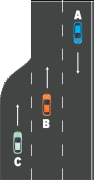
Which car goes last?

Diagram for question 24 of Zimbabwe VID test paper 6
  1. ACar A
  2. BCar C
  3. CCar B
Show the answer

Answer: Car C

C sits in the outside lane, the one that runs out where the road narrows ahead, with B alongside in the lane C has to join and A coming the other way in the far lane. The driver whose lane ends gives way to the traffic already in the lane he joins, so C goes last.

25.

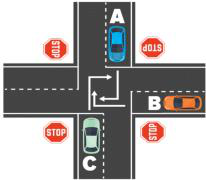
Which car goes last?

Diagram for question 25 of Zimbabwe VID test paper 6
  1. ACar C
  2. BCar B
  3. CCar A
Show the answer

Answer: Car B

Every road into this crossroads has a stop sign, so all three stop and then give way to the car on the right. The blue car has nothing on its right and turns right into the left hand road. B has that blue car on its right, and its own right turn cuts across the green car too, so Car B goes last.

Practise on your phone

The app sets the same 16 papers, keeps every attempt, gathers the questions you keep missing into a revision set, and works with no network.