Provisional - Zimbabwe Highway Code, Road Signs & VID Test Prep & lessons

Test 8

Twenty five questions from the 2026 paper, in the order they are set. Read them with the answers, or practise the paper and have your answers marked.

Practise this paper online

Questions
25
Pass mark
22
Practise this paper

Marked at the end, then every answer is shown.

All 25 questions in Test 8

The paper as it is set. Open the fold under a question to read its answer and why that answer is right, or practise the paper and have your answers marked.

1.

How many beer drinks should one consume before driving?

  1. AOne
  2. BTwo
  3. CNever
Show the answer

Answer: Never

None at all. There is no safe number of drinks before you drive: alcohol slows your reactions and makes you think you are driving better than you are, from the very first one, so the only figure that keeps you and everybody else safe is zero.
2.

What do you do on hearing an ambulance approaching sounding special warning device?

  1. AMove as fast as possible
  2. BMove out of its course and stop
  3. CMove slowly on the left side
Show the answer

Answer: Move out of its course and stop

Move out of its course, then stop and let it pass. An ambulance sounding its device is on an emergency, and trying to stay ahead of it only keeps it blocked. Pulling clear and standing still gives it the road at once.

3.

What time should persons driving on the road switch on their headlights?

  1. ABetween 5:30pm and 6:30am
  2. BBetween 5:30am and 6:30pm
  3. CAny convenient time
Show the answer

Answer: Between 5:30pm and 6:30am

Between 5:30pm and 6:30am. Those are the hours the law fixes for headlights, and they take in dusk and dawn as well as full dark, which is when an unlit vehicle is hardest of all to pick out.

4.

A pedal cyclist is allowed to carry a maximum weight of?

  1. A90kg
  2. B40kg
  3. C25kg
Show the answer

Answer: 40kg

Forty kilogrammes. Above that the load makes a pedal cycle hard to balance and hard to stop, and a wobbling cycle in traffic is a danger to the rider and to everyone passing.

5.

When you are driving and feel sleepy, what must you do?

  1. AMaintain a slow speed
  2. BMove off the road and rest
  3. CMaintain a high speed
Show the answer

Answer: Move off the road and rest

Move off the road and rest. Sleep is not something you can drive through: going slower does not keep you awake, and a driver who nods off for one second has left the road before he knows anything about it.

6.

At what speed must you approach a cross road, corner, bridge, sharp turn or steep descent?

  1. A40km/h
  2. B60km/h
  3. CSafe speed
Show the answer

Answer: Safe speed

At a safe speed, meaning one that lets you stop within the distance you can see to be clear. No single figure fits every crossroad, bend, bridge and steep descent, so the road ahead sets the speed, not the speedometer.

7.

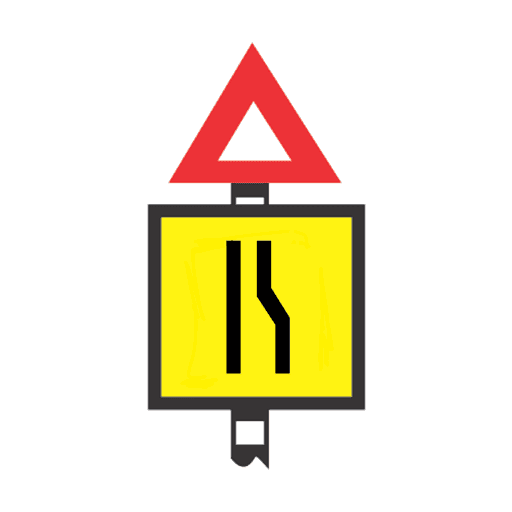
This sign indicates

Diagram for question 7 of Zimbabwe VID test paper 8
  1. ARoad narrows centrally
  2. BRoad narrows to the right
  3. CRoad narrows to the left
Show the answer

Answer: Road narrows to the left

On the sign the left hand edge runs straight down while the right hand edge kinks in towards it, so the road closes up from that side and what is left of it is to the left. Slow down and keep left: the width you have now is not the width ahead.

8.

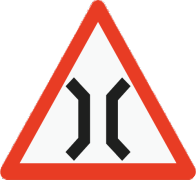
This sign warns of

Diagram for question 8 of Zimbabwe VID test paper 8
  1. ASide road ahead
  2. BNarrow bridge ahead
  3. CA grid ahead
Show the answer

Answer: Narrow bridge ahead

A red triangle with both edges of the road closing in warns of a narrow bridge ahead. The road loses width at the bridge, so slow down and be ready to give way if there is not room for two vehicles to pass on it.

9.

The maximum speed limit of heavy vehicles towing two trailers on wide tarred road is?

  1. A80km/h
  2. B40km/h
  3. C120km/h
Show the answer

Answer: 80km/h

The limit stays at 80 km/h. A heavy vehicle drawing two trailers is long, heavy and slow to pull up, so it keeps that limit even on a wide tarred road where a light vehicle may do 120.

10.

Your steering wheel must not have more than of free play?

  1. A90 degrees
  2. B30 degrees
  3. C45 degrees
Show the answer

Answer: 45 degrees

No more than 45 degrees of free play. Beyond that the front wheels lag behind your hands, which is enough to lose the vehicle on a bend or in a swerve, and it fails the vehicle on roadworthiness.

11.

Heavy vehicles should have the following reflectors

  1. AWhite in front and red at the rear
  2. BWhite in front and amber at the rear
  3. CWhite in front and red and yellow chevron pattern at the rear
Show the answer

Answer: White in front and red and yellow chevron pattern at the rear

White in front and a red and yellow chevron pattern at the rear. The chevrons are what tell a driver coming up behind in the dark that the thing ahead is a heavy vehicle, and how wide it is.

12.

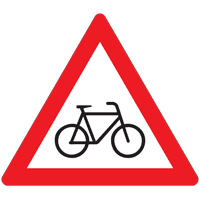
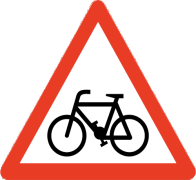
This sign means

Diagram for question 12 of Zimbabwe VID test paper 8
  1. AGive way to cyclists
  2. BCyclists to yield right of way
  3. CDanger of cyclists ahead
Show the answer

Answer: Danger of cyclists ahead

A bicycle inside a red triangle is a warning, so it warns of a danger of cyclists ahead. It hands right of way to nobody. Ease off, expect a cyclist round the next bend, and leave room as you go by.

13.

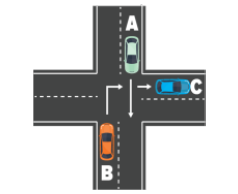
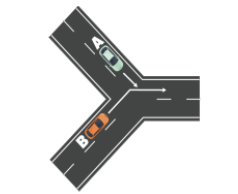
Which car goes first?

Diagram for question 13 of Zimbabwe VID test paper 8
  1. ACar B
  2. BCar A
  3. CCar C
Show the answer

Answer: Car A

Car A, the green car on the north arm, is going straight through. The orange car coming up from the south is turning right across its path, and a driver turning right gives way to oncoming traffic, so Car A goes first.

14.

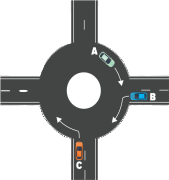
Which car goes last?

Diagram for question 14 of Zimbabwe VID test paper 8
  1. ACar C
  2. BCar B
  3. CCar A
Show the answer

Answer: Car B

The green car is already round on the circle, so it keeps the road. Car B is held at the east arm and must give way to it as it comes round on Car B's right before it can enter the circle.

15.

Which car has right of way?

Diagram for question 15 of Zimbabwe VID test paper 8
  1. ACar B
  2. BCar A
  3. CCar C
Show the answer

Answer: Car B

The road the blue and orange cars are on ends at the one the green car is on, and a road that stops at another gives way to it. Car B is on the road that carries straight through, so it has right of way and the other two wait.

16.

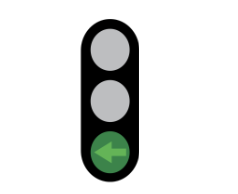
This traffic light regulates that

Diagram for question 16 of Zimbabwe VID test paper 8
  1. ATraffic turning to the right may filter if the road is clear
  2. BTraffic turning to the left may filter if the road is clear
  3. CTraffic going straight may proceed if road is clear
Show the answer

Answer: Traffic turning to the left may filter if the road is clear

Only the bottom lens is lit and it shows a green arrow pointing left. An arrow lets you go the way it points and no other way, so traffic turning left may filter through while everyone else at the robot waits.

17.

Which statement is true about double prohibition lines?

Diagram for question 17 of Zimbabwe VID test paper 8
  1. ACan only be crossed if necessary
  2. BThese lines may be crossed if the vehicle in front of you is moving slowly
  3. COvertaking on this portion of the road is prohibited
Show the answer

Answer: Overtaking on this portion of the road is prohibited

The two unbroken lines down the middle of the road are a barrier. No vehicle may cross them from either side, so overtaking on that stretch is prohibited even when the vehicle in front is moving very slowly.

18.

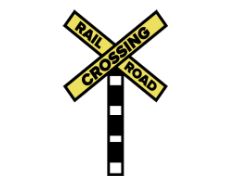
When approaching a rail-road level crossing, what must you do?

Diagram for question 18 of Zimbabwe VID test paper 8
  1. AIncrease speed
  2. BMaintain speed
  3. CReduce speed and be ready to stop
Show the answer

Answer: Reduce speed and be ready to stop

The crossed yellow boards spell out rail road crossing. There may be no gate and no bell, so reduce speed, look along the line both ways and be ready to stop. A train cannot stop for you.

19.

What is the maximum speed limit on wide tar roads?

  1. AThere is no maximum speed limit
  2. B100km/h
  3. C120km/h
Show the answer

Answer: 120km/h

The maximum is 120 km/h, and only where the road is wide and tarred. It is a limit and not a target: what you may do is still bounded by what you can see and by what the surface will hold.

20.

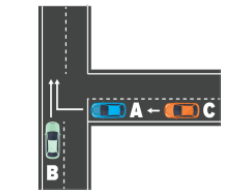
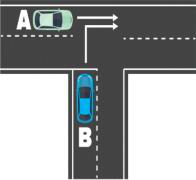
Which car stops?

Diagram for question 20 of Zimbabwe VID test paper 8
  1. AEither of the two
  2. BCar A
  3. CCar B
Show the answer

Answer: Car B

The road Car B is on ends at the road running across the top, and the green car is already travelling on that through road. A driver coming out of a road that ends must give way, so Car B stops.

21.

What is the general speed limit in an urban area?

  1. A40km/h
  2. B80km/h
  3. C60km/h
Show the answer

Answer: 60km/h

Sixty. The general limit in an urban area is 60 km/h unless a sign posts something else, and it holds whether the street is busy or looks empty.

22.

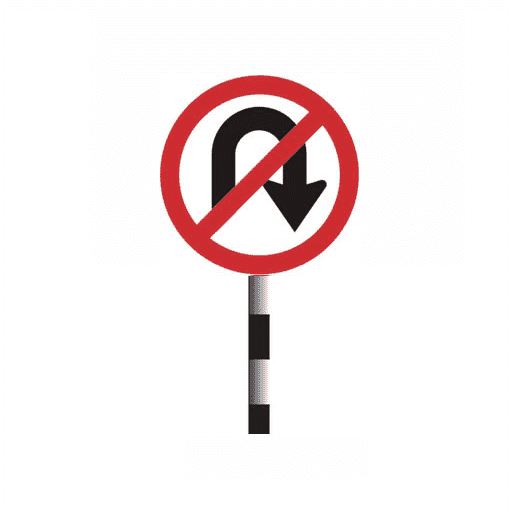
This sign regulates that

Diagram for question 22 of Zimbabwe VID test paper 8
  1. AAn about turn is prohibited
  2. BA right turn strictly prohibited
  3. CPrevious U-turn permission cancelled
Show the answer

Answer: An about turn is prohibited

A black U turn arrow in a red circle with a bar through it forbids the about turn. You may not swing round to face the way you came on that length of road. It says nothing about turning right, which is a different sign.

23.

Which car has right of way?

Diagram for question 23 of Zimbabwe VID test paper 8
  1. ACar A
  2. BCar B
  3. CEither A or B as long as it is safe to do so
Show the answer

Answer: Car B

Two roads converge into one. The orange car is coming up the lower road and is on the green car's right as they meet, and you give way to the vehicle on your right, so Car B has right of way.

24.

What is the meaning of this sign?

Diagram for question 24 of Zimbabwe VID test paper 8
  1. ACyclist prohibited beyond the sign
  2. BMotorists warned of presence of cyclist ahead
  3. CRoad reserved for cyclists only.
Show the answer

Answer: Motorists warned of presence of cyclist ahead

A bicycle in a red triangle is aimed at drivers, not at cyclists: it warns that there are cyclists on the road ahead. It neither closes the road to them nor reserves the road for them.

25.

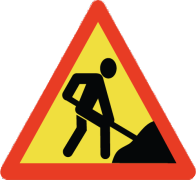
This sign warns of

Diagram for question 25 of Zimbabwe VID test paper 8
  1. AChildren on road ahead
  2. BRoad works ahead
  3. CPedestrian crossing ahead
Show the answer

Answer: Road works ahead

A man with a shovel on a yellow ground inside a red triangle warns of road works ahead. Expect a loose surface, plant crossing the road and people on foot, so drop your speed well before you reach the works.

Practise on your phone

The app sets the same 16 papers, keeps every attempt, gathers the questions you keep missing into a revision set, and works with no network.