Signals on the road
Signals tell other road users what you intend to do. Give them clearly and give them early: at least 50 m before you turn in ordinary city traffic, and 100 m before a turn on a main road at speed. As a general rule the signal goes on before you brake, because it is no use signalling what you are already doing.
Signalling does not give you the right to carry out your intention. Satisfy yourself that the move is safe, and that your signal has been understood, before you act on it. Cancel the signal once the manoeuvre is finished.
Indicators may be used where they work, provided they return to neutral once the turn is complete. Arm signals remain part of the Highway Code, and are worth knowing both to give and to read. Do not just dangle an arm out of the window: each signal has a shape.
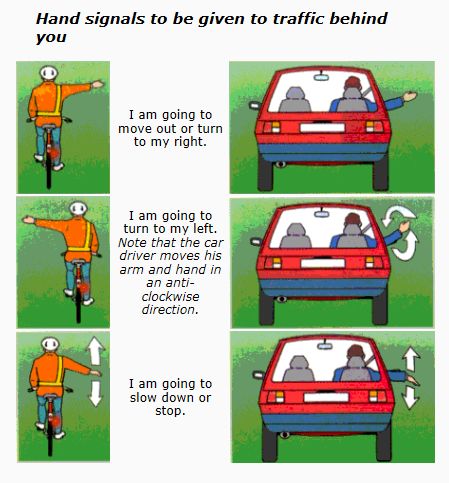
- Slowing down: extend the right arm, palm turned downwards, and move it slowly up and down with a loose wrist.
- Turning right: extend the right arm straight out from the offside of the vehicle, rigid and horizontal, palm to the front.
- Turning left: extend the right arm and rotate it from the shoulder in an anti-clockwise direction. On a two-wheeled vehicle you may instead extend the left arm horizontally with the palm facing forward.
- Stopping: extend the right arm with the forearm and hand vertical, palm to the front.
- Inviting the traffic behind to overtake on your right: extend the right arm and hand below shoulder level and move them backwards and forwards.
The signals of a police officer or traffic officer override all other signs and signals, robots included. Obey the officer, and give the correct hand signal so that your intention is clear. Do not speak to an officer who is directing traffic: it takes their attention off the road. Where no officer is present, the robot's instruction overrides every other device there.
The horn is a safety device. Sound it when another road user needs to know you are there, and never in an offensive manner. The Code's one use for flicking your lights up and down is to remind an oncoming driver to dip. Never treat another driver's flash as permission to proceed.