Overtaking
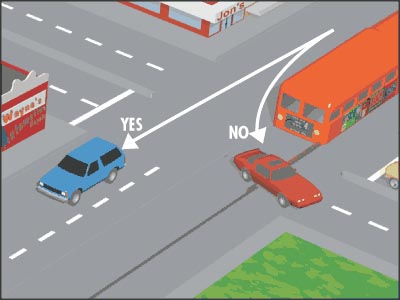
The desire to overtake for the sake of it can become an obsession. Fight it. Pass only when you have reason to and the road allows it.
Overtaking is done on the right. There are two exceptions: where your side of the road has two or more traffic lanes, and where the driver ahead has signalled a right turn. Even then, do not pass on the left if it means encroaching on the road shoulder or an occupied lane.
Before you move out of your lane or stream of traffic, four things must be true.
- The road ahead is clear of traffic.
- You have taken every precaution for changing lane, mirror and blind spot included.
- The driver ahead knows that you want to pass.
- You have judged that driver's speed and are sure you can get past without excessive speed or danger to others.
Never assume the driver ahead will slow down. An encouraging signal from someone else relieves you of nothing: a safe overtake is your responsibility alone.
When it is safe, move gradually into position well before you begin, checking the mirror to confirm the road behind and ahead is still clear. Check the blind spot, signal right, move out, accelerate and pass. Get properly ahead, ease gently back to the left without cutting in, and keep going rather than sitting in front of the vehicle you passed.
Behind a long vehicle, drop back first so you can see past it and its driver can see you, and be certain of the distance before you commit. If in doubt, stay where you are.
Never overtake:
- in the face of oncoming traffic;
- where road markings or another traffic control forbid it;
- when visibility is bad in dust, rain, mist or smoke, or approaching a blind corner or rise;
- past a vehicle that has slowed or stopped to let pedestrians or other traffic pass;
- on or approaching a bridge, flyover, tunnel or anywhere the road narrows;
- on or approaching a railway level crossing;
- at a pedestrian crossing; or
- at or approaching a road junction.
The overtaking prohibited sign holds for 500 m beyond it.