Turning
Decide what you are going to do at a junction early enough to take up the correct position on the road. Never act on a last minute decision. If you find yourself in the wrong lane, it is safer to overrun the junction and come back to it than to cut across for the turn.
Turning left. Your correct position is as far to the left of the road as is safe. The routine is mirror, signal, slow down, select the gear, then turn, coming out into the near lane of the road you are entering. Signal early enough to be useful: at least 50 m before the turn in town and 100 m on a main road. Do not overtake on the approach to a left turn, and look for a cyclist or a motorcyclist coming up on your left before you swing in. A long vehicle hides them completely.
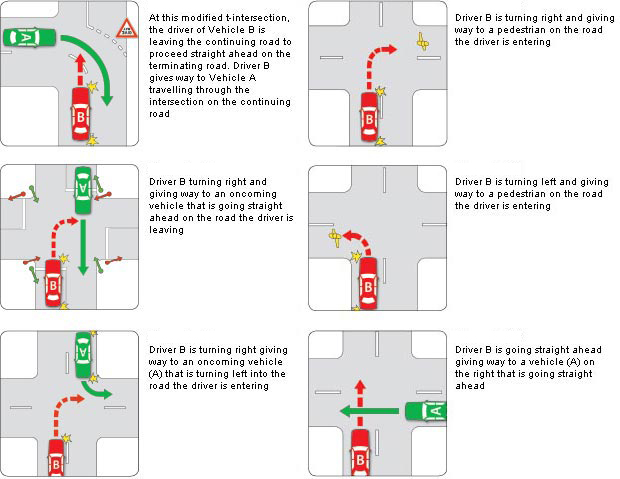
Turning right. Move as far to the right of your own side of the road as the markings allow, or into the lane marked for right turning traffic, and leave room for others to pass on your left. Wait for a gap rather than blocking the junction. Never turn right in front of oncoming traffic. The oncoming vehicle has the road, and a right turn taken across it is one of the commonest causes of a serious collision.
Before you move into position for either turn, treat it as a lane change: check the mirror, check the blind spot, signal, then move, and only when it will not inconvenience the traffic around you. Slow down before you enter the junction, and stop if you have to, so that traffic with precedence goes first.
Turning does not give you the crossing. Where a pedestrian crossing is marked at the junction, a vehicle turning left or right gives way to any pedestrian already within it.