Stopping distances
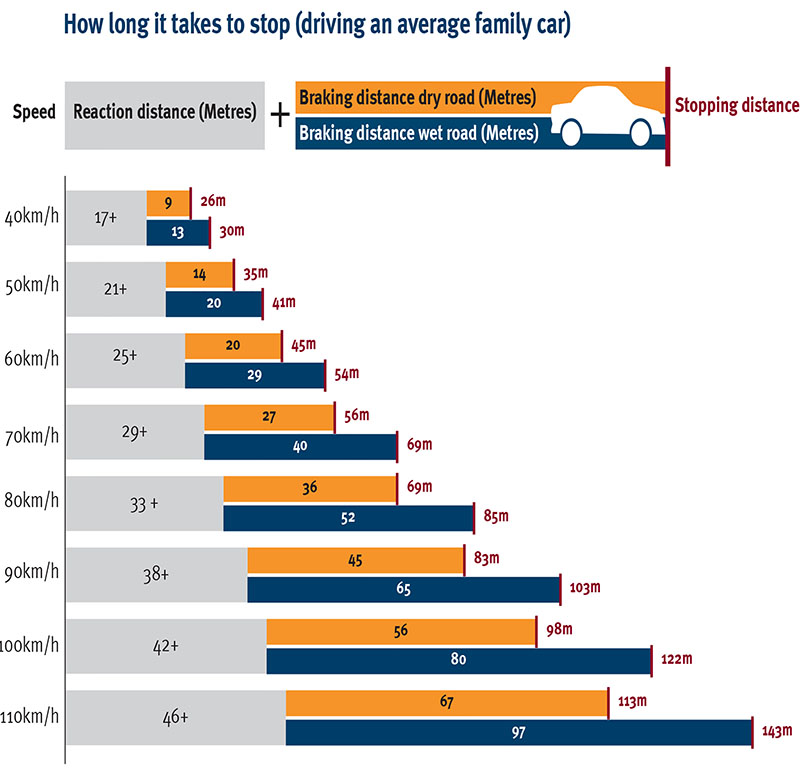
Drive at a speed that lets you stop well within the distance you can see to be clear. Anything beyond that distance is something you have not seen yet.
Stopping distance has two parts. There is the ground you cover while you register the danger and get your foot onto the pedal, about half a second for the average driver, and then the ground you cover under braking. The second part grows far faster than your speed does.
- 40 km/h: 5.6 m reacting, 12.4 m braking, 18 m in all.
- 60 km/h: 8.3 m reacting, 27.7 m braking, 36 m in all.
- 120 km/h: 16.7 m reacting, 113.3 m braking, 130 m in all.
Doubling 60 km/h to 120 km/h does not double the 36 m. It multiplies it by more than three, and those figures assume efficient brakes on a good surface.
Following distance follows from that. Leave a gap of at least one vehicle length for every 15 km/h you are travelling, which is four lengths at 60 km/h. The Code puts the same idea a second way, as a two second gap to the vehicle in front, and either measure will get you to the same place: the questions are set on vehicle lengths. Increase the gap in bad light, in rain, on dirt roads, and behind anything you cannot see past. A heavy vehicle takes longer to pull up than a car, so leave it more room when it is behind you and give it more room when you are behind it.
The risk drops sharply if you anticipate what the driver in front is going to do. Watch the stop lights, watch for hand and light signals that the driver means to slow, stop or turn, and read the traffic further ahead rather than only the vehicle immediately in front of you.