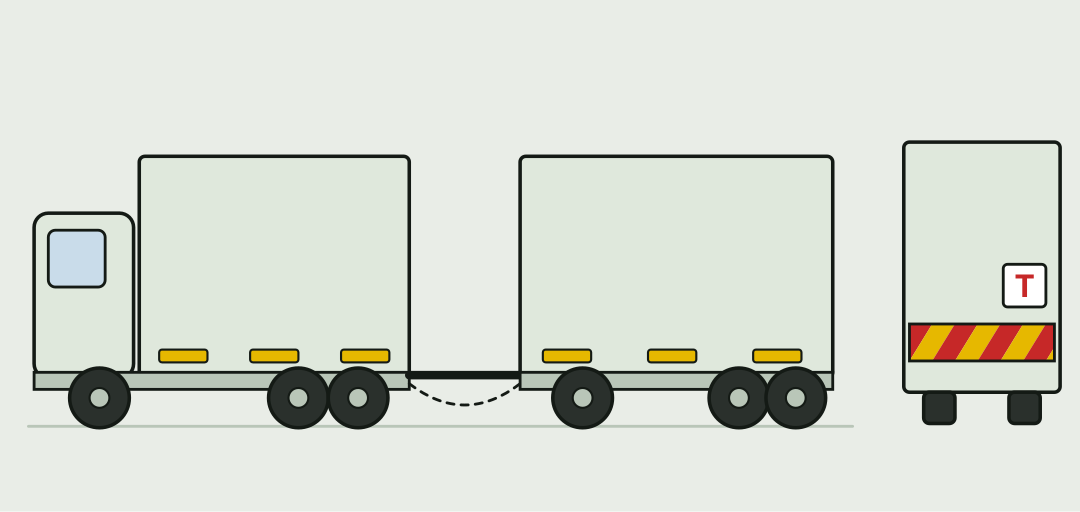
12 terms. The drawings number each part, and every term has its meaning below.
The bar that joins a trailer to the vehicle that pulls it.
Number 1 on a heavy vehicle drawing a trailer.
Chains fitted beside the draw bar. They hold the trailer if the draw bar breaks.
Number 2 on a heavy vehicle drawing a trailer. In the papers: 1 question, first in Test 3.
Also called caravan.
A vehicle with no engine that is pulled by another. A caravan is a trailer made to sleep in.
Number 4 on a heavy vehicle drawing a trailer. In the papers: 10 questions, first in Test 1.
A pattern of slanting stripes. A heavy vehicle has a red and yellow one across the rear.
Number 5 on a heavy vehicle drawing a trailer. In the papers: 1 question, first in Test 8.
A reflective letter T fitted to a trailer, white at the front and red at the rear. It tells other drivers that a trailer is being towed.
Number 6 on a heavy vehicle drawing a trailer. In the papers: 2 questions, first in Test 9.
A vehicle with a net mass of 2,300 kg or less, such as a car or a small van. It was class 4 and is now code B.
In the papers: 5 questions, first in Test 5.
A vehicle with a net mass over 2,300 kg, such as a lorry. It was class 2 and is now the C codes.
In the papers: 11 questions, first in Test 1.
Also called motor omnibus and taxicab.
A vehicle that carries passengers for payment, such as a bus or a taxicab. A motor omnibus is a bus.
In the papers: 8 questions, first in Test 2.
Also called draw.
To pull another vehicle or a trailer behind you. The papers also say draw.
In the papers: 14 questions, first in Test 1.
A load too wide, too long or too heavy for an ordinary vehicle. It may take up more than one lane.
In the papers: 3 questions, first in Test 3.
A vehicle that travels in front of or behind an abnormal load to warn other road users.
In the papers: 2 questions, first in Test 3.
A vehicle that lifts or tows vehicles that have broken down.
In the papers: 4 questions, first in Test 6.
Every term an explanation uses opens its drawing and meaning right there, beside the question that asks about it.