18 terms. The drawings number each part, and every term has its meaning below.
Also called roadway.
The part of a road made for vehicles to drive on.
Number 1 on a road from above. In the papers: 4 questions, first in Test 3.
One strip of the carriageway, wide enough for one line of vehicles, marked off by lines.
Number 2 on a road from above. In the papers: 20 questions, first in Test 4.
A line painted in short pieces with gaps. You may cross it when it is safe.
Number 3 on a road from above. In the papers: 5 questions, first in Test 1.
Also called solid line and prohibition line.
A line painted without a gap. You do not cross it. The papers also call it a solid line or a prohibition line.
Number 4 on a road from above. In the papers: 14 questions, first in Test 1.
Also called edge line.
The yellow line along the left edge of the carriageway.
Number 5 on a road from above. In the papers: 5 questions, first in Test 1.
Also called verge.
The strip beside the carriageway. The verge is the ground beyond it.
Number 6 on a road from above.
The raised edge between the road and the pavement.
Number 7 on a road from above. In the papers: 1 question, first in Test 9.
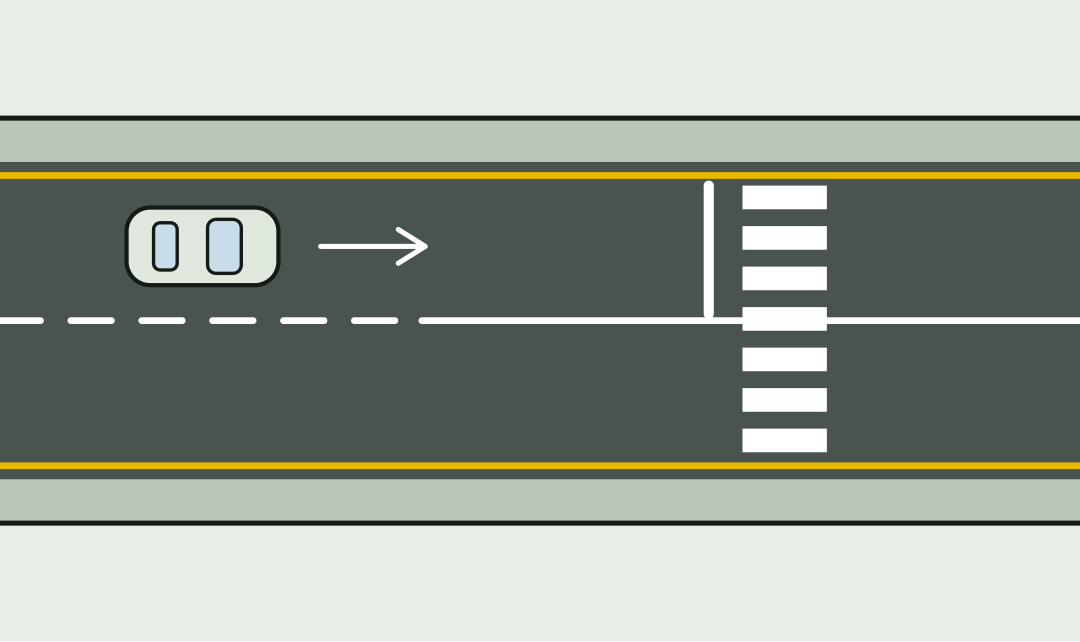
A place marked on the road for people on foot to cross. Away from an intersection it is painted in black and white stripes.
Number 8 on a road from above. In the papers: 11 questions, first in Test 2.
Also called transverse line.
A line painted across your lane that shows where to stop. A transverse line is a line across the road.
Number 9 on a road from above. In the papers: 1 question, first in Test 7.
Also called dualised carriageway.
A road where the two directions are kept apart, each with its own carriageway.
In the papers: 5 questions, first in Test 6.
To drive with the wheels of one side over a line and the wheels of the other side not.
In the papers: 3 questions, first in Test 1.
A narrow road made of two strips of tar or concrete, one for each line of wheels.
In the papers: 2 questions, first in Test 12.
The top of a hill, where you cannot see the road on the other side.
In the papers: 4 questions, first in Test 4.
Also called incline and gradient.
A descent is a road going downhill. An incline or a gradient is a slope, up or down.
In the papers: 5 questions, first in Test 8.
A bridge that carries one road over another.
In the papers: 2 questions, first in Test 5.
Also called rail road crossing.
A place where a road crosses a railway line at the same level.
In the papers: 23 questions, first in Test 1.
The bars that come down across the road at a level crossing when a train is coming.
In the papers: 2 questions, first in Test 11.
Converging lanes come together: two lanes become one. Diverging lanes move apart: one lane becomes two.
In the papers: 2 questions, first in Test 12.
Every term an explanation uses opens its drawing and meaning right there, beside the question that asks about it.